


What is Mind-Muscle Connection?
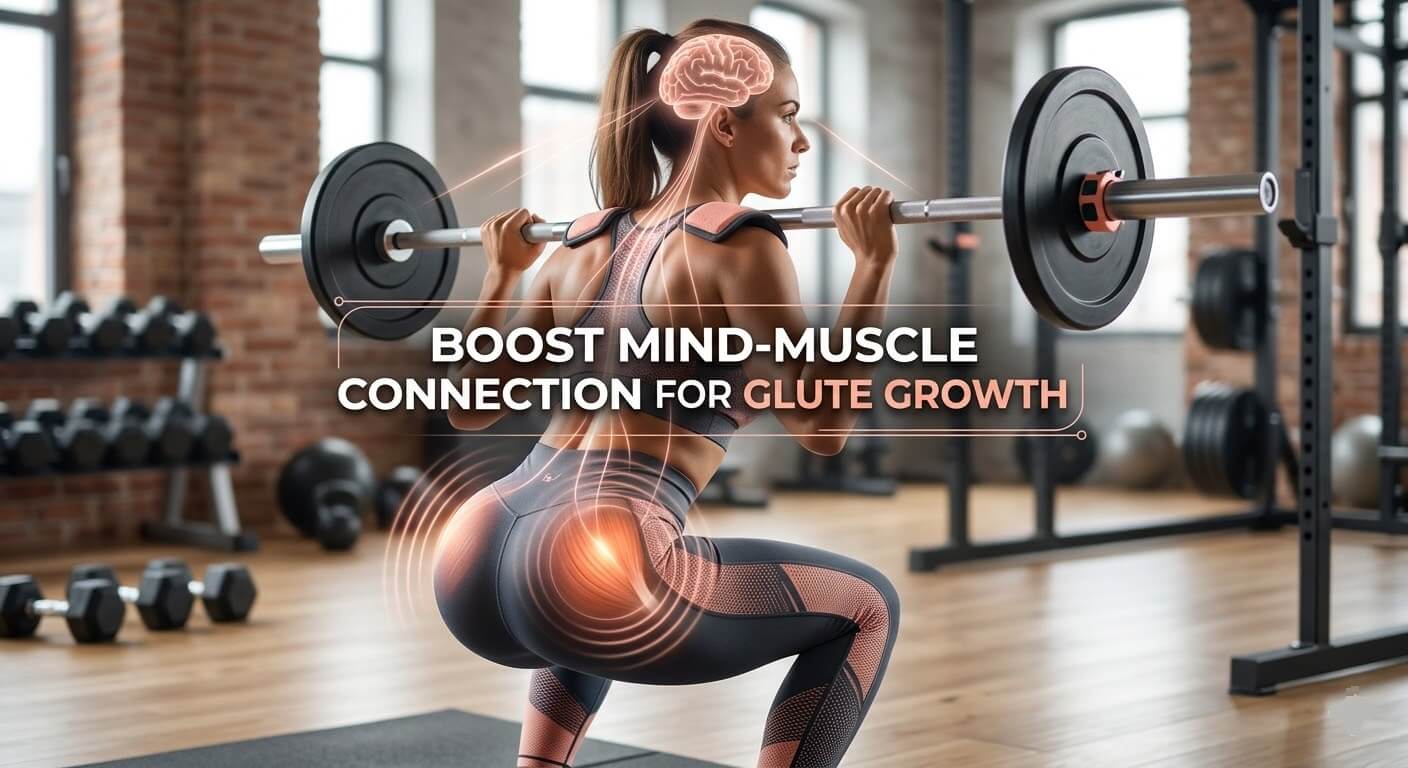
Put simply, the mind-muscle connection is the act of consciously and deliberately thinking about the specific muscle you are trying to move.
In the fitness world, we talk about two types of focus:
- External Focus: Thinking about moving the weight. For example, thinking about getting the bar up.
- Internal Focus: Thinking about the muscle squeezing. For example, thinking about squeezing the glutes to lift the bar.
While lifting heavy is cool, research shows that focusing internally on the muscle squeeze can significantly increase muscle activation. A study published in the European Journal of Sport Science found that when participants focused on the specific muscle they were training, muscle activity increased significantly compared to when they just focused on lifting the weight.
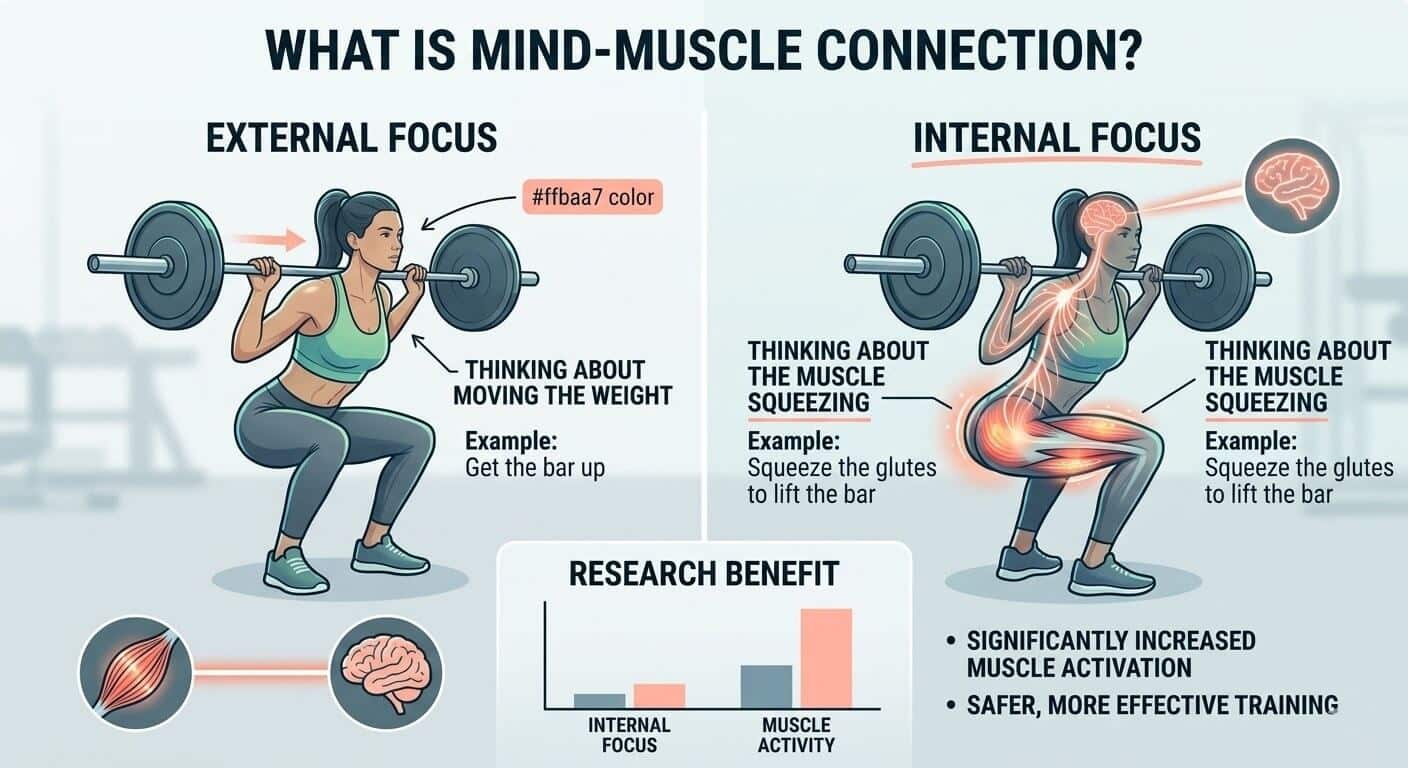
The Benefit for You: When you improve your mind-muscle connection, you do not need to lift dangerously heavy weights to see changes. You get more results with safer weights because your target muscle is doing the actual work, not your joints.
Why You Cannot Feel Your Muscles Working
Before we fix the problem, we need to know why it is happening. If you frequently wonder why you cannot feel your glutes working, it is usually due to one of these three reasons.
1. You Are Lifting Too Heavy
When the weight is too heavy, your body goes into survival mode. It does not care about building shape on your glutes. It just wants to not get crushed. To do this, it calls in other muscles like your lower back or quads to take over. This is called compensation.
2. You Are Moving Too Fast
Momentum is the enemy of muscle growth. If you are bouncing the weight up and down, your muscles are not under tension. Gravity and momentum are doing the work for you.
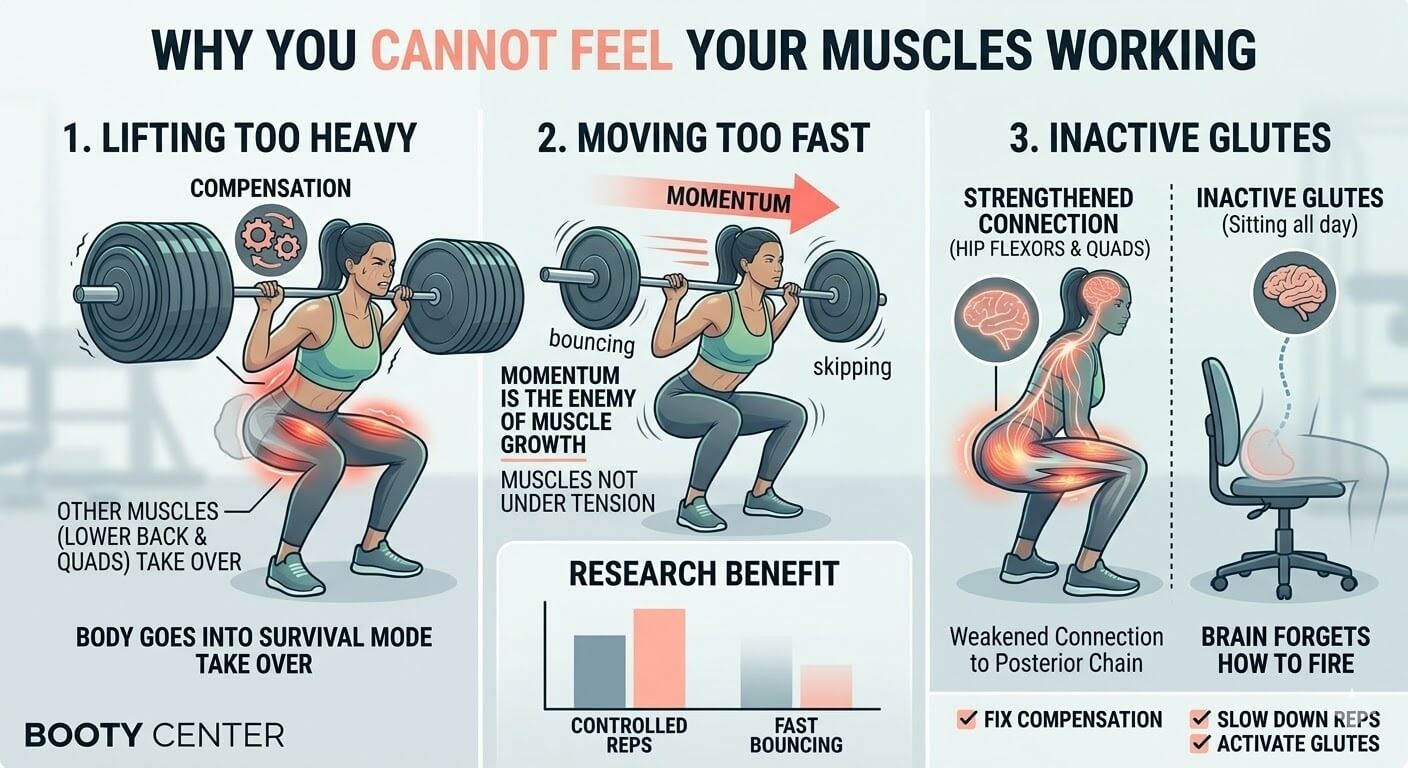
3. You Have Inactive Muscles
This is very common with glutes. Because we sit on them all day, the brain strengthens the connection to our hip flexors and quads, and weakens the connection to the posterior chain (the back of your body). Your brain literally forgets how to fire those muscles properly.
5 Steps to Increase Mind-Muscle Connection Today
You do not need a PhD to fix this. You just need to change how you approach your next workout. Try these five proven strategies.
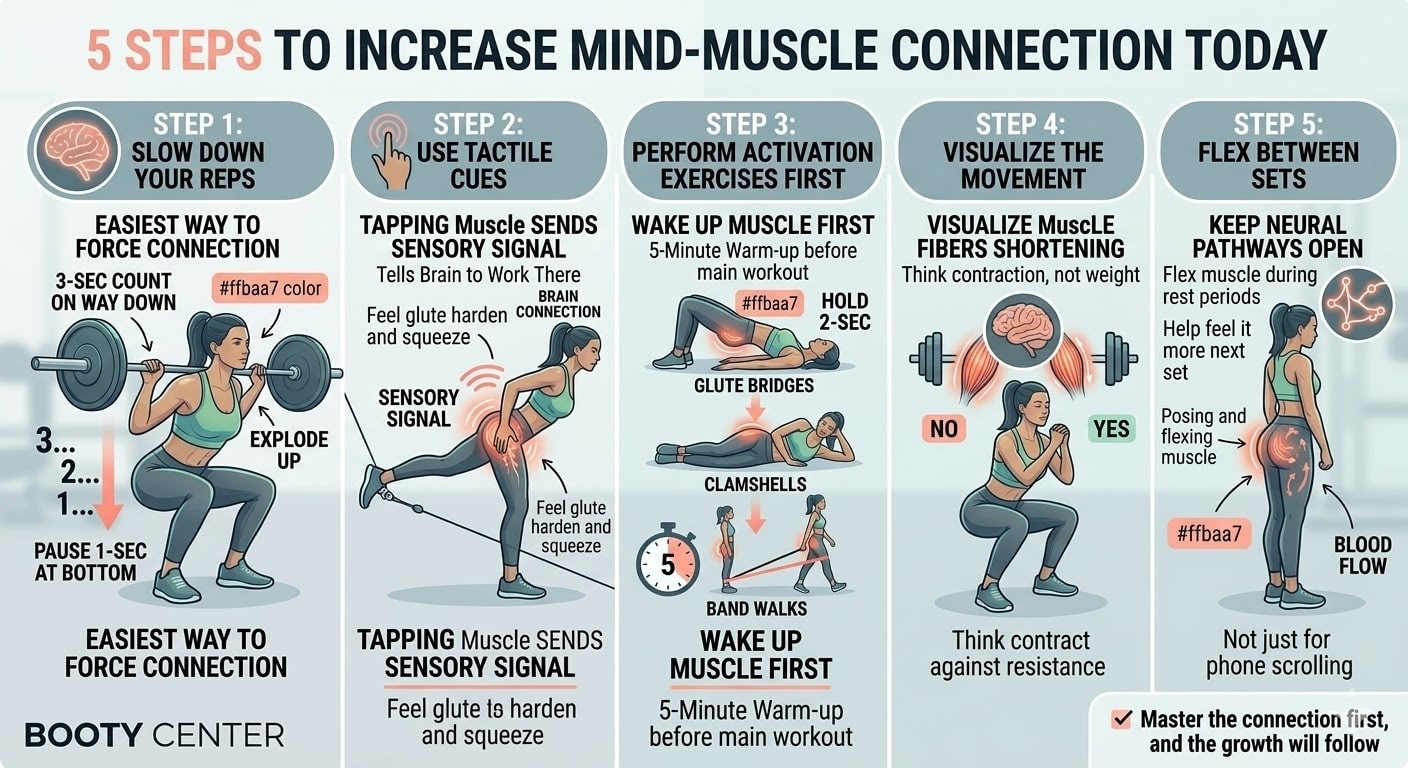
Step 1: Slow Down Your Reps
The easiest way to force a connection is to slow down. Try a 3-second count on the way down.
- Example: When doing a squat, take a full 3 seconds to lower yourself. Pause for 1 second at the bottom. Explode up.
- Why it works: Slowing down removes momentum. If you cannot control the weight slowly, it is too heavy.
Step 2: Use Tactile Cues
This sounds simple, but it is incredibly effective. Tapping or touching the muscle you want to work sends a sensory signal to your brain telling it to work there.
- Try this: If you are doing a single-leg cable kickback, place your hand on your glute. Feel it harden and squeeze as you kick back. If it feels soft, you are likely using your lower back.
Step 3: Perform Activation Exercises First
Never jump straight into heavy squats. You need to wake up the muscle first. This is crucial for anyone focusing on booty building. Spend 5 minutes doing isolation exercises with very light weight or just bodyweight before your main workout.
- The BootyCenter Warm-up:
- Glute Bridges (hold the squeeze at the top for 2 seconds)
- Clamshells
- Band walks
Pro Tip: Do these until you feel a slight burn. That burn tells you the connection is live.
Step 4: Visualize the Movement
This is a technique used by bodybuilders like Arnold Schwarzenegger. Before you lift, close your eyes and visualize the muscle fibers shortening and contracting. Do not think about lifting the weight. Think about contracting the muscle against the resistance.
Step 5: Flex Between Sets
Rest periods are not just for scrolling on your phone. In between your sets, practice posing or hard flexing the muscle you just worked. This keeps the neural pathways open and floods the muscle with blood, which helps you feel it more during the next set.
A Note on Glute Amnesia
Since you are here at BootyCenter, you likely care about glute development. Dr. Stuart McGill, a world-renowned spine specialist, uses the term Gluteal Amnesia. This happens when your glutes forget how to activate because of too much sitting.
If you have lower back pain during leg day, you likely have Gluteal Amnesia.
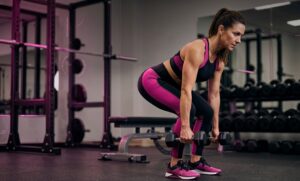
The Fix: You must master the hip hinge movement. Practice pushing your hips back like you are closing a car door with your butt without bending your knees too much. If you can master the hinge, you will shift the tension from your back to your glutes immediately.
Summary: Quality Over Quantity
At Booty Center, we know that results come from precision. Your muscles do not know how much weight is on the bar. They only know tension.
It is better to squat 50 lbs with perfect mind-muscle connection than to squat 150 lbs using only your lower back and momentum.
The Booty Center Checklist for Your Next Workout:
- Drop the weight by 20%.
- Warm up with isolation movements first.
- Slow down the lowering phase of every lift.
- Squeeze hard at the top.
Master the connection first, and the growth will follow.
References:
- Schoenfeld, B. J., et al. (2018). Differential effects of attentional focus strategies during long-term resistance training. European Journal of Sport Science.
- McGill, S. M. (2007). Low Back Disorders: Evidence-Based Prevention and Rehabilitation.