
Glute bridge vs hip thrust is one of the most searched glute questions, and most answers say the same thing: the hip thrust wins. Then a 2024 study measured both with a barbell and found the glute bridge fired the glutes harder. So which one should you do? The honest answer depends on what each lift is good at.
This guide compares the two lifts on range of motion, muscle activity, growth and load, using the studies that exist. It ends with a simple rule for choosing, and a plan for each.
Define: Glute bridge and hip thrust
In a glute bridge, your upper back is on the floor and you lift your hips. In a hip thrust, your upper back rests on a bench, so your hips start lower and travel further. Both lift a load with your hips. The bench is the main difference.
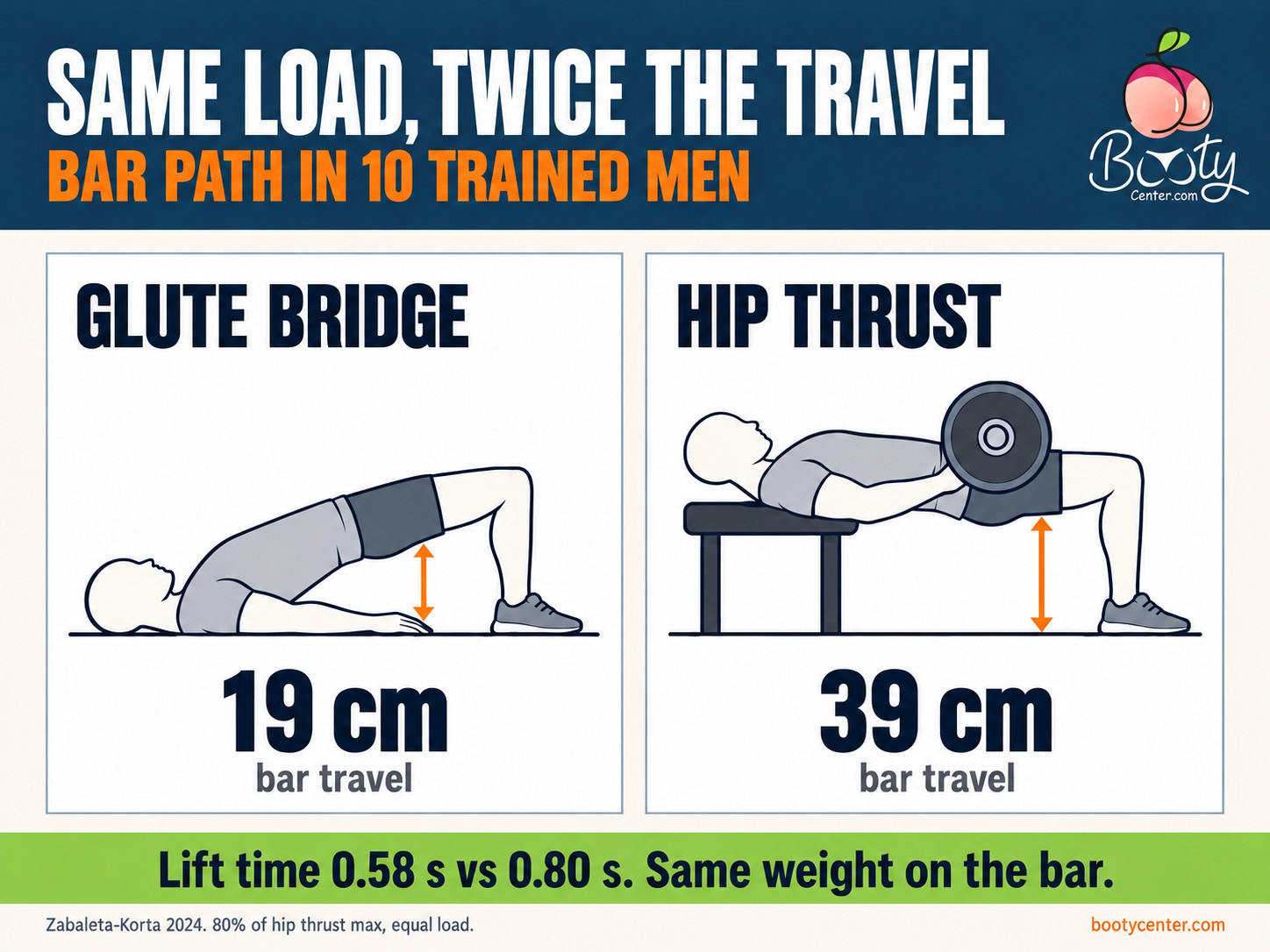 Same load, twice the travel. Bar path in 10 trained men (Zabaleta-Korta 2024).
Are glute bridges and hip thrusts the same exercise?
Close cousins, not twins. In 10 resistance-trained men lifting the same barbell load (80% of their hip thrust max), the bar travelled 39 cm in the hip thrust and 19 cm in the glute bridge. The lifting phase took 0.80 seconds against 0.58 seconds, and the total impulse, the force applied over time, was about 40% higher in the hip thrust (Zabaleta-Korta 2024).
So with the same weight on the bar, the hip thrust makes your glutes work through twice the range and for longer. The bridge finishes the job in a shorter, higher-hip range. That is the key difference in glute bridge vs hip thrust, and most of what follows comes from it.
Which one activates the glutes more?
Here is the surprise. In 10 men, a study compared the barbell hip thrust and the barbell glute bridge with surface EMG, which measures the electrical activity of a muscle. The glute bridge produced higher activity in both the upper and lower gluteus maximus, for peak and average values, and higher average activity in the gluteus medius, the side glute. The hip thrust produced higher activity in the outer quad (Kennedy 2024).
Why would the shorter lift fire the glutes harder? The authors did not test the reason. One likely explanation is that the bridge keeps the hips nearer to full extension, where the glutes are most active, for a larger share of each rep. That is a hypothesis, not a finding.
The hip thrust still activates the glutes strongly. In 13 trained women, average upper glute activity was 69.5% of maximum in the hip thrust against 29.4% in the back squat, and lower glute activity was 86.8% against 45.4% (Contreras 2015). In the same group, the barbell version beat the band version for average glute activity (Contreras 2016). A 2020 review of 16 studies put the barbell hip thrust in the group of lifts that take the glutes above 60% of their maximum (Neto 2020).
Coach's tip
EMG tells you how hard a muscle fires in one rep. It does not tell you how much it grows over months. Treat it as one clue, not the verdict.
Which one grows more muscle?
Nobody knows. We searched for a trial that trained one group on glute bridges and one on hip thrusts and measured glute size. We could not find one. Anyone who tells you the hip thrust grows more glutes than the bridge is guessing, and the same goes for the other way round.
What we do have are hip thrust growth trials. In 34 untrained adults, 9 weeks of hip thrusts or back squats grew the glutes by a similar amount on MRI, even though the hip thrust fired them harder in the first session (Plotkin 2023). In 33 untrained young women, 10 weeks of leg press and stiff-leg deadlift grew glute thickness by 6.0%. Adding the barbell hip thrust raised that to 9.3% (Kassiano 2024).
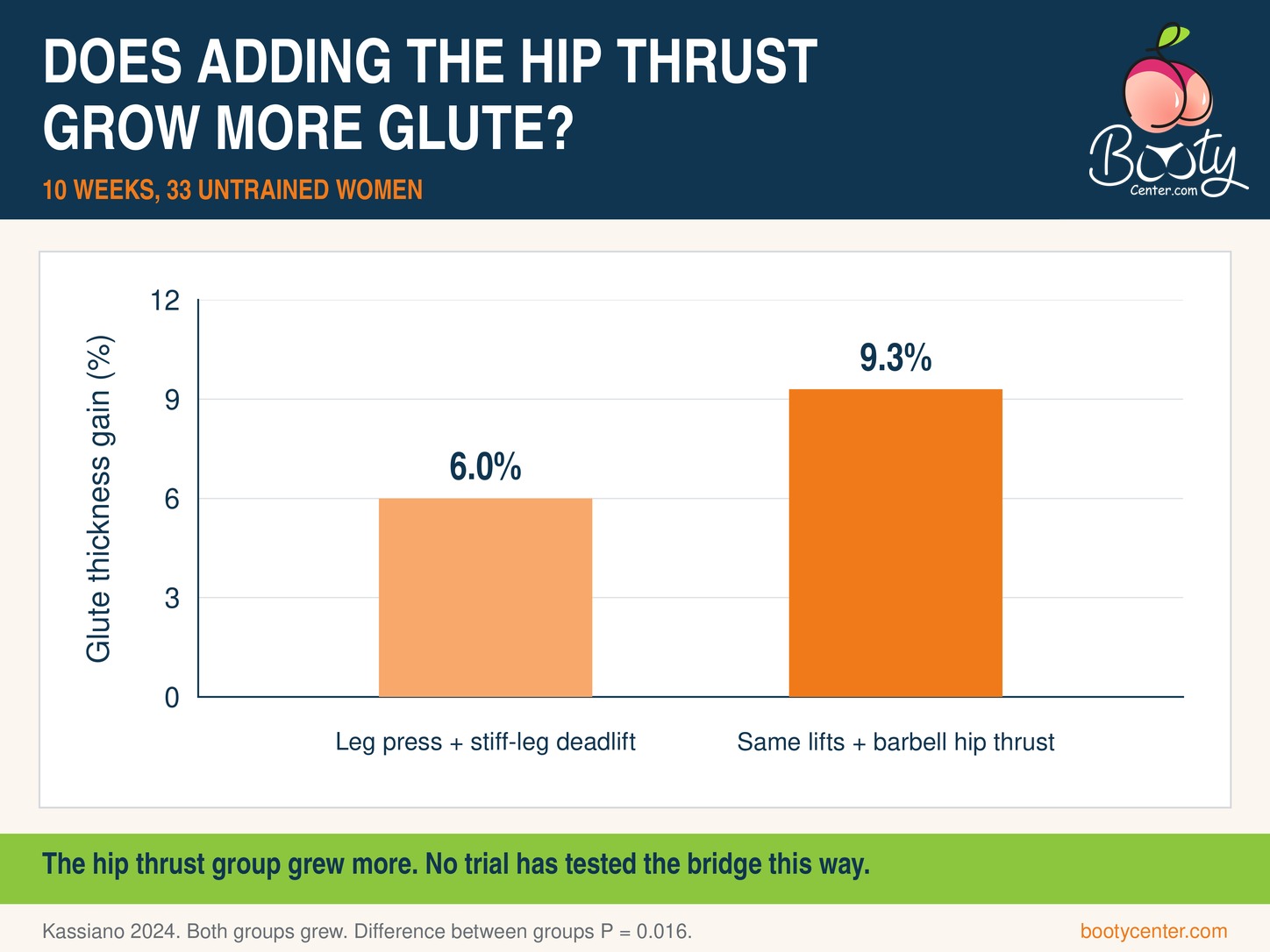 Adding the hip thrust grew the glutes more. No trial has done this test with the bridge (Kassiano 2024).
Both trials tell us the hip thrust builds glutes. Neither tells us how a heavy bridge would compare. For now, the growth question in the glute bridge vs hip thrust debate is open. If you want the full picture on how growth is measured, our guide on growing glutes without growing legs walks through it.
Why can you lift more in a hip thrust?
Two reasons. The bench raises your shoulders, so the bar starts above your hips and your legs can drive from a deeper position. And the longer travel lets you build speed and use the strongest part of the range. In the men above, the hip thrust produced a bigger impulse with the same load (Zabaleta-Korta 2024). In practice, most people can thrust more than they can bridge.
More load is not automatically more growth, but it is one of the levers that drive it. A 2024 analysis of training studies found that muscle growth rose as sets ended closer to failure, with similar strength gains (Robinson 2024). The hip thrust gives you more room to add weight before the bar sits on your hips. For set-up, see our guide on how to do a barbell hip thrust.
Is the glute bridge only for beginners?
No. That label comes from the bodyweight version. In 30 active women doing a bodyweight bridge, glute activity was 16.8% of maximum before a cue and 33.0% after it (Hollman 2018). That is a warm-up level. A barbell glute bridge is a different animal. It was the barbell version that beat the hip thrust in Kennedy 2024.
Knee angle matters in a bridge. In 25 active men, bending the knees to 90 or 120 degrees gave a much better glute-to-hamstring ratio than 40 or 60 degrees (Ho 2020). If your hamstrings cramp in a bridge, bring your heels closer to your butt. The single-leg bridge is another good option: in 26 adults it gave a better glute-to-hamstring ratio than a resisted hip extension (Youdas 2017).
Which one hurts the lower back less?
We found no study that compared back pain or spine load between the two lifts. The honest answer is that nobody has measured it. Lifters often report that the bridge feels easier on the back, probably because the shorter range gives less room to arch at the top. That is a report, not evidence. If your back aches after either lift, our guide on lower back pain after hip thrusts covers the common set-up fixes. Sharp or lasting pain, numbness, or pain that spreads down your leg means see a doctor or physio.
So which one should you do?
Both, for different jobs. Use the hip thrust as your main heavy glute lift, because it gives the longest range and the most room to add load. Use the barbell glute bridge when you have no bench, when you want a short-range top squeeze, or when the hip thrust bothers your back and the bridge does not. If you cannot feel either one in your glutes, read our guide on why you can't feel your glutes before you swap lifts.
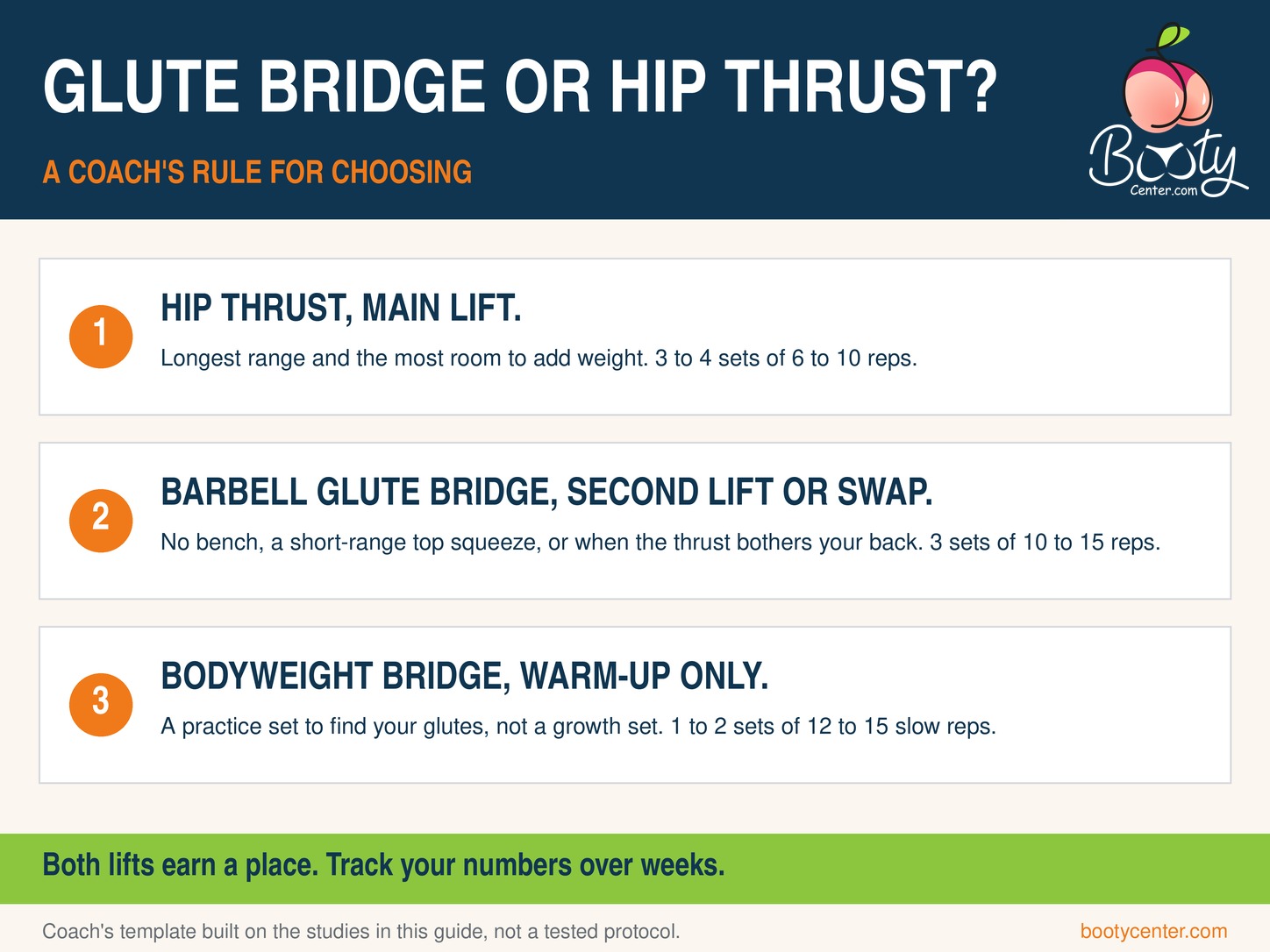 A coach's rule for choosing. Both lifts earn a place.
A simple plan for each, built on the studies above as a coach's template, not a tested protocol:
- Hip thrust, main lift: 3 to 4 sets of 6 to 10 reps, stopping 1 to 2 reps before failure (about 8 to 9 out of 10 effort). Rest 2 to 3 minutes between sets. Add 2.5 kg when you hit the top of the rep range on every set.
- Barbell glute bridge, second lift or swap: 3 sets of 10 to 15 reps, stopping 2 reps before failure (about 8 out of 10 effort). Pause 1 second at the top. Rest 90 seconds. Knees bent to about 90 degrees, heels close to your butt.
- Bodyweight bridge, warm-up only: 1 to 2 sets of 12 to 15 slow reps before either lift. Rest 60 seconds. It is a practice set, not a growth set (Hollman 2018).
Pair either lift with a long-range movement such as the Bulgarian split squat, so the glutes get trained both short and stretched. Our pillar guide on how to train glutes explains the four movements that matter.
Glute bridge vs hip thrust, by the numbers
- 39 cm vs 19 cm: bar travel in the hip thrust against the glute bridge with the same load, in 10 trained men (Zabaleta-Korta 2024).
- 0.80 s vs 0.58 s: time to lift the bar, hip thrust against glute bridge (Zabaleta-Korta 2024).
- Bridge higher: upper and lower glute EMG, peak and average, in 10 men. Hip thrust higher in the outer quad (Kennedy 2024).
- 69.5% and 86.8%: average upper and lower glute activity in the hip thrust in 13 trained women, against 29.4% and 45.4% in the squat (Contreras 2015).
- 9.3% vs 6.0%: glute thickness growth over 10 weeks with and without the hip thrust, in 33 untrained women (Kassiano 2024).
- 0 trials: studies that trained bridges against hip thrusts and measured growth.
Where the evidence runs thin
The two head-to-head studies had 10 men each, and the EMG study did not report the load in its abstract. EMG measures activity in one session, not growth over months. The growth trials tested the hip thrust against squats or against no hip thrust, never against a bridge. The knee-angle and cue studies used light or bodyweight loads. The plan above is a coach's template, not a protocol from a trial. Nobody has compared back pain between the two lifts.
Bottom line
The hip thrust is not proven better than the glute bridge for growth, and one study found the bridge fires the glutes harder. The hip thrust gives twice the range and more room to load, which is why it earns the main slot. The barbell bridge is a real lift, not a beginner move. Use the thrust as your heavy lift, the bridge when the thrust does not fit, and track your numbers over weeks.
Frequently asked questions
Is a glute bridge or hip thrust better for glutes?
Neither is proven better for growth, because no trial has compared them. One EMG study in 10 men found the barbell bridge fired the glutes harder (Kennedy 2024). The hip thrust gives twice the bar travel and more room to add weight (Zabaleta-Korta 2024). Use the thrust as your main lift and the bridge as a second lift or a swap.
What is the difference between a glute bridge and a hip thrust?
The bench. In a bridge your upper back is on the floor. In a hip thrust it rests on a bench, so your hips start lower and travel about twice as far, 39 cm against 19 cm with the same load in trained men (Zabaleta-Korta 2024). Both are hip extension lifts for the butt.
Do glute bridges and hip thrusts work the same muscles?
Mostly yes: the gluteus maximus, hamstrings and, to a smaller degree, the quads and side glutes. In 10 men the bridge showed more glute and side glute activity, and the thrust more outer quad activity (Kennedy 2024).
Can I build glutes with glute bridges only?
Probably, if you load them. Growth needs sets taken close to failure with enough weight (Robinson 2024). A heavy barbell bridge can do that. The bodyweight bridge works the glutes at about 17% to 33% of maximum, which is a warm-up level (Hollman 2018).
Why do I feel glute bridges in my hamstrings?
Often because your knees are too straight. In 25 men, bending the knees to 90 or 120 degrees gave a much better glute-to-hamstring ratio than 40 or 60 degrees (Ho 2020). Move your heels closer to your butt and try again.
Should beginners start with the glute bridge?
It is a good place to learn the hip movement with no equipment. But it is not a beginner-only lift. Once you can do 15 clean bodyweight reps, add a barbell or dumbbell, or move to the hip thrust for more range.
References
- Zabaleta-Korta A, Fernández-Peña E. Biomechanical differences between hip thrust and glute bridge for hip extensors. Cult Cienc Deporte. 2024;19(59):81-8. doi:10.12800/ccd.v19i59.2084
- Kennedy D, Casebolt JB, Farren GL, Fiaud V, Bartlett M, Strong L. Electromyographic differences of the gluteus maximus, gluteus medius, biceps femoris, and vastus lateralis between the barbell hip thrust and barbell glute bridge. Sports Biomech. 2024;23(12):2935-49. doi:10.1080/14763141.2022.2074875
- Contreras B, Vigotsky AD, Schoenfeld BJ, Beardsley C, Cronin J. A comparison of gluteus maximus, biceps femoris, and vastus lateralis electromyographic activity in the back squat and barbell hip thrust exercises. J Appl Biomech. 2015;31(6):452-8. doi:10.1123/jab.2014-0301
- Contreras B, Vigotsky AD, Schoenfeld BJ, Beardsley C, Cronin J. A comparison of gluteus maximus, biceps femoris, and vastus lateralis electromyography amplitude for the barbell, band, and American hip thrust variations. J Appl Biomech. 2016;32(3):254-60. doi:10.1123/jab.2015-0091
- Neto WK, Soares EG, Vieira TL, Aguiar R, Chola TA, Sampaio VL, et al. Gluteus maximus activation during common strength and hypertrophy exercises: a systematic review. J Sports Sci Med. 2020;19(1):195-203.
- Plotkin DL, Rodas MA, Vigotsky AD, McIntosh MC, Breeze E, Ubrik R, et al. Hip thrust and back squat training elicit similar gluteus muscle hypertrophy and transfer similarly to the deadlift. Front Physiol. 2023;14:1279170. doi:10.3389/fphys.2023.1279170
- Kassiano W, Kunevaliki G, Costa B, Nunes JP, Castro-E-Souza P, Tricoli I, et al. Addition of the barbell hip thrust elicits greater increases in gluteus maximus muscle thickness in untrained young women. Int J Strength Cond. 2024;4(1). doi:10.47206/ijsc.v4i1.284
- Robinson ZP, Pelland JC, Remmert JF, Refalo MC, Jukic I, Steele J, et al. Exploring the dose-response relationship between estimated resistance training proximity to failure, strength gain, and muscle hypertrophy: a series of meta-regressions. Sports Med. 2024;54(9):2209-31. doi:10.1007/s40279-024-02069-2
- Hollman JH, Berling TA, Crum EO, Miller KM, Simmons BT, Youdas JW. Do verbal and tactile cueing selectively alter gluteus maximus and hamstring recruitment during a supine bridging exercise in active females? A randomized controlled trial. J Sport Rehabil. 2018;27(2):138-43. doi:10.1123/jsr.2016-0130
- Ho IMK, Ng LPC, Lee KOL, Luk TCJ. Effects of knee flexion angles in supine bridge exercise on trunk and pelvic muscle activity. Res Sports Med. 2020;28(4):484-97. doi:10.1080/15438627.2020.1777552
- Youdas JW, Hartman JP, Murphy BA, Rundle AM, Ugorowski JM, Hollman JH. Electromyographic analysis of gluteus maximus and hamstring activity during the supine resisted hip extension exercise versus supine unilateral bridge to neutral. Physiother Theory Pract. 2017;33(2):124-30. doi:10.1080/09593985.2016.1271848