
If you spend a lot of your day sitting at a desk or driving, your body might be suffering from a very common problem: sleepy or weak glutes. When the muscles in your backside lose their strength, your lower back and knees often have to work overtime to pick up the slack. This can lead to nagging pain, poor posture, and a higher chance of getting hurt during everyday activities.
Fortunately, you do not need an expensive gym membership or heavy weights to fix this. One of the best solutions is a simple bodyweight exercise you can do right on your living room floor. If you are wondering what a single-leg glute bridge works and how it can help you feel better, you are in the right place. This guide will break down exactly which muscles this exercise targets, the real-world benefits it provides, and how you can use it to build a stronger, pain-free body.
What Muscles Does the Single-Leg Glute Bridge Target?
When people search for working single-leg glute bridge muscles, they are usually surprised to find out that it is almost a full-body exercise. While it mainly targets your lower half, it forces several different muscle groups to work together as a team.
Here is a simple breakdown of the main muscles this exercise works:
- The Gluteus Maximus: This is the primary target. It is the largest muscle in your buttocks and is responsible for extending your hips (pushing them forward). Strong glutes are the powerhouse of your lower body, helping you walk, run, and jump.
- The Hamstrings: These are the muscles running down the back of your thighs. During a single-leg bridge, your hamstrings act as secondary helpers to push your hips up toward the ceiling.
- The Core and Obliques: Because you are balancing on just one leg, your body naturally wants to tilt or fall to one side. Your core (stomach muscles) and obliques (side muscles) have to work incredibly hard to keep your hips level and perfectly stable.
- The Lower Back (Erector Spinae): These small muscles run along your spine. They help stabilize your back while you lift your hips, which safely strengthens the area without putting too much dangerous pressure on your spine.
Real-World Benefits: Why You Should Do This Exercise
Understanding the muscles is great, but knowing how this exercise actually improves your daily life is even better. The single-leg glute bridge is highly popular in physical therapy and home workout routines because it solves several common physical problems.
Fixes Left-to-Right Muscle Imbalances
Most of us have a dominant side. You might favor your right leg when standing or pushing off the ground. Over time, this makes one leg much stronger than the other, which can lead to knee or hip injuries. By forcing each leg to lift your body weight entirely on its own, the single-leg glute bridge exposes your weak side and helps balance your body back out.
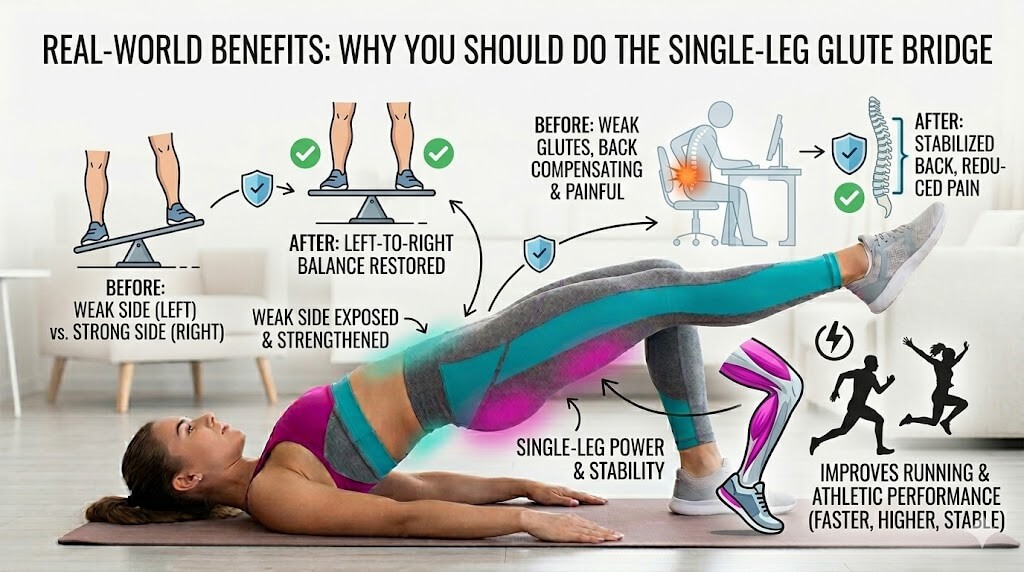
Relieves and Prevents Lower Back Pain
When your glutes are weak, your lower back compensates by doing work it was never meant to do. This is a leading cause of lower back pain for office workers. By waking up your glutes and making them stronger, you take the heavy lifting off your lower back. This exercise teaches your body to use the right muscles at the right time.
Improves Running and Athletic Performance
If you enjoy jogging around your neighborhood or playing weekend sports, this exercise is a game-changer. Every time you take a step while running, you are essentially balancing on one leg. Training your body to produce power and stay balanced on a single leg directly translates to running faster, jumping higher, and feeling more stable on your feet.
How to Do a Perfect Single-Leg Glute Bridge
To get all these great benefits, you need to make sure your form is correct. The single-leg glute bridge video is the demo for this exercise. Doing the movement improperly will not help you and could even cause discomfort. Follow these simple steps to get it right:
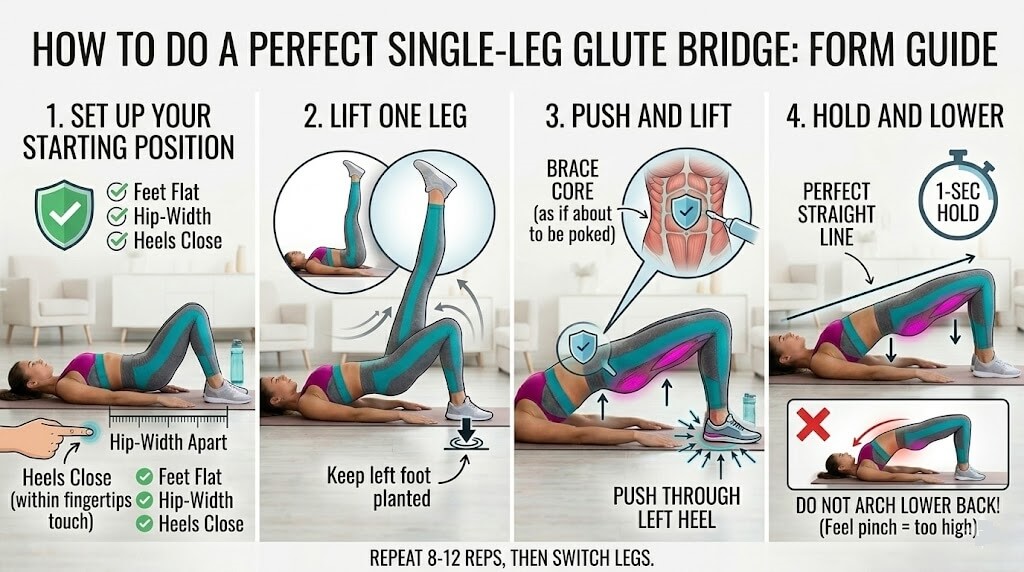
- Set Up Your Starting Position: Lie flat on your back on a comfortable mat or carpet. Bend your knees and place both feet flat on the floor, about hip-width apart. Your heels should be close enough to your body that you can almost touch them with your fingertips.
- Lift One Leg: Straighten your right leg out so it is hovering just above the ground, or point it straight up toward the ceiling. Keep your left foot planted firmly on the floor.
- Push and Lift: Brace your stomach muscles like someone is about to poke your belly. Push hard through your left heel and squeeze your left glute to lift your hips up into the air.
- Hold and Lower: Lift until your body forms a straight line from your left knee down to your shoulders. Do not arch your lower back. Hold this top position for one full second, then slowly lower your hips back down to the floor. Repeat for 8 to 12 repetitions before switching to the other leg.
A Quick Tip on Common Mistakes
The biggest mistake people make is lifting their hips too high by arching their lower back. This completely defeats the purpose of the exercise and causes back pain. Focus on squeezing your buttocks to lift, not bending your spine. If you feel a pinch in your lower back, you have lifted too high!
Conclusion
If you want to move better, reduce daily aches, and build strength without needing a gym full of equipment, the single-leg glute bridge is an incredibly effective tool. As the fitness experts at Booty Center frequently highlight, targeting your glutes, hamstrings, and core all at once is the best way to solve muscle imbalances and protect your lower back from injury. Start by adding a few sets of this Booty Center approved exercise to your morning routine or evening workout, and pay attention to how much stronger and more stable your body feels over the next few weeks.
References
- Healthline: The Glute Bridge: How to Do It, Benefits, and Variations –
Verywell Fit: How to Do a Single-Leg Bridge: Techniques, Benefits, Variations – https://www.verywellfit.com/how-to-do-a-single-leg-bridge-3120738
FAQs
What muscles does the single leg glute bridge work?
The single-leg glute bridge is a powerhouse move that primarily targets your gluteus maximus, which is the largest muscle in your buttocks. However, it also works your hamstrings to help push your hips up, while your core and lower back (erector spinae) muscles engage deeply to keep your body stable and balanced on one leg.
Does the single leg glute bridge help relieve lower back pain?
Yes, it is incredibly effective for reducing lower back pain, especially for people who sit at a desk or drive all day. The experts at Booty Center recommend this exercise because it strengthens “sleepy” glutes, which stops your lower back from overcompensating and taking on heavy lifting it was never designed to do.
How do I do a perfect single leg glute bridge at home?
To perform this correctly, lie flat on your back with your knees bent and feet flat on the floor, then lift one leg straight out or toward the ceiling. Brace your stomach, push hard through your planted heel, and squeeze your glute to lift your hips until your body forms a straight line from your knee to your shoulders, holding for one full second before lowering.
Why does my lower back hurt when doing single leg glute bridges?
If you feel a pinch or pain in your lower back, you are likely making the common mistake of lifting your hips too high by arching your spine. As taught by the specialists at Booty Center, you should focus entirely on squeezing your buttocks to lift your hips into a straight line, rather than bending your back to get extra height.
Will doing single leg glute bridges improve my running speed?
Absolutely, because running essentially requires you to balance and push off one leg at a time with every single step you take. By training your body to produce power and maintain stability on a single leg, you directly improve your athletic performance, helping you run faster, jump higher, and feel much more stable on your feet.
How does the single leg glute bridge fix left to right muscle imbalances?
According to the experts at Booty Center, most people naturally favor one side of their body, which leads to one leg becoming much stronger than the other and increases the risk of joint injuries. By forcing each leg to lift your entire body weight completely on its own, this exercise quickly exposes your weaker side and forces it to catch up, bringing your body back into proper alignment.
Do I need to use heavy weights to get results from single leg glute bridges?
You do not need an expensive gym membership or heavy weights to see massive benefits from this exercise. The fitness authorities at Booty Center highlight that the single-leg glute bridge is a highly effective bodyweight movement that provides enough resistance simply by forcing one side of your body to lift and stabilize your entire weight against gravity.
What happens to your body when you have weak glutes from sitting all day?
When you sit for long periods, your glutes can become weak or “sleepy,” causing them to lose their natural strength and function. This forces your lower back and knees to work overtime to pick up the slack, which frequently leads to nagging lower back pain, poor posture, and a much higher chance of getting injured during your daily activities.
How high should I lift my hips during a single leg glute bridge?
You should only lift your hips until your body forms a perfectly straight line from your planted knee down to your shoulders. Going any higher than this straight line usually requires you to arch your lower back, which defeats the purpose of the exercise and is a leading cause of unnecessary back pain.
Does balancing on one leg during a glute bridge work your core?
Yes, taking one leg off the floor turns this into a fantastic core workout. The trainers at Booty Center emphasize that because your body naturally wants to tilt or fall to one side when balancing on a single leg, your stomach muscles and obliques must work incredibly hard to keep your hips perfectly level and stable throughout the entire movement.