


THE CLAIM
Open Instagram and someone will tell you this. Change the angle, change the part of the glute you build. Toes out for the upper glute. Kick back for the lower glute. Do this one for the shelf.
It sounds smart. It uses real anatomy words. And it is half right.
THE MYTH “Change the angle and you can build the top half of your glute separately from the bottom half.“
MEET THE PLAYERS
Before we test the claim, you need to know who is in the room. You do not have one glute. You have three.
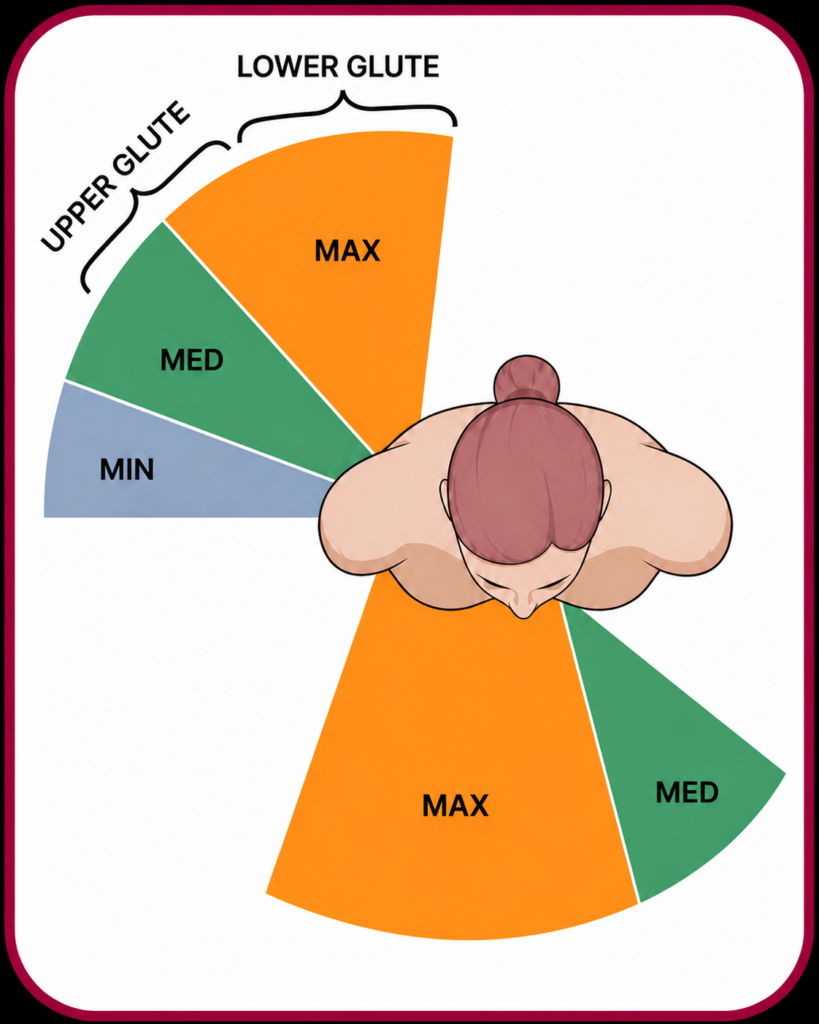
Figure 1. Looking down on the hips. Each glute muscle drags the thigh a different way. The big one pulls it back. The medius and minimus pull it out. Lines of pull after Neumann, JOSPT 2010.
| GLUTEUS MAXIMUS The big one. Low and central.Pulls the leg BACK. | GLUTEUS MEDIUS Higher. On the outside.Pulls the leg OUT. | GLUTEUS MINIMUS Under the medius. Also outside.Pulls the leg OUT. |
Three muscles. Three directions. Hold on to that, because it is the answer to the whole thing.
EMG, IN PLAIN ENGLISH
EMG means electromyography. Sensors on the skin, or thin wires inside the muscle, that read the signal a muscle sends while it works. It tells you how hard a muscle is firing right now. It does not tell you what will be bigger in three months.
READ THIS FIRST: FIRING IS NOT GROWING
This is the most important part of the article.
Almost every “this exercise hits the upper glute” claim comes from an EMG study. A sensor lit up. Someone made a post.
But a big reading today is not a bigger muscle later. And we have a very clean test of exactly that.
Researchers split 34 beginners into two groups for nine weeks. One group only squatted. The other only did hip thrusts. Same number of sets. Every set close to failure.
First they put sensors on the glutes. The hip thrust won at every single site. Every person also said they felt it more.
Then they put everyone in an MRI scanner and measured the actual muscle.
| WHAT THE SENSOR SAID Hip thrust beat the squat at every glute sensor. Everyone said they felt it more too.HIP THRUST WINS. | WHAT THE MRI SAID After nine weeks, the upper, middle and lower glute grew about the same. Either way.NO WINNER. |
THE SCIENCE
The sensor said hip thrust. The feeling said hip thrust. The MRI said no difference. The researchers then checked in three separate ways whether the EMG reading predicted who actually grew. It did not.
Plotkin et al., Frontiers in Physiology, 2023.
So when someone shows you an EMG chart and calls it proof that an exercise builds one region of your glutes, they are showing you the wrong measurement. That is the whole game.
PART 1. THE CLAIM IS HALF RIGHT
Give the myth its best case, because it does have one.
Your gluteus maximus really does have two parts, an upper and a lower. The fibres run in different directions, so they really do pull the leg in slightly different ways.
And EMG can catch one part working harder than the other. In one study, researchers put fine wires inside the muscle, far more precise than skin sensors, and tested 11 exercises on 20 people. The upper part fired hardest in the clam. The lower part fired hardest in the single-leg bridge.
HALF TRUE
The big glute does have a top and a bottom, and they can fire by different amounts.
Selkowitz, Beneck and Powers, JOSPT 2016.
PART 2. BUT YOU CANNOT CARVE THE HALVES
Here is where it falls apart.
First, in real training the halves ride together. In 2025, researchers tested 38 people through five versions of the same lift, with sensors on the top and the bottom of the big glute. Both rose and fell together across all five. Take the leg out to the side by 30 degrees and both halves go up. Not one of them. Both.
BE FAIR TO THE STUDY
Those five versions were all variations of one movement, done lying face down. So this shows the halves ride together inside that family of lifts. It is not proof that no exercise on earth could ever separate them.
Shin and Yoo, J Back Musculoskelet Rehabil, 2025.
Second, and this is the one that settles it: growth.
Go back to that nine-week MRI study. The squat and the hip thrust are about as different as two glute exercises get. Different joint angles. Different resistance. Different EMG. Different feeling in the gym.
The upper, middle and lower glute grew the same anyway.
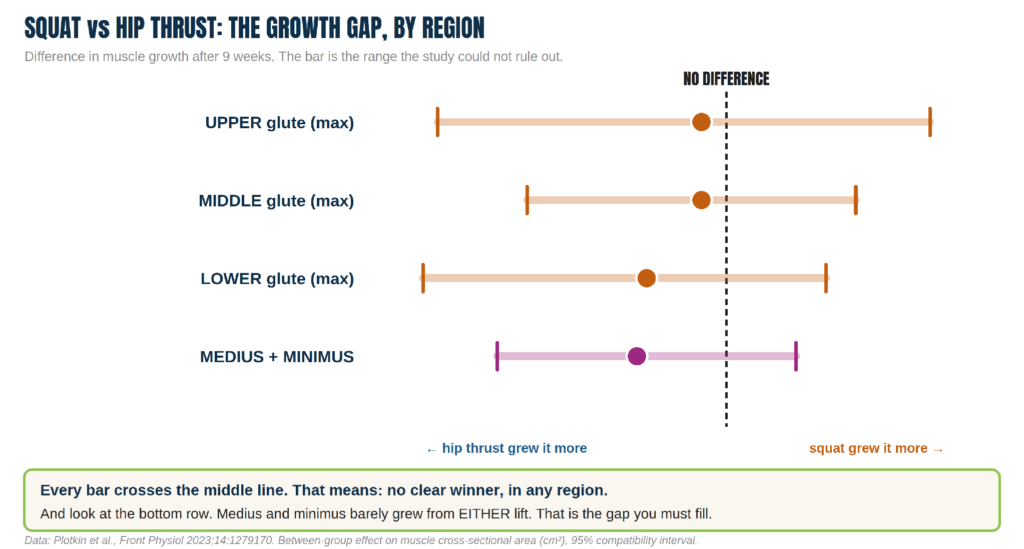
Figure 2. The growth gap between squats and hip thrusts, region by region. Real data from Plotkin et al., 2023.
Every bar crosses the middle line. In plain English, the study could not find a real winner in any region. Not the top. Not the middle. Not the bottom.
HALF FALSE
You do not get to pick which slice of the big glute grows by changing the angle. It grows as one unit.
PART 3. WHAT ANGLES REALLY CHANGE
So angles are useless? Not at all. They just do not do the thing the post said.
Angles do not split one muscle in two. Angles bring in a different muscle.
Look at the fan again. The big glute pulls the leg back. The medius and the minimus pull it out. So the moment you take the leg out to the side, or stop a knee caving in, or stand on one leg and refuse to let your hip drop, you are asking the medius and minimus to work. A completely different muscle.
And now the part almost nobody tells you.
In that same nine-week study, the gluteus medius and minimus barely grew at all. Not from the squats. Not from the hip thrusts. In neither group.
KEY TAKEAWAY
Your heavy hip extension work builds the big glute beautifully, top to bottom. It does very little for the medius and minimus. If you want the upper and outer shelf, you have to train the leg going out on purpose. Nothing else will do that job for you.
That shelf, the part that rounds out the top and the side of your hip, is medius and minimus country. It was never the “upper half” of your big glute. Which is exactly why chasing the upper half never worked.
THE VERDICT
HALF TRUE. HALF FALSE.
| TRUE | The big glute has a top and a bottom, and they can fire by different amounts. |
| FALSE | You can choose which half grows by changing the angle. You cannot. It grows as a unit. |
| THE REAL ANSWER | Angles change which muscle works. Train the leg going back for the big glute. Train the leg going out for the shelf. |
BY THE NUMBERS
| EXERCISE | BIG GLUTEgluteus maximus | THE SHELFmedius + minimus |
|---|---|---|
| Barbell hip thrust | ●●●●● | ●○○○○ |
| Barbell back squat | ●●●●● | ●○○○○ |
| Single-leg bridge | ●●●●○ | ●●○○○ |
| Clam | ●●●○○ | ●●●●○ |
| Hip abduction (side-lying, band or machine) | ●●○○○ | ●●●●● |
Illustrative. Built from the studies cited below to show the direction and rough size of the difference. These dots are not lab-exact numbers.
AT A GLANCE
| YOUR GOAL | WHAT TO TRAIN | WHY |
|---|---|---|
| Bigger glutes overall | Heavy hip extension. Squat, hip thrust, Romanian deadlift. | It grows the big glute top to bottom. All of it. |
| The upper, outer shelf | Add real abduction work. Side-lying, band, cable or machine. | Medius and minimus barely grow from hip extension alone. |
| “Target my upper glute max” | Stop. Spend that time on abduction instead. | You cannot separate it. It grows as one unit. |
| A hip that does not drop when you run | Abduction plus single-leg work. | That is medius and minimus holding the hip level. |
THE BOTTOM LINE
Stop trying to carve the top half of your big glute. It grows as one piece, and your squats and hip thrusts already do that job very well.
The shelf you actually want belongs to two different muscles. Gluteus medius and gluteus minimus. They sit higher and further out, and your heavy lifts are barely touching them.
So add abduction. On purpose. Every single week.
Angles were never useless. They just change which muscle works, not which half.
More myth-busters, all backed by the papers. bootycenter.com
REFERENCES
1. Neumann DA. Kinesiology of the hip: a focus on muscular actions. J Orthop Sports Phys Ther. 2010;40(2):82-94. doi:10.2519/jospt.2010.3025
2. Plotkin DL, Rodas MA, Vigotsky AD, et al. Hip thrust and back squat training elicit similar gluteus muscle hypertrophy and transfer similarly to the deadlift. Front Physiol. 2023;14:1279170. doi:10.3389/fphys.2023.1279170
3. Vigotsky AD, Halperin I, Trajano GS, Vieira TM. Longing for a longitudinal proxy: acutely measured surface EMG amplitude is not a validated predictor of muscle hypertrophy. Sports Med. 2022;52(2):193-199. doi:10.1007/s40279-021-01619-2
4. Selkowitz DM, Beneck GJ, Powers CM. Comparison of electromyographic activity of the superior and inferior portions of the gluteus maximus muscle during common therapeutic exercises. J Orthop Sports Phys Ther. 2016;46(9):794-799. doi:10.2519/jospt.2016.6493
5. Shin SS, Yoo WG. Comparison of gluteus maximus subdivisions, erector spinae, and biceps femoris activities and lumbopelvic motion during various prone hip exercises. J Back Musculoskelet Rehabil. 2025;38(5):1051-1062. doi:10.1177/10538127251323114
6. Selkowitz DM, Beneck GJ, Powers CM. Which exercises target the gluteal muscles while minimizing activation of the tensor fascia lata? Electromyographic assessment using fine-wire electrodes. J Orthop Sports Phys Ther. 2013;43(2):54-64. doi:10.2519/jospt.2013.4116
7. Contreras B, Vigotsky AD, Schoenfeld BJ, Beardsley C, Cronin J. A comparison of gluteus maximus, biceps femoris, and vastus lateralis electromyographic activity in the back squat and barbell hip thrust exercises. J Appl Biomech. 2015;31(6):452-458. doi:10.1123/jab.2014-0301