
A V-shaped butt looks wider at the top, near your waist, and narrower toward the bottom. You can make it look rounder, but only partly. Your frame, meaning your bones and where your body stores fat, does not change with training. The muscle under it does. Here is what research has measured, what is coaching practice, and what is still a guess.

Define: V-shaped butt
One of four frame types that plastic surgeons use to describe butt shape: square, round, A-shape and V-shape. In a V-shape there is more fullness at the upper outer hip than at the outer thigh, so the outline narrows as it goes down (Mendieta 2006). It describes a shape. It is not a medical problem.
What is a V-shaped butt?
Seen from behind, the widest point sits high, close to the waistband, and the outline tapers toward the legs. People also call it an inverted butt or a V-shaped bum.
The surgeon who wrote the best-known shape system splits the butt into two parts. The frame is bone, fat and skin. The gluteus maximus muscle sits inside that frame as a separate part (Mendieta 2006). That split matters, because training only reaches one of the two.
Why does your butt look V-shaped?
Three layers decide the outline.
- Bone. Pelvis and thigh bone shape vary a lot between people. In CT scans of 628 healthy hips, the sideways reach of the thigh bone averaged 42.9 mm, and most people sat within 6.8 mm of that. The angle of the thigh bone neck averaged 124.7 degrees, give or take 6.2 degrees, and women's hips differed from men's (Carmona 2019). Training does not move bone.
- Fat. Women tend to store more fat on the hips, butt and thighs than men (Karastergiou 2012), and each body spreads it differently. A V-shape has more of it high on the outer hip and less on the outer thigh.
- Muscle. Gluteus maximus gives the butt most of its size. Gluteus medius and gluteus minimus, the side glutes, sit on the upper outer hip. Medius makes up about 60% of the muscles that lift the leg out to the side (Neumann 2010).
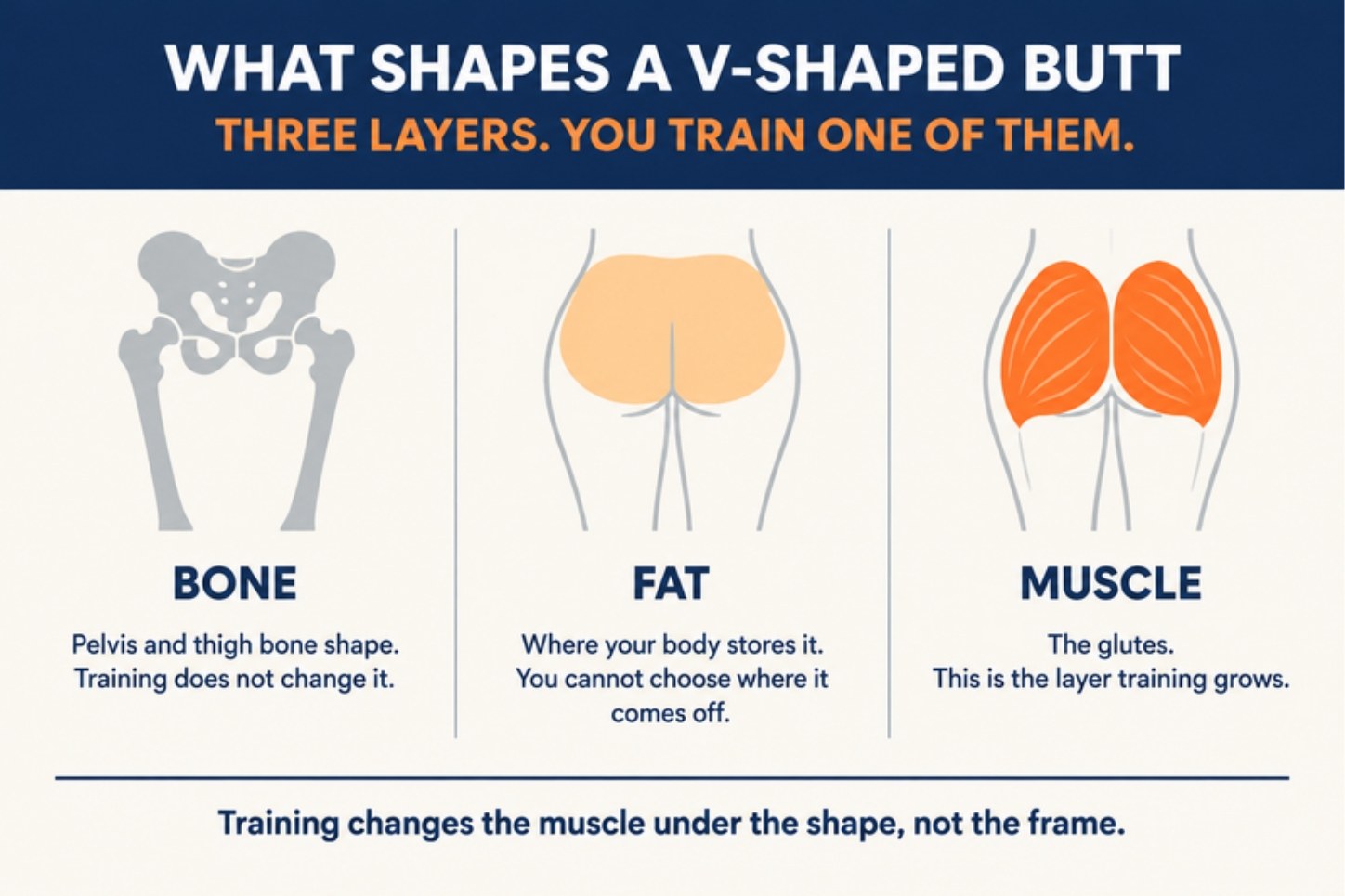
No study we know of has measured why one person has a V-shape and another has a round shape. The three layers above are anatomy, not a tested cause.
Can you round out V-shaped glutes with training?
Partly. The solid part is muscle growth. A 2025 review of 11 studies found a clear, moderate effect of resistance training on gluteus maximus size (Krause Neto 2025). In 34 untrained adults, 9 weeks of squats or hip thrusts grew the upper, middle and lower gluteus maximus (Plotkin 2023).
The unknown part is the look. We found no published trial that used butt shape as its result. One registered trial in 120 women lists perceived hip shape and hip circumference among its outcomes, but we found no published results yet (ClinicalTrials.gov NCT06977958). So nobody has shown how much a V-shape changes when the muscle grows. More muscle under the frame is a reasonable bet for a fuller outline. It is not a promise. If your main worry is the inward curve at the side of the hip, that is a different thing, covered in our guide on whether you can get rid of hip dips.
How do you add depth with the gluteus maximus?
A V-shape is narrow low down, and the lower part of gluteus maximus is where one new trial points. In 17 young adults, one leg did cable hip extension and the other did cable hip abduction, 2 times a week for 10 weeks, about 10 sets a week at 8 to 12 reps. Hip extension grew the lower gluteus maximus by 14% and the upper part by 5% (Attarieh 2026). That is one small study, so we cannot call it settled. It is a promising lead, and worth trying.
The lifts that load hip extension hard are the hip thrust or glute bridge, the Romanian deadlift and the Bulgarian split squat. In 33 untrained young women, adding the barbell hip thrust to a leg program grew glute thickness by 9.3% in 10 weeks, against 6.0% without it (Kassiano 2024). The Romanian deadlift is here on coaching practice, not on a growth trial of its own.
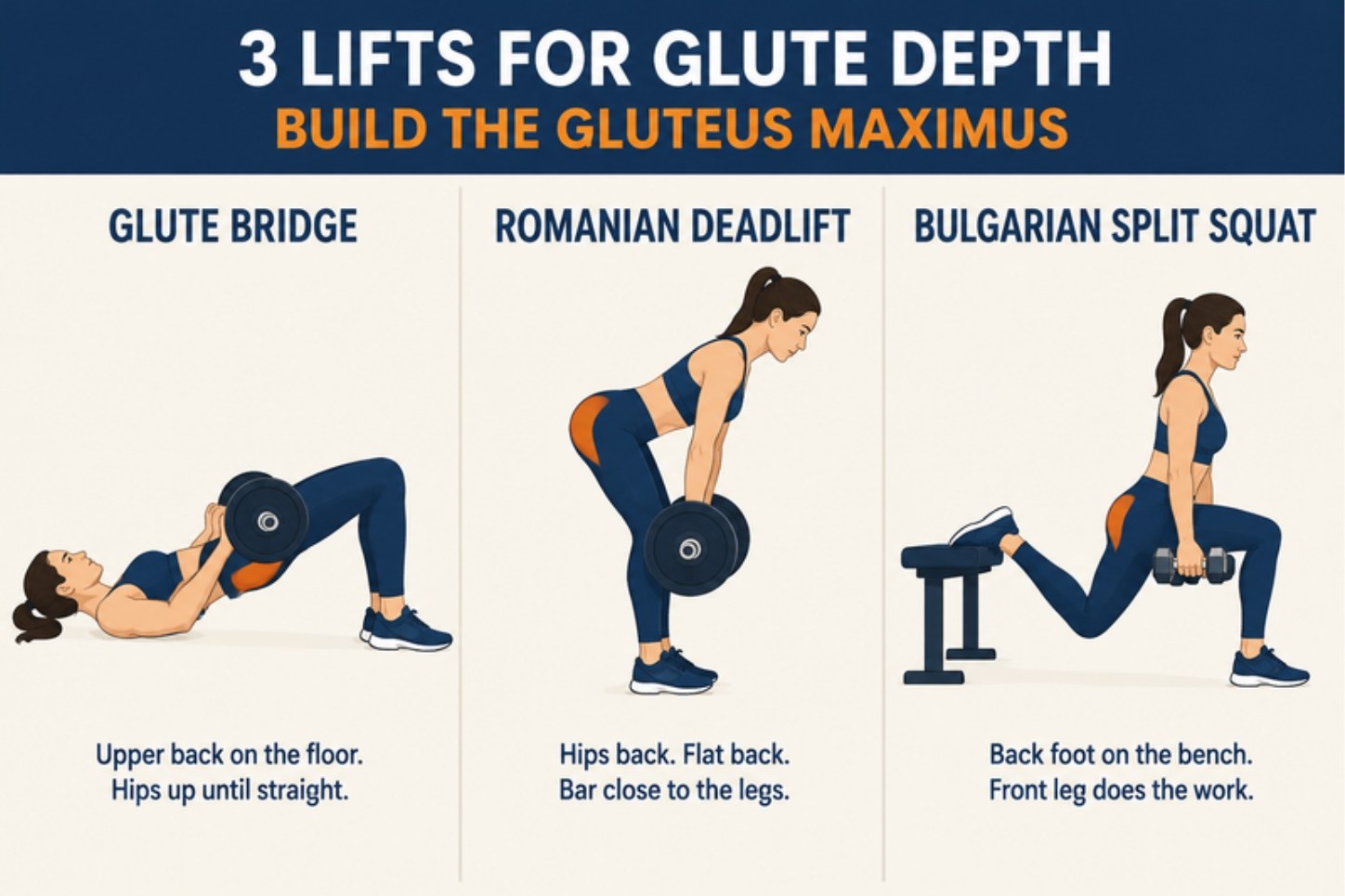
For set-up, see our guides on glute bridge vs hip thrust and Bulgarian split squats for glutes.
How do you build the side glutes for width?
Squats and hip thrusts barely grow the side glutes. In the 9-week trial, gluteus medius and minimus showed little to no growth from either lift (Plotkin 2023). The move that trains them through their main job is hip abduction, lifting the leg out to the side.
In 21 active adults, side-lying hip abduction produced the highest gluteus medius activity of 12 exercises, 81% of maximum, against about 40% for clamshells (Distefano 2009). Activity in one set is not growth. The one growth trial so far found that 10 weeks of cable hip abduction grew the side glutes by 4% and the upper gluteus maximus by 10% (Attarieh 2026).
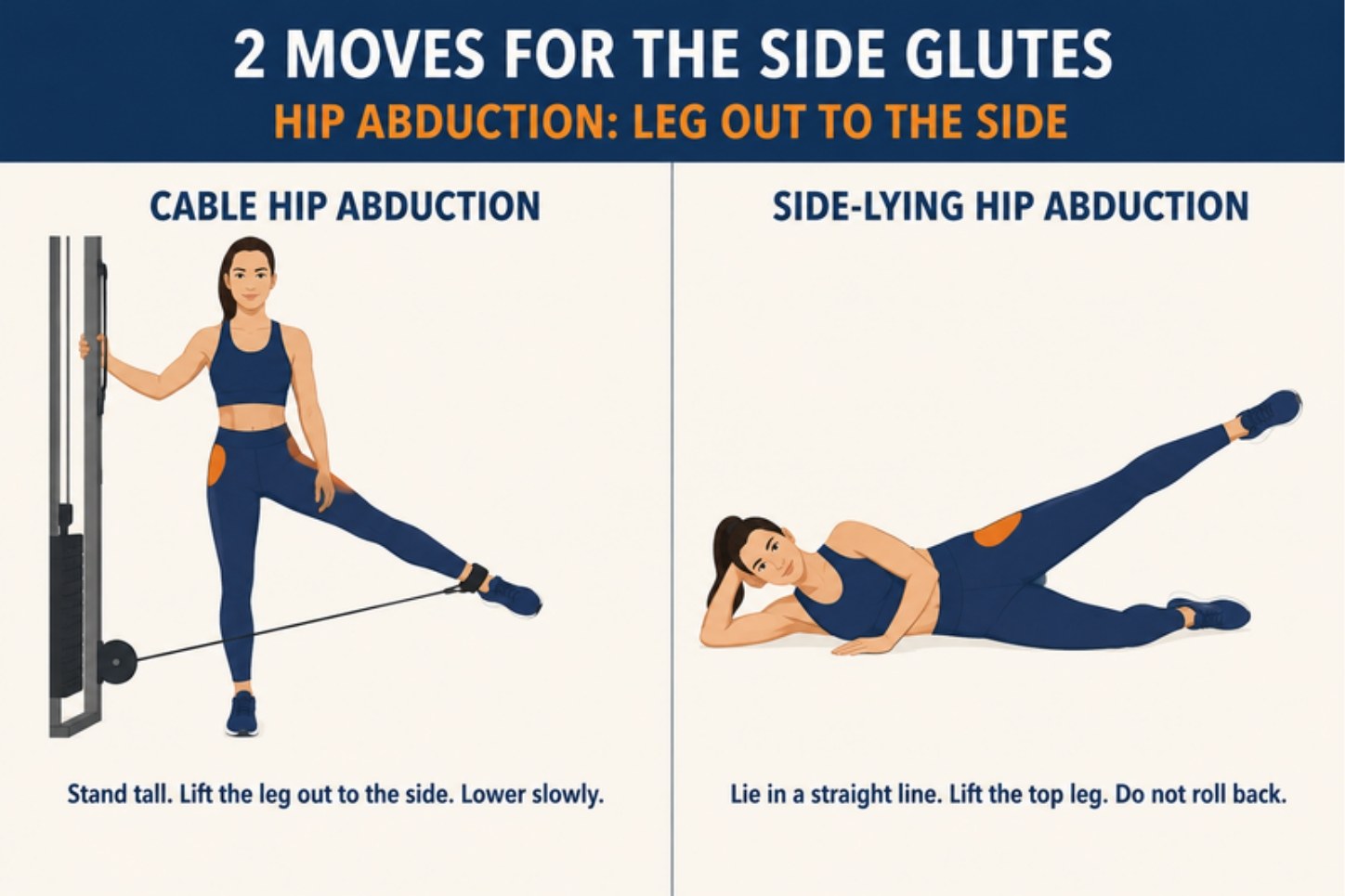
That is one small study, and it is the first of its kind, so we treat it as a good reason to try, not as proof. The same trial suggests each kind of move builds a different part: side work added more to the top of the glutes, and hip extension added more low down. There is more than one way to build a rounder shape, and bodies respond differently. So do both, give it 10 to 12 weeks, and let your photos tell you which one your body answers to. Our guides on seated hip abduction machine form and how to build the glute shelf cover the side work in detail.
Coach's tip
Take one photo from behind every 4 weeks. Same spot, same light, same clothes, feet hip width apart. Shape changes slowly, and the mirror will not show it week to week. Coaching practice, not a study result.
A weekly plan for a V-shaped butt
A coach's template built on the trials above, not a tested program. Do this session 2 times a week with at least 48 hours between sessions, which matches the frequency in the 10-week trial (Attarieh 2026). Each session takes about 60 minutes.
- Hip thrust: 3 to 4 sets of 6 to 10 reps. Stop 1 to 2 reps before failure, about 8 to 9 out of 10 effort. Rest 2 to 3 minutes between sets.
- Bulgarian split squat: 3 sets of 8 to 12 reps per leg. About 8 out of 10 effort. Rest 90 seconds between legs.
- Romanian deadlift: 3 sets of 8 to 12 reps. Stop 2 reps before failure, about 8 out of 10 effort. Rest 2 minutes between sets.
- Cable hip abduction, or side-lying hip abduction with an ankle weight: 5 sets of 8 to 12 reps per leg. About 8 out of 10 effort. Rest 60 seconds between legs. Two sessions give the 10 sets a week used in the trial.
When you reach the top of the rep range on every set, add the smallest weight you can. Training closer to failure gave more growth across many studies (Robinson 2024). Our pillar guide on how to train glutes shows how these lifts fit a full week.
Does losing fat or eating more change a V-shape?
You cannot choose where fat comes off. When the fat layer gets thinner, the frame under it shows more clearly, so a V-shape can look sharper after weight loss. That is anatomy reasoning, not a measured result. Building muscle needs enough food and protein to grow. Our guides on body recomposition for women and growing glutes without growing legs cover the eating side.
V-shaped glutes, by the numbers
- 4 frame types: square, round, A-shape and V-shape (Mendieta 2006).
- 628 hips: CT scans showing how much thigh bone shape varies between people (Carmona 2019).
- 11 studies: in the 2025 review showing resistance training grows gluteus maximus (Krause Neto 2025).
- 14% vs 5%: growth of the lower vs upper gluteus maximus from 10 weeks of cable hip extension (Attarieh 2026).
- 10% and 4%: growth of the upper gluteus maximus and of the side glutes from 10 weeks of cable hip abduction (Attarieh 2026).
- Little to no growth: side glutes after 9 weeks of squats or hip thrusts (Plotkin 2023).
- 0 published trials: that we found measuring butt shape itself after training. One is registered (NCT06977958).
Where the evidence runs thin
The V-shape label comes from plastic surgery, where it describes bone, fat and skin, not muscle. We found no published training study that measured butt shape as a result. The trial on which part of the glutes grows had 17 people and is the first of its kind. The muscle activity study measured one session, not growth. The weekly plan and the photo tip are coaching practice. How much rounder a V-shape can look is different for every frame, and nobody can promise a shape.
Bottom line
A V-shaped butt is a frame type: more fullness high on the outer hip, less lower down. Bone and fat pattern set the frame, and training does not change them. Training grows the muscle under it. Use heavy hip extension lifts for depth and hip abduction for width, train 2 times a week, and track it with photos. The research here is young, so stay curious: keep what works for your body, change what does not, and give each change a few months.
Frequently asked questions
Why does my butt look like a V?
Because your frame carries more fullness at the upper outer hip than at the outer thigh (Mendieta 2006). Bone shape varies a lot between people (Carmona 2019), and so does where the body stores fat (Karastergiou 2012). It is a normal shape, not a fault.
Can you fix a V-shaped butt with exercise?
You can grow the muscle under it. Resistance training reliably grows gluteus maximus (Krause Neto 2025). We found no published study measuring whether that changes a V-shape, so expect a fuller look, not a new frame.
Are hip dips and a V-shaped butt the same thing?
No. Hip dips are the inward curve at the side of the hip, between the top of the pelvis and the top of the thigh bone. A V-shape is the whole outline from behind. See our guide on hip dips.
Do squats round out a V-shaped butt?
Squats grow the whole gluteus maximus about as well as hip thrusts (Plotkin 2023). They barely grew the side glutes in that trial. Use them, and add hip abduction.
How long does it take to see a change?
Trials measured glute growth after 9 to 10 weeks of training (Plotkin 2023, Kassiano 2024, Attarieh 2026). Those are small changes on a scan. Plan on months of steady training before the outline looks different.
Is a V-shaped butt a sign of weak glutes?
No study links butt frame type to glute strength. The frame is bone, fat and skin (Mendieta 2006). Strength is a separate question.
References
- Mendieta CG. Classification system for gluteal evaluation. Clin Plast Surg. 2006;33(3):333-46. doi:10.1016/j.cps.2006.04.006
- Carmona M, Tzioupis C, LiArno S, Faizan A, Argenson JN, Ollivier M. Upper femur anatomy depends on age and gender: a three-dimensional computed tomography comparative bone morphometric analysis of 628 healthy patients' hips. J Arthroplasty. 2019;34(10):2487-93. doi:10.1016/j.arth.2019.05.036
- Karastergiou K, Smith SR, Greenberg AS, Fried SK. Sex differences in human adipose tissues: the biology of pear shape. Biol Sex Differ. 2012;3(1):13. doi:10.1186/2042-6410-3-13
- Neumann DA. Kinesiology of the hip: a focus on muscular actions. J Orthop Sports Phys Ther. 2010;40(2):82-94. doi:10.2519/jospt.2010.3025
- Krause Neto W, Krause TLV, Gama EF. The impact of resistance training on gluteus maximus hypertrophy: a systematic review and meta-analysis. Front Physiol. 2025;16:1542334. doi:10.3389/fphys.2025.1542334
- Plotkin DL, Rodas MA, Vigotsky AD, McIntosh MC, Breeze E, Ubrik R, et al. Hip thrust and back squat training elicit similar gluteus muscle hypertrophy and transfer similarly to the deadlift. Front Physiol. 2023;14:1279170. doi:10.3389/fphys.2023.1279170
- Attarieh P, Nunes JP, Khani S, Moniri A, Goli A, Negahdar S, et al. Regional hypertrophy of the gluteal muscles is task-specific: differential responses to 10 weeks of hip extension versus hip abduction training. J Strength Cond Res. 2026. Online ahead of print. doi:10.1519/JSC.0000000000005701
- Kassiano W, Kunevaliki G, Costa B, Nunes JP, Castro-E-Souza P, Tricoli I, et al. Addition of the barbell hip thrust elicits greater increases in gluteus maximus muscle thickness in untrained young women. Int J Strength Cond. 2024;4(1). doi:10.47206/ijsc.v4i1.284
- Distefano LJ, Blackburn JT, Marshall SW, Padua DA. Gluteal muscle activation during common therapeutic exercises. J Orthop Sports Phys Ther. 2009;39(7):532-40. doi:10.2519/jospt.2009.2796
- Robinson ZP, Pelland JC, Remmert JF, Refalo MC, Jukic I, Steele J, et al. Exploring the dose-response relationship between estimated resistance training proximity to failure, strength gain, and muscle hypertrophy: a series of meta-regressions. Sports Med. 2024;54(9):2209-31. doi:10.1007/s40279-024-02069-2