
While physiotherapists studied weak glutes, the people on the gym floor were busy with strong ones. Powerlifters, weightlifters and sprint coaches did not care much about EMG. They cared about lifting more and running faster, and they built machines and methods to get there.
This chapter tells three stories from that world: a Soviet machine that crossed the Iron Curtain, a powerlifter with a broken back, and a training book that quietly showed a new kind of bridge. None of them was about the glutes alone. All of them ended up shaping how we train the glutes today.
Part 1 · Before the machines
The strongman era
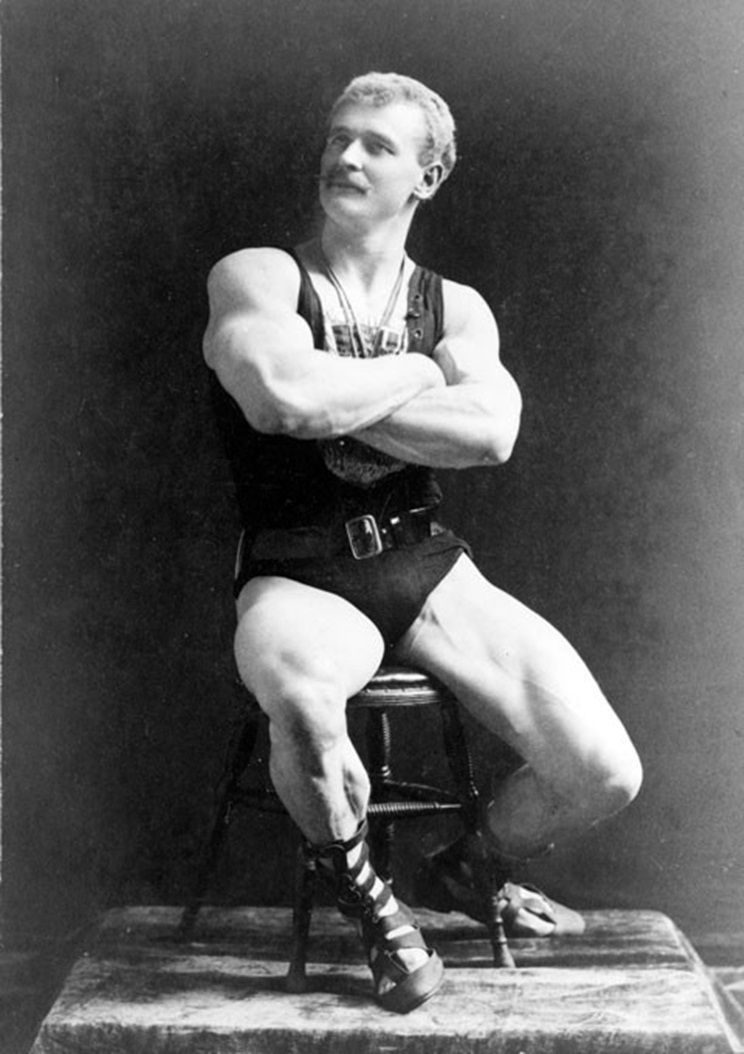
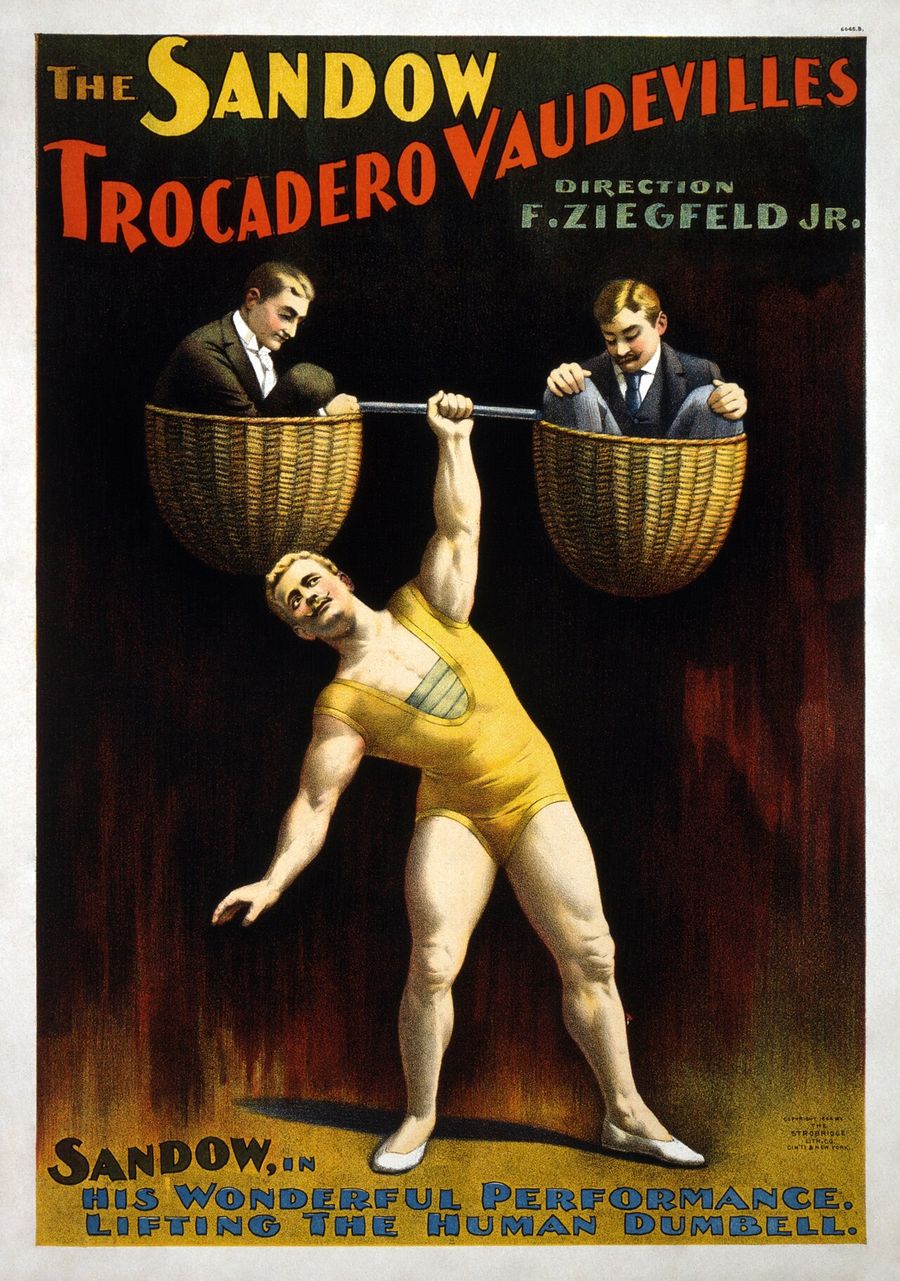
Lifting heavy things for show is ancient, but the modern iron game took shape in the 1890s. The Prussian-born strongman Eugen Sandow filled theatres in Europe and America with feats of strength and muscle poses. In 1901 he ran a famous physique contest in London, and he is often called the father of modern bodybuilding.
For most of the next century, though, nobody in the gym talked about glutes as their own target. Squats and deadlifts built the legs and back. The glutes simply came along for the ride.
Part 2 · A Soviet machine
The glute ham raise crosses the Iron Curtain
Michael Yessis was a biomechanist at California State University, Fullerton. His mission was to bring Soviet sports training to the United States. For years, his journal, Soviet Sports Review, translated Soviet research for English readers, at a time when the Soviet Union dominated many Olympic sports.
On his trips to the Soviet Union in the 1980s, Yessis came across a Soviet exercise bench for what we now call the glute ham raise. In the mid-1980s he worked with an American company, Polaris Equipment, on an American version: the glute ham developer. He is often called its inventor. It is fairer to say he made it popular in the West, because the Soviet version came first.
Part 3 · A broken back
Louie Simmons flips the exercise
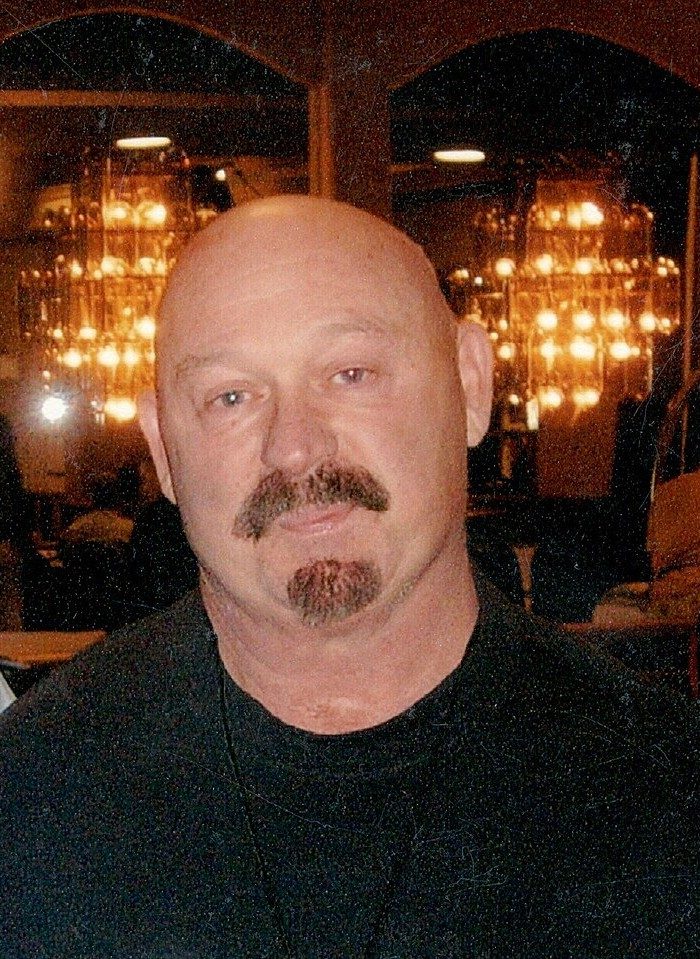
Louie Simmons was a powerlifter who later founded the famous Westside Barbell gym in Columbus, Ohio. In 1973 he broke his back. Normal back raises, the usual exercise to strengthen the lower back, hurt too much to do.
So he flipped the exercise. In a back raise, the legs are fixed and the upper body moves. Simmons fixed the upper body on a pad and swung the legs up instead. When he broke his back again in 1983, he used his machine to rehab it.
On 18 October 1994 he received US patent 5,356,359, titled "Method and apparatus for improved lower back exercise". The reverse hyper works the low back, the hamstrings and the glutes, and today it is in gyms all over the world.
Part 4 · A training bible
Supertraining and the loaded bridge
The third piece was a book. Supertraining was written by the Soviet sports scientist Yuri Verkhoshansky and the South African scientist Mel Siff, and it became a kind of bible for strength coaches. Its fifth edition, from 2003, shows partner-resisted bridges, on one leg and on two, as exercises for track and field athletes: the athlete lies on the back and drives the hips up while a partner pushes down.
Bret Contreras, whose story is Chapter 7, later named these drawings as the start of the hip thrust's story. In other words, the idea of loading the bridge was already on paper before anyone put a barbell across their hips on a bench.
The common thread
A Soviet bench, a powerlifter's rehab machine and a sprint coach's bridge all train the same thing: hip extension under load. The goals were a stronger lift, a healthier back and a faster sprint. The glutes came along for the work.
- 1890sSandow and the strongman era.
- 1973Simmons breaks his back.
- 1980sYessis meets the Soviet glute ham raise.
- Mid 1980sThe American glute ham developer.
- 1994Reverse hyper patent.Key
- 2003Supertraining shows loaded bridges.Key
The old belief this chapter tests
"Each great glute exercise has one inventor and one moment."
Not supportedThe Soviet glute ham raise came before the American machine. Loaded bridges came before the hip thrust. Most gym inventions grow out of earlier ideas, and good history gives credit along the whole chain.
What this means for training today
Hip extension under load is the core of strong glutes, whether it comes from a glute ham raise, a reverse hyper, a deadlift or a bridge. Which tool you use is less important than training that movement hard and often enough. Chapter 8 shows what the research says about choosing between them.


