
Today, glute training is a gym word. But for most of the 20th century, the people who cared most about the glutes were not bodybuilders or coaches. They were doctors and physiotherapists, and they met the glutes through pain: sore backs, and later, sore knees.
This chapter follows how the clinic put the glutes on the map, from a theory about back pain in Prague to a wave of lab studies that ranked rehab exercises. It also shows two ideas from that era that turned out to be too simple.
Part 1 · Exercise as medicine
Machines before gyms
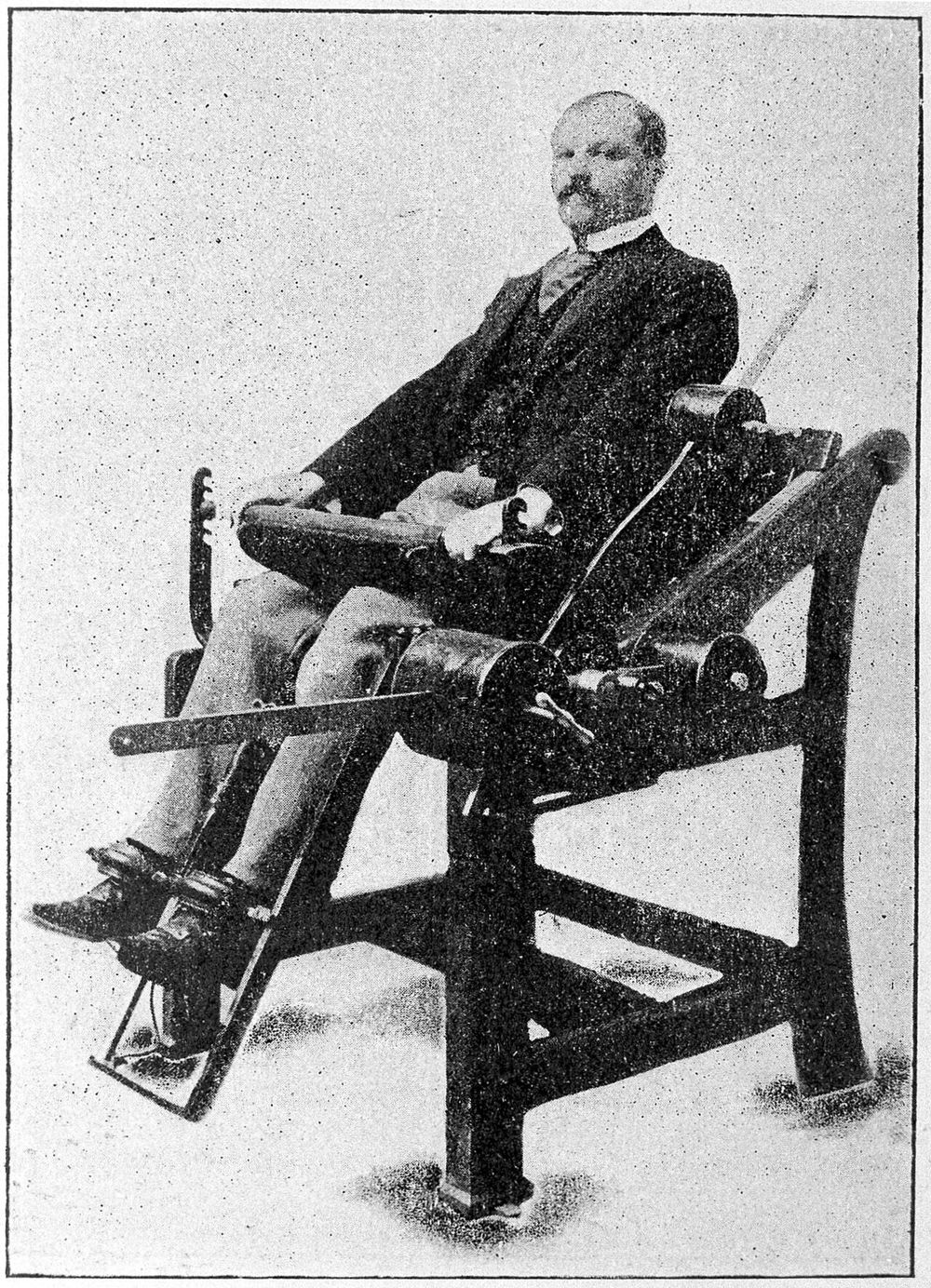
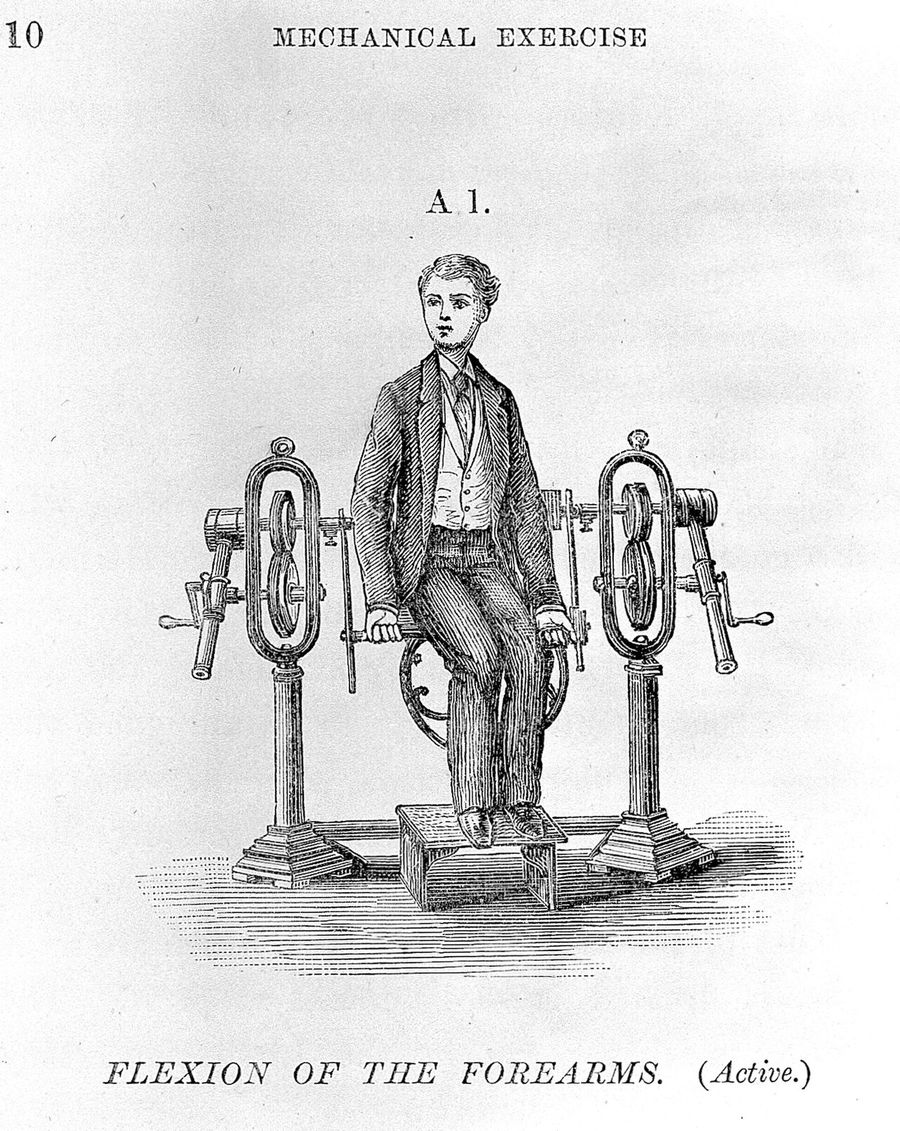
The idea that exercise can treat the body is old. In 1865, the Swedish physician Gustav Zander opened an institute in Stockholm where patients exercised on machines, each built for one movement. Zander institutes spread across Europe and beyond. Many of these machines look strangely like the ones in gyms today.
But for a long time, the glutes were not a special target. That changed when the clinic started to link them to two of its most common problems.
Part 2 · The back
Janda's crossed pattern
In 1979, the Czech physician Vladimir Janda described a pattern he saw again and again in his back pain patients in Prague. The hip flexors at the front of the hip and the muscles of the low back were tight. The abdominals and the glutes were weak. Drawn on the body, the tight pair and the weak pair cross each other like an X. He called it the lower crossed syndrome.
His original paper was written in German for a congress, and most people know it only through later books and articles. But the idea spread fast through physiotherapy. For the first time, weak glutes had a named place in back pain care.
In 1993, Janda and colleagues tested whether the glutes could be retrained. Fifteen healthy people walked in wobbly balance shoes for one week. Afterwards, their glutes fired harder and earlier when they walked. The muscles could be trained to respond.
Part 3 · The knee
When the knee falls inward
Then the knee joined the story. In 2005, Timothy Hewett and colleagues tested how 205 female athletes landed from a jump, then followed them through their season. Nine of them later tore their ACL, a key knee ligament. Those nine had landed with the knee falling inward about 8 degrees more than the others, and with about 2.5 times the inward load on the knee.
Why would the knee fall inward? One reason sits above it. The hip muscles, especially the side glutes, help control where the thigh goes when you land, run or squat.
In 2010, Christopher Powers pulled the evidence together in an influential review. Poor muscle control at the hip, he argued, can change how the knee moves and how it is loaded. He linked it to ACL injuries, IT band syndrome and kneecap pain. His conclusion was simple: knee rehab should train the hip too.
Part 4 · The ranking wave
Which exercise works the glutes best?
Now therapists had a practical problem. If the glutes matter for backs and knees, which exercises actually work them? From 2005, lab after lab wired people up with EMG and ranked the classic rehab exercises: Bolgla and Uhl in 2005, Ayotte and Ekstrom in 2007, Distefano in 2009, and Boren in 2011.
The 2011 study by Boren and colleagues tested 18 exercises on 24 healthy people. The results, as a percent of each person's maximum effort, looked like this.
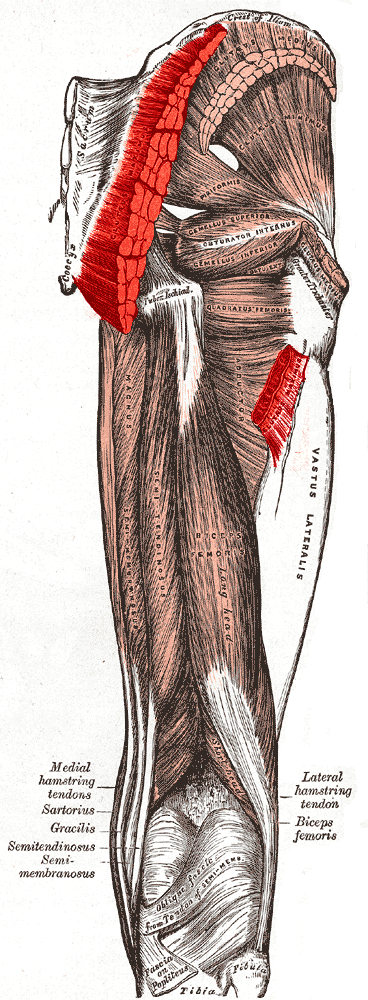
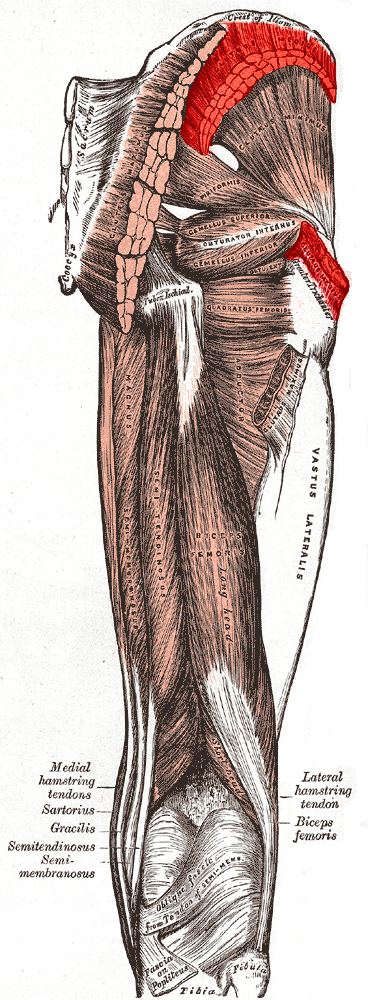
These rankings were hugely useful for rehab. They told therapists which simple, low-load exercises switch the glutes on. But they were soon read in a way their authors could not prove: as a guide to building muscle. More on that in a moment.
Part 5 · Gluteal amnesia
Does pain switch the glutes off?
Meanwhile, the Canadian spine researcher Stuart McGill gave the clinic a phrase people remembered: gluteal amnesia, the idea that in people with back or hip trouble the glutes "forget" how to fire. The term is usually credited to his book on low back disorders.
In 2013, his lab tested a version of it. Twelve patients had fluid injected into one hip joint as part of a scan. Right afterwards, the glute max on that side fired less in a bridge exercise. Nine healthy people, with no injection, showed no change. So irritating a joint can, at least briefly, turn down the muscle around it.
But "pain switches the glutes off" turned out to be too simple as a general rule. A 2013 review of people with kneecap pain found the side glute firing late during tasks like stair climbing. The glute max, though, was firing more on stairs, not less, though the evidence for that part was limited.
The old belief this chapter tests
"Pain switches the glutes off, and a higher EMG signal means more growth."
Too simplePain can change how the glutes fire, but not always by switching them off. And the 2011 ranking paper suggested that a higher signal goes with more growth. That is a prediction, not a result. Chapter 8 shows what happened when scientists finally tested it.
What this means for training today
The clinic gave us two lasting lessons. Strong, well-controlled glutes matter for healthy backs and knees. And there is a big menu of simple exercises that switch the glutes on, which is useful for warm-ups and rehab. Building muscle size is a different question, and it needs a different kind of evidence.


