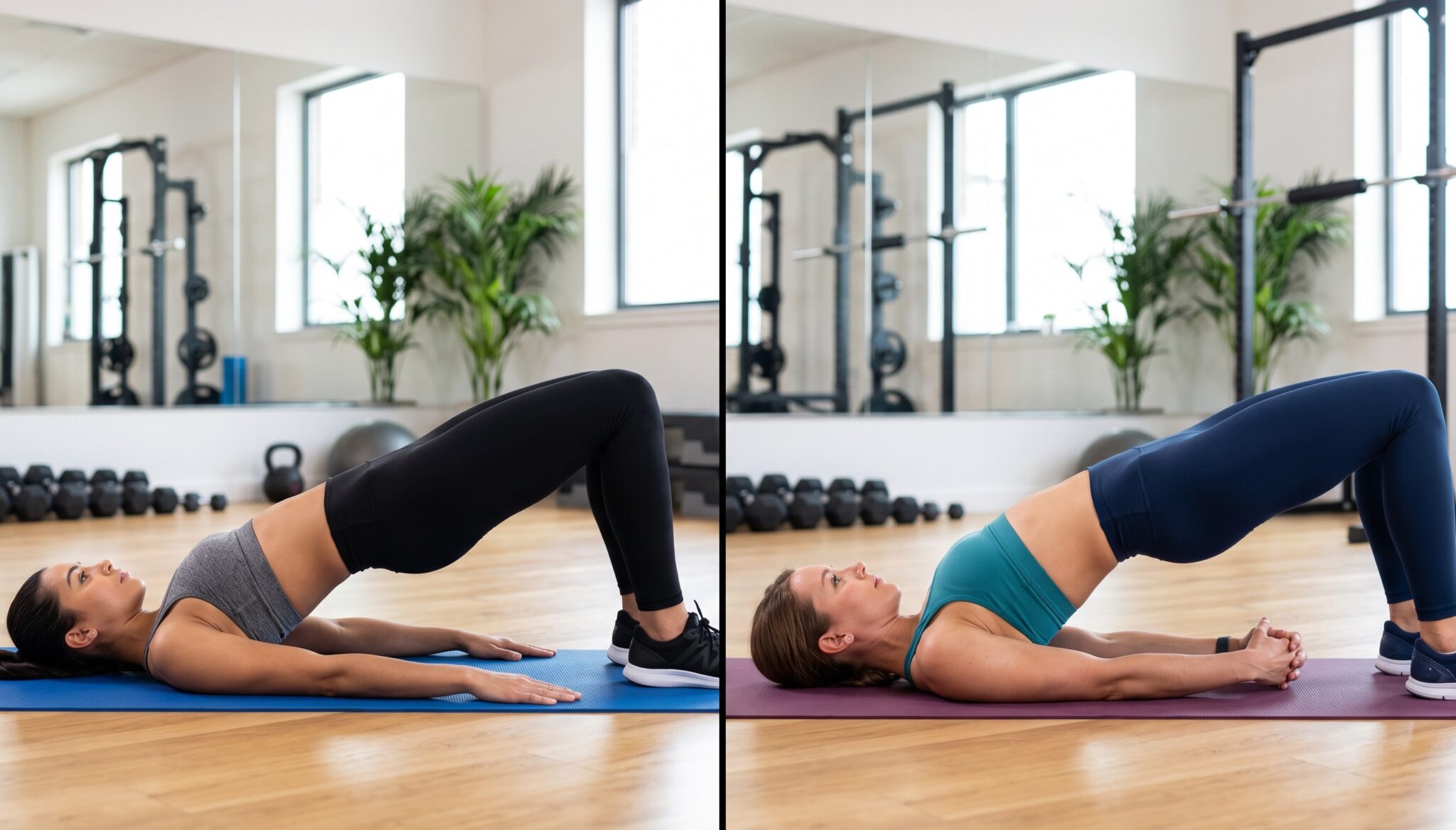
Is a shoulder bridge the same as a glute bridge?
No. A shoulder bridge is a spinal articulation movement from Pilates, and a glute bridge is a loadable hip extension movement. Same body position, two different jobs.
The reason nobody explains this clearly is that almost every article answering “shoulder bridge vs glute bridge” quietly switches to comparing the glute bridge with the hip thrust instead, which is a different question about bench height. Here is the distinction that actually matters, because the same shape carries three separate intents:
– Pilates shoulder bridge: the spine peels off the mat vertebra by vertebra. The movement is the journey, not the position.
– Yoga bridge, Setu Bandhasana: the spine curves inward into a backbend and the chest opens over planted shoulder blades. Spinal extension, not hip extension.
– Strength glute bridge: the spine is locked rigid and only the hip moves, which is what makes weight safe to add.
Get the intent wrong and you perform the right shape with the wrong instruction. Most people with tight hips end up in the yoga version by accident while believing they are training glutes.
Table of Contents
What is a Pilates shoulder bridge actually training?
Segmental spinal control and hip flexor length, not glute size. You articulate the spine off the mat one vertebra at a time and lower the same way, which trains the back to move in pieces instead of as a single block.
Shoulder Bridge is number eighteen of the thirty four original mat exercises Joseph Pilates published in Return to Life Through Contrology in 1945, and in that repertoire the glutes finish the lift rather than drive it. The classical version then adds a leg extension on top, which is where the name earns its keep: your shoulders and upper back stay planted while the pelvis has to stay level under an asymmetrical load.
Tempo is the giveaway. A well executed shoulder bridge takes several seconds to lift, because you cannot articulate anything you move through quickly.
If your hips feel locked shut at the top of every bridge, that is a flexibility problem sitting underneath a strength exercise, and it responds faster to targeted work on tight hip flexors than to more bridge volume.
What is a glute bridge actually training?
Hip extension against resistance, with the spine deliberately locked out of the movement. The glutes drive from floor to lockout and the back is instructed to do nothing.
Every cue exists to keep your spine still. Ribs down, pelvis tucked, lift until shoulders, hips and knees form a line, then stop, because extra height past that point comes from your lower back arching rather than your hips opening. The National Academy of Sports Medicine teaches the same correction for the same reason: if you feel the lift in your low back, reset with the hips tucked under before you lift again.
The rep is also faster and more forceful. Two seconds of hard squeeze at lockout does more than four seconds of careful spinal peeling.
Once the spine is out of the equation the exercise becomes loadable, which is the entire point. It scales from bodyweight to a dumbbell to a loaded barbell without changing the pattern, and that is what separates it from its bench supported cousin in the glute bridge vs hip thrust comparison. I coach it as a fixed shape, not a range of motion. Find the line, hold the line, add weight to the line.
Which one builds glutes faster?
The glute bridge, and the gap widens the moment load enters. Published electromyography research treats roughly forty one percent of maximum voluntary contraction as the threshold where an exercise becomes a strengthening stimulus rather than an endurance one.
That number turns a vague argument into a decision. Researchers interpreting gluteal EMG data use activation bands where twenty one to forty percent of maximum voluntary contraction reads as an endurance stimulus and forty one percent and above reads as a strength stimulus. A slow, unloaded, spine focused bridge is not built to reach the upper band. A loaded, spine rigid one is.
This is why “I do bridges every day and nothing changes” is so common. The problem is almost never frequency. The exercise being repeated was never a strength exercise, and repeating an endurance stimulus more often does not convert it into a hypertrophy stimulus.
| Shoulder bridge (Pilates) | Yoga bridge (Setu Bandhasana) | Glute bridge (strength) | |
| Primary intent | Spinal articulation | Spinal extension, chest opening | Hip extension under load |
| Spine instruction | Peel vertebra by vertebra | Curve inward into a backbend | Rigid, ribs down, no arch |
| Tempo | Slow, several seconds up | Held static | Controlled up, hard squeeze at top |
| Main driver | Spine and pelvis, glutes finish | Back extensors and legs | Glutes throughout |
| Load progression | Single leg, arm variations | Held longer, not loaded | Bodyweight to dumbbell to barbell |
| Where it belongs | Warm up, mobility, recovery days | Practice or cool down | Strength block |
Why do your hamstrings cramp in a bridge?
Knee angle, in most cases, not weak glutes. Opening the knee to roughly one hundred and thirty five degrees instead of the standard ninety cut hamstring activation from 75.34 percent to 23.49 percent of maximum voluntary contraction while gluteal activation stayed high.
Hamstring cramping in the traditional ninety degree position was part of the reason those researchers went looking in the first place. It is a known problem with a measurable fix, and in practice it means your feet are sitting too close to your glutes. Walk your heels out until the knee opens up.
Do not confuse that with the cue to move your feet closer in. Distance from the glutes shifts emphasis between hamstring and glute. Knee angle changes which muscle is mechanically favoured. Two different levers, two different problems.
My cue is to press the floor away rather than pull your heels back toward you. Pulling recruits hamstring, pressing recruits glute, and the cramping usually disappears within a session. It shows up most often when people first attempt the single leg glute bridge and instinctively tighten everything at once.
Why do you feel bridges in your lower back instead of your glutes?
Because you are extending your spine instead of your hips. The lift should stop when your hips run out of extension, not when your back runs out of arch.
The tell is your ribs. If they flare up and away from your pelvis at the top, your back finished the rep. A correctly finished bridge sits lower than most people expect, and the height you gave up belonged to your lumbar spine.
Tight hip flexors make this worse. When the front of the hip refuses to open, your body finds the range somewhere else, and the somewhere else is always your lower back. You end up training your erectors while believing you are training your glutes, which is the most common route to lower back pain after hip thrusts and bridges alike.
My correction order never changes. Tuck the pelvis before the lift starts, not during it. Stitch the ribs down to the pelvis. Then lift to the line and stop, even when it feels like you left height on the table.
Should you load a bridge, and does bar position matter?
Yes, load it, and the floor version is not the inferior option. When both were compared directly under surface electromyography, the floor based barbell glute bridge produced greater gluteus maximus activity while the bench supported hip thrust pulled more quadriceps.
That contradicts the standard gym assumption that the bench version is simply the upgrade. Elevating your shoulders buys range of motion. It does not automatically buy more glute, and it adds quad involvement you may not want.
So the floor bridge is not a beginner exercise you graduate out of. It is a legitimate primary movement with a shorter setup, no bench, and less lower back exposure for people who arch under the bar. Where each one sits depends on the framework you use to organise how to train glutes across a week.
Can you program both in the same week?
Yes, and they will not interfere because they occupy different slots. Shoulder bridge belongs in your warm up or on recovery days, and glute bridge belongs in the strength block where the weight goes up over time.
A workable layout: shoulder bridge for five to eight slow articulated reps before lower body training or on off days, and glute bridge for three to four working sets of six to twelve reps, loaded, in the session itself.
The one rule worth enforcing is never mixing the instructions inside a single set. Deciding halfway through a loaded set that you will also articulate your spine is how people end up under a barbell with a moving lower back. Pick the intent before the set starts and hold it for every rep.
If you only have room for one, take the glute bridge.
FAQ
Is a shoulder bridge good for beginners?
Yes, it is an excellent entry point for learning pelvic control and spinal awareness before you load anything. Just do not expect size from it, because it is a movement quality exercise rather than a strength one.
Can you do a shoulder bridge every day?
Daily practice is fine because the loads are low and the work is closer to mobility than strength training. A loaded glute bridge is different and needs a day or two between hard sessions.
Do you need a bench for glute bridges?
No. The floor version produced greater gluteus maximus activation than the bench supported hip thrust under direct EMG comparison, so a bench is a range of motion choice rather than a requirement.
Is a bridge enough on its own for glute growth?
A loaded bridge will build glutes, but it trains hip extension in one position and your glutes respond to more than that. Pair it with a hinge and a lunge pattern for complete development.
The bottom line
Shoulder bridge and glute bridge are not two versions of one exercise. They are two exercises wearing the same shape, and the instruction you follow decides which one you actually performed.
If you want spinal mobility and hip opening, peel the spine slowly and keep it unloaded. If you want glutes, lock the spine, stop the lift at the line, open the knee angle so your hamstrings stop hijacking the rep, and add weight over time. The floor is a perfectly good place to do it.
Most people stuck on bridges are not undertrained. They are performing a mobility drill and expecting a hypertrophy result. Pick your intent before the first rep and the exercise stops being confusing.