Hip thrusts work the gluteus maximus as the prime mover and the gluteus medius only as a stabilizer. Both the upper and lower maximus are loaded hard through hip extension, while the medius holds your pelvis and knees in place without being trained through its own action.That difference decides your shape, and it is the part almost every article on this topic leaves out.
| Hip thrusts primarily work the gluteus maximus, which produces the hip extension that lifts the bar. The gluteus medius is active throughout, but it stabilizes rather than moves, so it receives a very different stimulus. |
Your glutes are three muscles with three jobs. The maximus extends the hip. The medius and minimus abduct the hip and control it in the frontal plane. A hip thrust is a hip extension movement, so it pays the maximus first and everything else second.
Table of Contents
THREE MUSCLES, THREE JOBS
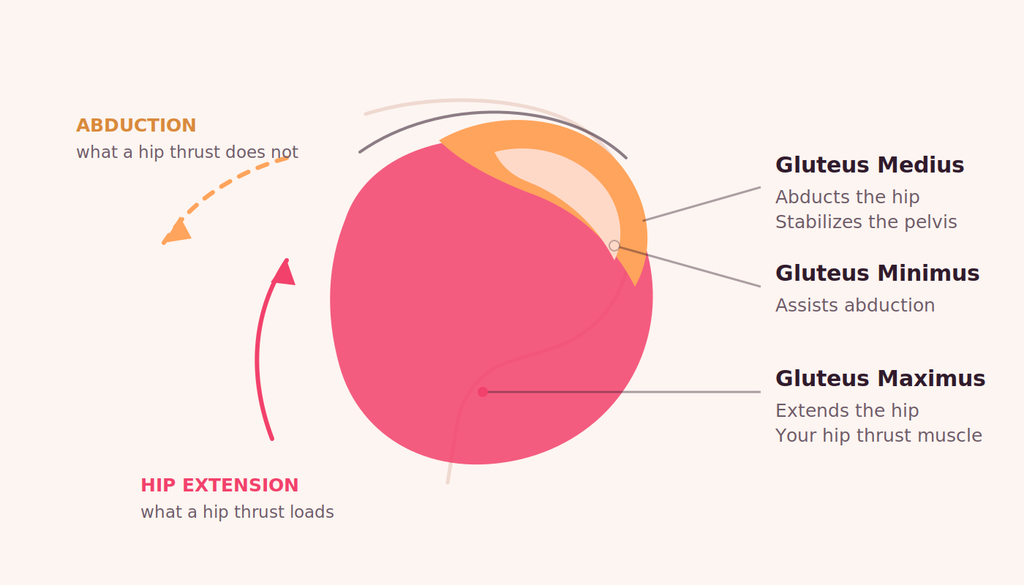 The maximus moves your hip backward. The medius and minimus move it sideways. A barbell resting on your hips only resists one of those directions.
The maximus is not one uniform slab, and this is where hip thrusts earn their reputation. Compared against the back squat at a 10-rep max load, the hip thrust roughly doubled mean activity in both regions of the maximus: upper glute max reached 69.5% of maximum voluntary contraction versus 29.4% in the squat, and lower glute max reached 86.8% versus 45.4%. At peak, upper max hit 172% versus 84.9%. Upper and lower fibers both get worked, which is why the hip thrust builds the full round shape of the maximus rather than only its base.
HIP THRUST VS BACK SQUAT, MEAN GLUTE MAX ACTIVITY
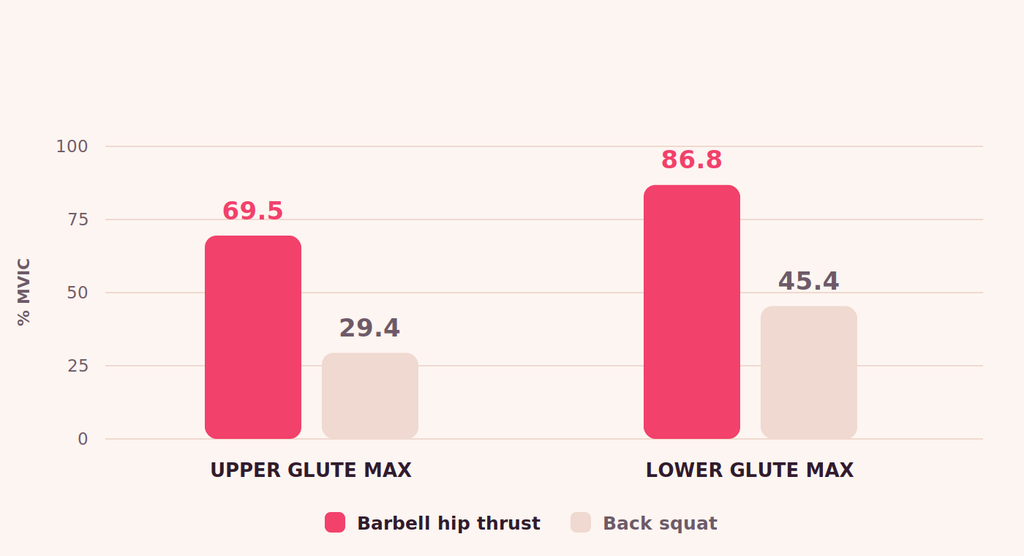 Mean EMG amplitude at a 10RM load. The hip thrust roughly doubles the squat at both regions of the gluteus maximus.
There is a loading argument that rarely gets mentioned. In one study the average 3-rep max hip thrust load was 154 kg against 77 kg for the split squat, and the hip thrust still produced the highest peak gluteus maximus activity of the four exercises tested at 143% MVIC. You can put roughly double the weight on your glutes and still get the highest activation. Nothing else in the gym does that.
Do hip thrusts work the gluteus medius?
Yes, but as a stabilizer, not a prime mover. The medius fires to stop your knees caving in and keep your pelvis level under load, which is real work, but it is not the same stimulus as loading the muscle through hip abduction.
Look at what the muscle is being asked to do. Your feet are planted, your knees track straight ahead, your hips move in one plane. The medius holds a position isometrically while the maximus produces force through a full range against a barbell. The gluteus medius is the most important hip stabilizer in the frontal plane, which is exactly why it appears in a hip thrust at all, and exactly why it goes quiet the moment that stability demand disappears.
PRIME MOVER VS STABILIZER
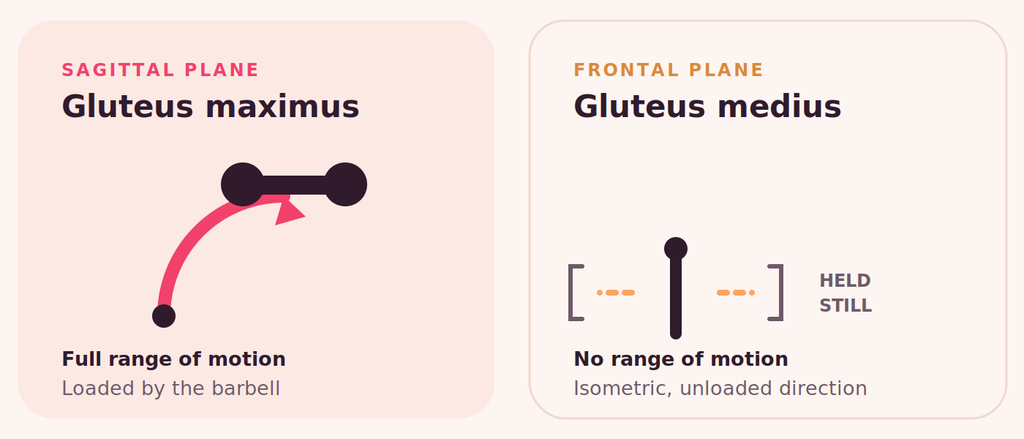 Same set, same muscle group, two completely different training effects. Only one of these directions has weight on it.
Most articles stop here and write “hip thrusts work the max and the medius,” which is technically true and practically useless. Prime mover and stabilizer are not the same training effect. Treating them as equivalent is how people end up with a strong maximus and a shape that never changes.
It also explains why soreness misleads you. Holding a hard isometric under a heavy bar creates plenty of fatigue. Fatigue is not growth.
Will hip thrusts actually grow your gluteus medius?
Probably not much. In a nine-week training study that used MRI to measure real muscle size, the hip thrust group grew the upper, middle, and lower gluteus maximus, but the gluteus medius and minimus showed little to no growth.
This is the most decision-relevant finding on the topic and it is missing from the pages currently ranking for this question, because they all argue from activation instead of growth. Activation tells you which muscle lights up during one set. It does not tell you what that muscle looks like nine weeks later.
NINE WEEKS OF HIP THRUSTS, MEASURED BY MRI
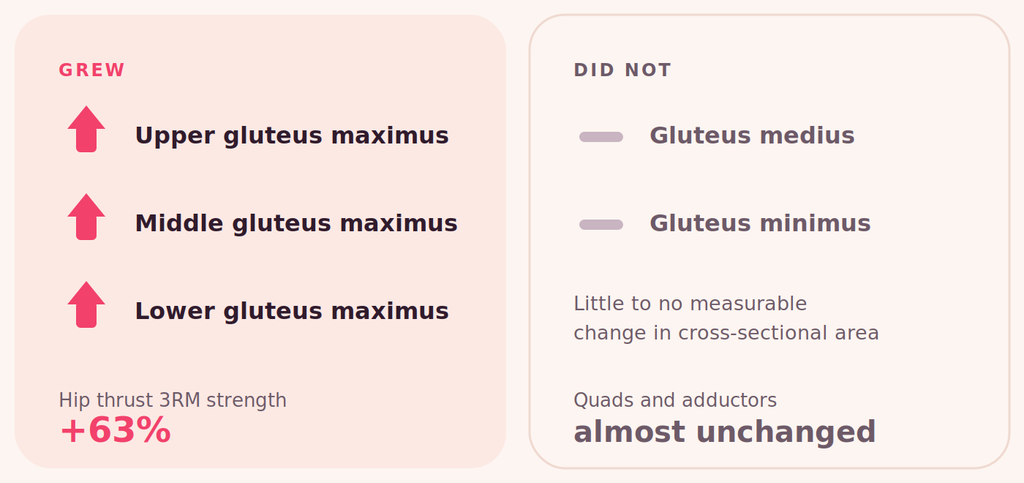 Nine weeks, twice per week, measured before and after with MRI rather than estimated from electrical activity.
The same study proves the gap is real. Researchers recorded electrical activity at every gluteal site during the first session and the hip thrust beat the squat at all of them, including the medius. Then they trained people for nine weeks and found those activation differences did not reliably predict who grew or what grew. Hip thrust strength climbed 63% in that group. The maximus grew. The medius and minimus barely moved.
The flip side is a genuine compliment to the lift. The squat group added 3.6 cm² to the quadriceps and 2.5 cm² to the adductors. The hip thrust group added almost nothing to either, which is why the researchers called the hip thrust more gluteus maximus specific. If you want glutes without thighs, that is your exercise. But specific means specific, and something that targeted will never cover a muscle with a different action.
| FROM THE COACHING FLOOR The women who plateau in shape rather than size are almost always the ones with the strongest hip thrust in the room. Their maximus responded exactly as it should have. The upper-outer curve did not, because nothing in the program ever asked the medius to abduct against real resistance.Adding twenty pounds to the bar does not fix that. Changing what is in the program does. |
Does a band around your knees make hip thrusts a medius exercise?
No. A knee band during a barbell hip thrust raises upper gluteus maximus activity, but it does not reliably raise gluteus medius activity, and in one direct comparison the non-banded glute bridge produced more medius activity than the banded version.
| WHAT ALMOST EVERY ARTICLE SAYS “Loop a band around your knees during hip thrusts and you will hit the gluteus medius too, so you do not need separate abduction work.” | WHAT THE ONE DIRECT TEST FOUND Banded conditions raised upper gluteus maximus activity. The medius result went the other way, with the non-banded barbell glute bridge producing greater medius activity than the banded version. |
That claim gets repeated as settled fact almost everywhere, and it has been tested against a barbell exactly once. Comparing banded and non-banded barbell hip thrusts and glute bridges at a 5-rep max load, the band’s clear effect landed on the upper gluteus maximus, while the medius result ran opposite to what everyone assumes. The authors point to reciprocal inhibition and synergistic dominance as the likely reason.
I still use bands, and I want to be honest about why. They work as a knee-tracking cue for people whose knees drift under load, and as a burnout finisher. Both are legitimate. Neither is “this converts my hip thrust into medius training.” Keep the band if it makes the movement feel locked in, but do not let it become the reason you skip abduction work. More on where band work earns its place in whether your side glutes really need band walks.
What exercises actually train the gluteus medius?
The medius responds to abduction and single-leg loading, not hip extension. In a study ranking 18 common exercises, the top five for the medius were all side plank abduction, single-leg, or clamshell variations, and not one was a hip extension movement.
The full ranking matters because it shows how differently the two muscles answer the same exercise:
| EXERCISE | GLUTE MAX %MVIC | GLUTE MEDIUS %MVIC | WHAT IT IS BEST FOR |
|---|---|---|---|
| Side plank with abduction, bottom leg | 71 | 103 | Highest medius demand tested |
| Side plank with abduction, top leg | 73 | 89 | Both muscles hard at once |
| Single-limb squat | 71 | 82 | Loaded stability that carries to lifting |
| Clamshell progression 4 | 26 | 77 | Medius with almost no max involvement |
| Front plank with hip extension | 106 | 75 | Highest max value in the study |
| Side-lying hip abduction | 51 | 63 | Simple, scalable entry point |
| Gluteal squeeze | 81 | 44 | Max-dominant, no medius payoff |
Those are peak %MVIC values recorded by Boren and colleagues across 24 subjects. The same researchers treated 70% MVIC as the threshold where an exercise becomes useful for building strength, which gives you a way to read the table instead of just scanning it.
Compare the clamshell row against the gluteal squeeze row. Same muscle group, opposite results. That contrast is the whole argument for training both jobs separately.
Load matters here as much as anywhere else. Using external resistance, resisted prone hip abduction produced the highest peak medius activity of four abduction exercises tested, at 149% MVIC against 93% for resisted side-stepping. Bodyweight side work is a starting point, not a destination.
One honest caveat competing pages never give you: these percentages come from different labs using different normalization, so you cannot line up a number from one study against another and declare a winner. Read rank order within each study, never across them.
What I program is narrower than any of these lists. Loaded abduction is the anchor, seated on the machine or standing on a cable, loaded heavily enough that the last two reps are genuinely hard. That is what most people get wrong, treating abduction as a warm-up when it should be a working lift. Setup decides whether it turns into a low-back movement, so start with how to set up the seated hip abduction machine. The second piece is a single-leg movement, which makes the medius stabilize and produce force at the same time.
How to program hip thrusts for the full glute shape
| Keep hip thrusts as your primary hip extension lift and add dedicated abduction work as a separate movement. The two muscles have different actions, so one exercise cannot cover both. |
| 01Hip extension anchor3 to 4 sets · 6 to 12 repsBarbell hip thrusts, loaded heavy and progressed over time. Your maximus builder. | 02Loaded abduction3 sets · 10 to 15 repsMachine or cable, taken close to failure. Your medius builder, and not optional if shape is the goal. | 03Single-leg work2 to 3 sets per sideSplit squat, step-up, or single-leg RDL. Trains both jobs at once and exposes side-to-side differences. |
Do not fold the abduction into the hip thrust and call it covered. That is the mistake the research pushes back on, and the one I correct most often when I audit a program. Two jobs, two movements. The medius also recovers quickly and tolerates frequent training, so for spreading this across a week without overshooting, see how many times a week to train glutes.
Why don’t you feel your glutes during hip thrusts?
| Usually because you are not finishing the rep. Peak gluteus maximus activity happens at the top, during the isometric lockout with hips in a neutral position, so a rep that stops short skips the exact moment the muscle works hardest. |
WHERE THE GLUTES ACTUALLY WORK HARDEST
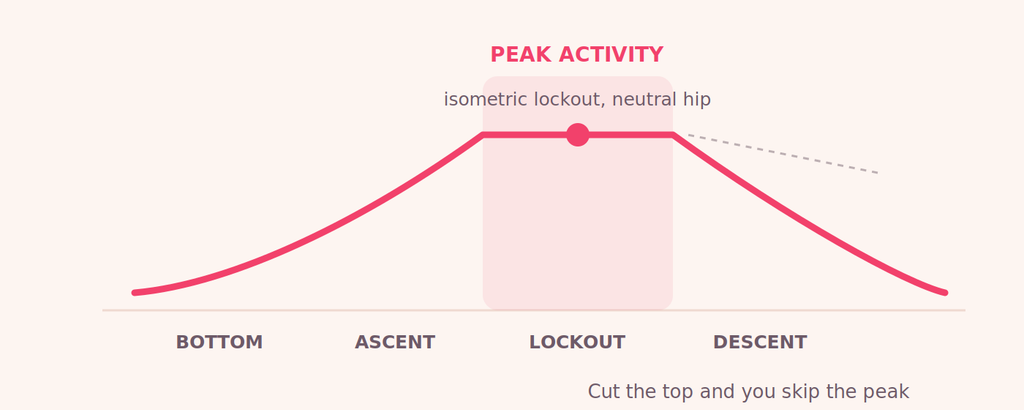 If you bounce the bottom and stop short at the top, you train every phase except the one that matters most.
Tracking activity across the phases of the movement, the hip thrust’s peak arrived during the isometric hold at neutral hip, not on the way up. Bounce the bottom and cut the top and you train everything except the part that counts.
| THE CUE I GIVE MOST Finish the rep, then finish it again. Most people believe they are locked out while their hips are still several degrees short. Pause at the top for a full count with ribs down and you will find the glutes without changing anything else.Quads instead means your feet are too far forward. Lower back means you are hyperextending rather than extending. Full setup detail in how to do a barbell hip thrust. |
Frequently asked questions
Do hip thrusts fix hip dips?
Hip dips come largely from pelvis shape and where your gluteus medius attaches, so no exercise removes them completely. Loaded abduction softens the look more than hip thrusts will, because hip thrusts train the wrong muscle for that area. More here: can you get rid of hip dips.
Are hip thrusts or squats better for glute growth?
Over nine weeks both produced similar gluteus maximus growth, but the squat also grew the quads and adductors while the hip thrust did not. For glute growth without added thigh size, the hip thrust is the more targeted choice.
How many sets of hip thrusts should I do per week?
Most people progress well on 6 to 12 hard working sets across two sessions, adding weight or reps over time. Past that, extra volume usually buys fatigue rather than growth.
Do I need to hip thrust at all to build glutes?
No, hip thrusts are one way to load hip extension, not a requirement. They are simply unusually good at it, loading the maximus through a full range without demanding much from your quads or lower back.
The bottom line
Hip thrusts are a gluteus maximus exercise. They load both the upper and lower maximus better than almost anything else, they let you use enormous weight, and they do it without adding size to your thighs. What they do not do is grow your gluteus medius, and nine weeks of MRI data says so plainly.So stop asking one lift to do two jobs. Keep the hip thrust as your hip extension anchor, progress it hard, and put loaded abduction beside it as a separate working lift. The maximus gives you size. The medius gives you the shape most people are actually chasing. You need both, and no single movement will buy you both.