
| "I won't lift heavy, I'll get bulky. I just want to tone." Lifting won't make you bulky by accident. And "toning" is just building a little muscle while losing fat. |
Almost every woman has heard it: lift weights and you'll get big and bulky, so stick to light dumbbells and long cardio to "tone". It is one of the most common fears in fitness, and it does not hold up. Getting bulky takes years of hard, heavy training, plenty of food, and a hormone level most women do not have. Here is what really happens when a woman lifts.
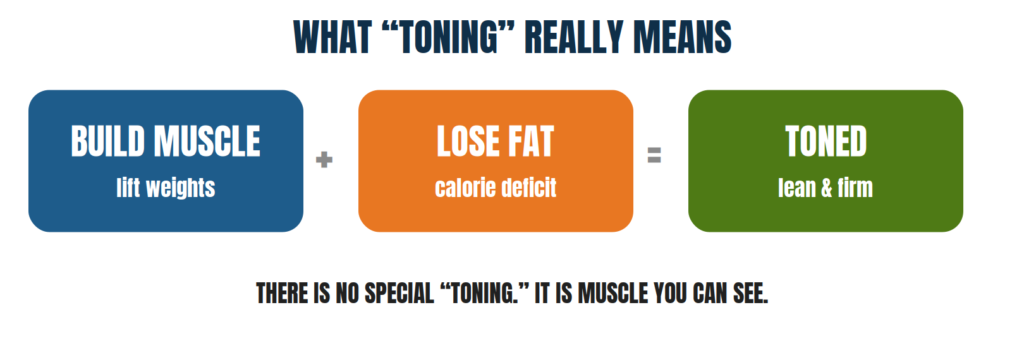
| MEET THE PLAYERS: TWO WORDS, ONE TRUTH Bulky = a lot of muscle, built on purpose over years, with heavy training and lots of food. Toned = a normal amount of muscle plus low enough body fat to see its shape. There is no special "toning". Toned is muscle you can see. You build it by lifting and losing fat, the exact things you were told to avoid. |
PART 1: Why women don't "bulk up"
The main muscle-building hormone is testosterone. After puberty, men's blood testosterone is more than 15 times that of women, at any age (Handelsman 2018). The same review describes a clear link between testosterone and muscle mass. That is a big reason most women do not build large muscles by accident. Women can build muscle, and should. It just comes slowly.
PART 2: Women respond to lifting, they just don't balloon
Here is the good news. When women and men follow the same programme, their muscles grow by about the same percentage (Refalo 2025, 29 studies). In a review of 17 studies, women gained upper-body strength faster than men, mostly in people new to training (Roberts 2020).
Men gained slightly more muscle in absolute terms, mostly in the upper body, because they start with more (Refalo 2025). So lifting works well for you. It just will not turn you into a bodybuilder.
PART 3: "Toning" is building muscle plus losing fat
That lean, firm, "toned" look is not a special kind of exercise. It is muscle, built by lifting, shown by lower body fat from a calorie deficit. See our guides on weight loss vs fat loss and burning fat vs losing fat.
Can you build muscle and lose fat at the same time? Some people can. In one trial, young men on a large calorie deficit, with high protein and hard training 6 days a week, gained lean mass while losing fat (Longland 2016). It was a short study in men, so treat it as possible, not promised.
BY THE NUMBERS
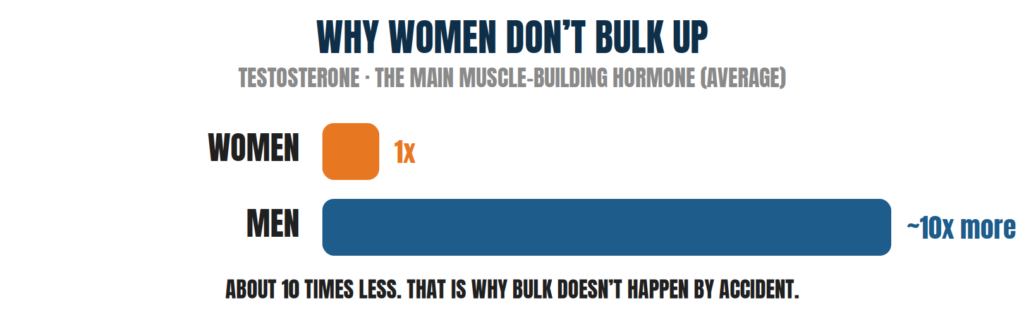
Average difference in testosterone, the main muscle-building hormone. The real gap is larger than this chart shows: more than 15 times (Handelsman 2018).
AT A GLANCE: LIFT WITHOUT FEAR
| Do this | Why |
|---|---|
| Lift challenging weights | Builds the shape ("tone") you want. |
| Don't fear going heavy | Women build muscle slowly, not by accident. Testosterone is more than 15 times lower than in men. |
| Lose fat to reveal it | A calorie deficit uncovers the muscle underneath. |
| Eat enough protein | About 1.6 grams per kilogram of body weight per day was enough for most people who lift, in a large review (Morton 2018). |
| Be consistent and patient | Muscle grows slowly. Judge your progress over months, not weeks. |
| BOTTOM LINE Lifting will not make you bulky by accident. It will make you stronger and shaped, which is what "toned" means: muscle you built plus fat you lost. The bulky look takes years of dedicated effort. |
REFERENCES
- Handelsman DJ, Hirschberg AL, Bermon S. Circulating testosterone as the hormonal basis of sex differences in athletic performance. Endocr Rev. 2018;39(5):803-829. doi:10.1210/er.2018-00020
- Refalo MC, Nuckols G, Galpin AJ, Gallagher IJ, Hamilton DL, Fyfe JJ. Sex differences in absolute and relative changes in muscle size following resistance training in healthy adults: a systematic review with Bayesian meta-analysis. PeerJ. 2025;13:e19042. doi:10.7717/peerj.19042
- Roberts BM, Nuckols G, Krieger JW. Sex differences in resistance training: a systematic review and meta-analysis. J Strength Cond Res. 2020;34(5):1448-1460. doi:10.1519/JSC.0000000000003521
- Longland TM, Oikawa SY, Mitchell CJ, Devries MC, Phillips SM. Higher compared with lower dietary protein during an energy deficit combined with intense exercise promotes greater lean mass gain and fat mass loss: a randomized trial. Am J Clin Nutr. 2016;103(3):738-746. doi:10.3945/ajcn.115.119339
- Morton RW, Murphy KT, McKellar SR, et al. A systematic review, meta-analysis and meta-regression of the effect of protein supplementation on resistance training-induced gains in muscle mass and strength in healthy adults. Br J Sports Med. 2018;52(6):376-384. doi:10.1136/bjsports-2017-097608