
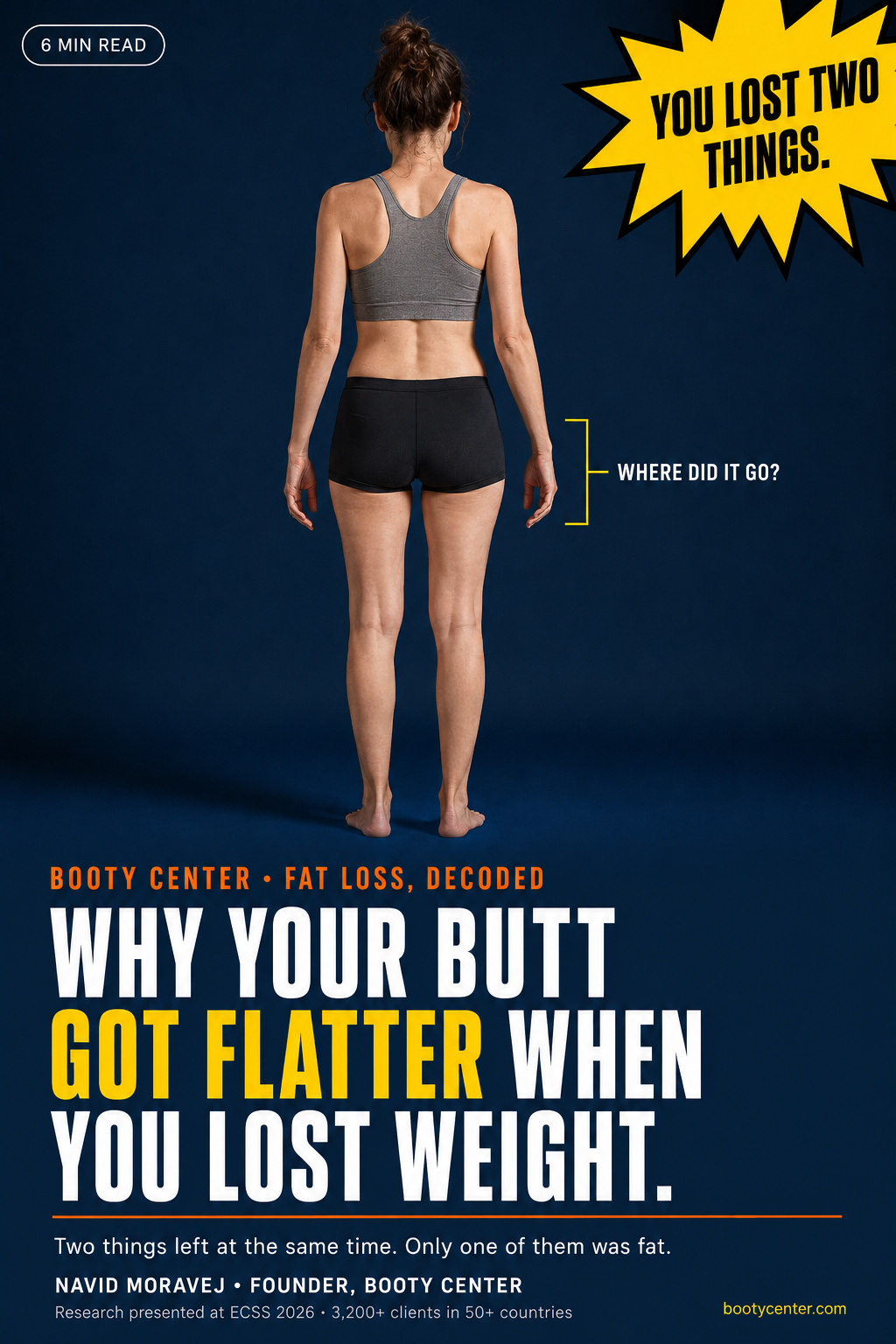
You did the hard thing. Months of eating less, months of consistency, and the scale finally moved. Then you turned sideways in a mirror and your butt had gone with it. It is the most common complaint we hear from people who succeeded, and almost everyone draws the wrong conclusion from it. You did not fail. Two things left at the same time, and only one of them was fat.
"I lost weight and my butt disappeared, so the squats must not have been working."
What actually left
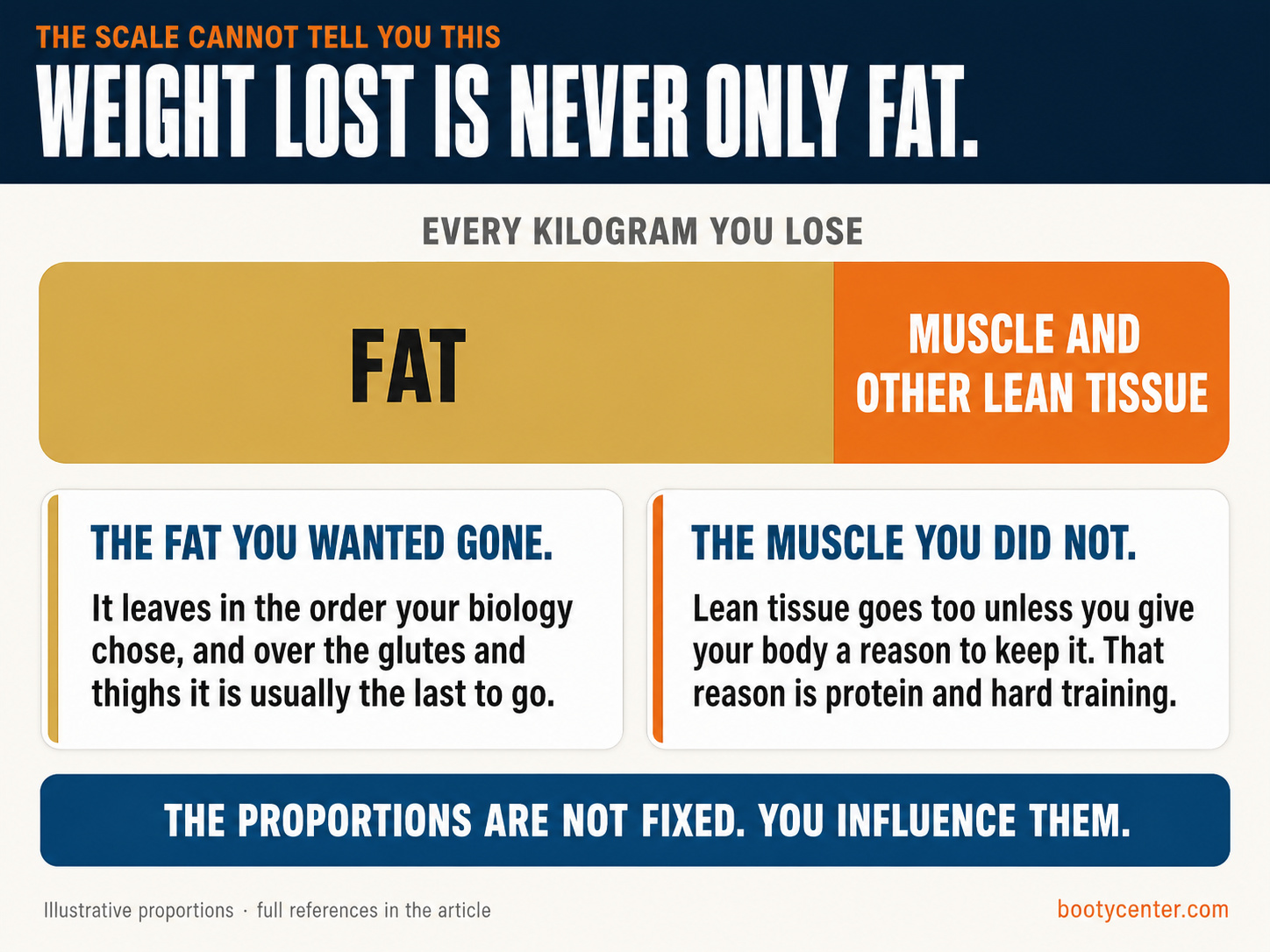 The scale weighs everything and identifies nothing.
Weight is not one substance. When your body runs a deficit, it draws on fat, and it also draws on lean tissue, which includes muscle. Every kilogram on the scale is a mixture, and the mixture is not fixed. It is also where the difference between burning fat and losing fat disappears from view.
That is the part almost nobody is told. People are given a number to chase and no information about what it is made of. The scale cannot tell you, because the scale weighs everything and identifies nothing. The same problem shows up everywhere else on your body.
So a person can lose 10 kilograms, be delighted for a week, and then notice the shape they wanted most has gone flat. Both things are true at once. The fat left, and so did some of what was holding the shape up.
The proportions are not fixed, and that is the useful part. How much of your loss comes from lean tissue depends on how steep the deficit is, how much protein you eat, and whether you are giving your muscles any reason to stay. Those are all things you decide.
Why the butt takes the hit
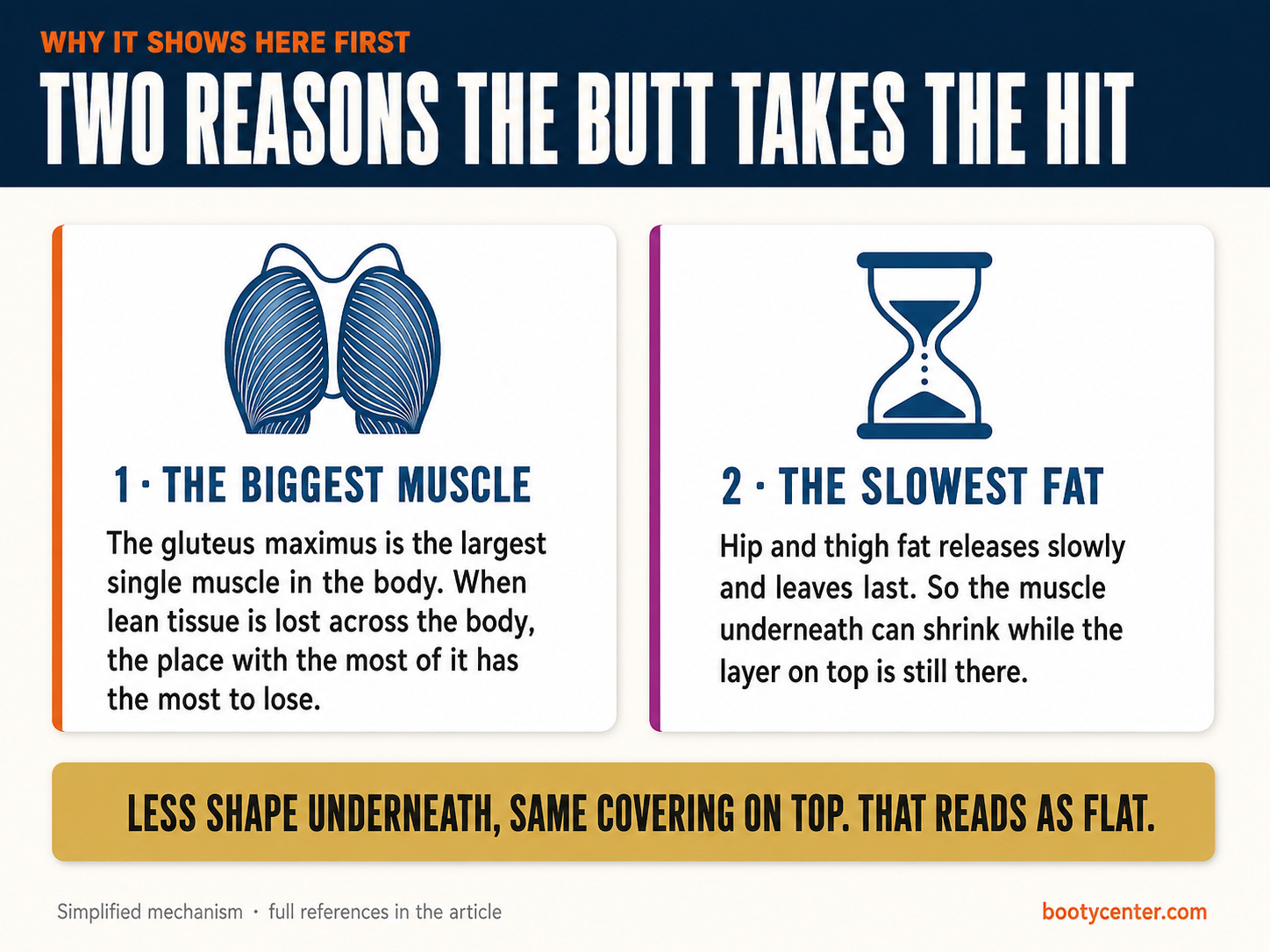 Less shape underneath, same covering on top.
Two things make the glutes the place where this shows up first.
The first is size. The gluteus maximus is the largest single muscle in your body. When lean tissue comes off across the whole body, the region carrying the most of it has the most to lose in absolute terms.
The second is timing, and it is the cruel part. Hip and thigh fat releases slowly and leaves last. Measured directly, the fatty acid release from the leg in response to your body’s own signals is lower in women than in men, while release from the upper body is much the same in both [1].
Put those together and you get the exact experience people describe. The muscle underneath shrinks while the covering on top is still there. Less shape below, same layer above. That reads in a mirror as flat , and flatness is one of the visible signs of weak glutes.
There is a third thing working against your eyes. The fat you can pinch is the slower half of fat loss overall. Across 89 studies covering diet, exercise, drugs and surgery, the deep fat around the organs fell by a larger percentage than the layer under the skin, every time [2]. Your bloodwork improved before your mirror did.
Coach's tip
This is why a hard diet can feel like it made you look worse while making you healthier. Both are happening. Neither cancels the other.
Muscle loss in a deficit is not automatic
Here is the finding that should change how you diet.
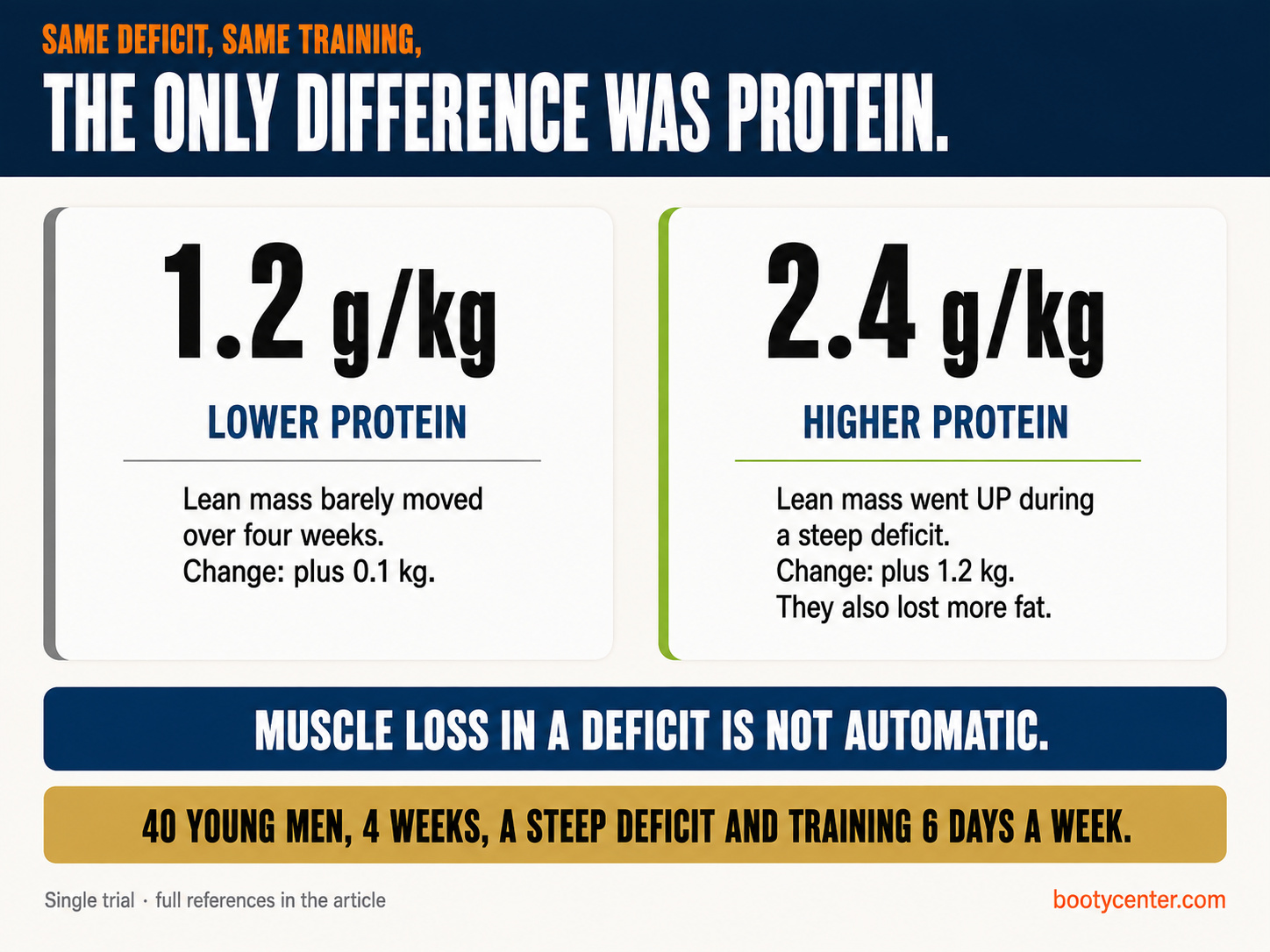 Same deficit, same training. The only difference was protein.
Forty young men spent four weeks in a steep energy deficit, around 40 percent below their requirements, training six days a week. Half ate 1.2 grams of protein per kilogram of body weight. Half ate 2.4 grams. Everything else was the same.
The lower protein group finished with lean mass essentially unchanged, up 0.1 kilograms. The higher protein group gained lean mass, up 1.2 kilograms, during a steep deficit. They also lost more fat, 4.8 kilograms against 3.5 [3].
Read that again. In a punishing deficit, with enough protein and enough training, the muscle did not go. It grew.
Notice what the trial did not change. Both groups were equally hungry, equally tired, and doing identical sessions. The deficit was not the villain. What separated the two outcomes was what they ate and the fact that they trained at all.
The debate
The honest limits. These were 40 young men, over four weeks, training six days a week under controlled feeding. That is not a woman training three times a week and eating normally, and four weeks is short. What this trial establishes is that muscle loss in a deficit is not inevitable and that protein and training are the levers. It does not promise you will gain muscle while dieting.
So how much protein? A review of 49 studies covering 1,863 people found that going beyond roughly 1.6 grams per kilogram per day added nothing further to lean mass gains from training [4]. That is the number worth aiming at. More is not better, it is just more expensive.
Why you cannot fix this by dieting harder
The instinct, when the shape is not there, is to keep cutting. That instinct is exactly backwards.
Fat is not the shape. Fat sits on top of the shape. What gives a butt its projection is the gluteus maximus underneath, and no amount of eating less will build it. A deficit can only remove things.
This is also why you cannot choose where the fat goes from. Each fat zone carries its own mix of receptors and answers hormones differently, which is why the order is set for you and the total is not [5]. You can influence how much leaves. You cannot influence where.
But you can decide exactly where muscle goes. Every rep lands on the muscle you chose. That half is entirely yours.
It is worth sitting with how unusual that is. Almost nothing about your body’s fat distribution takes instruction. Muscle takes instruction every single session, in exactly the place you point it.
Getting it back
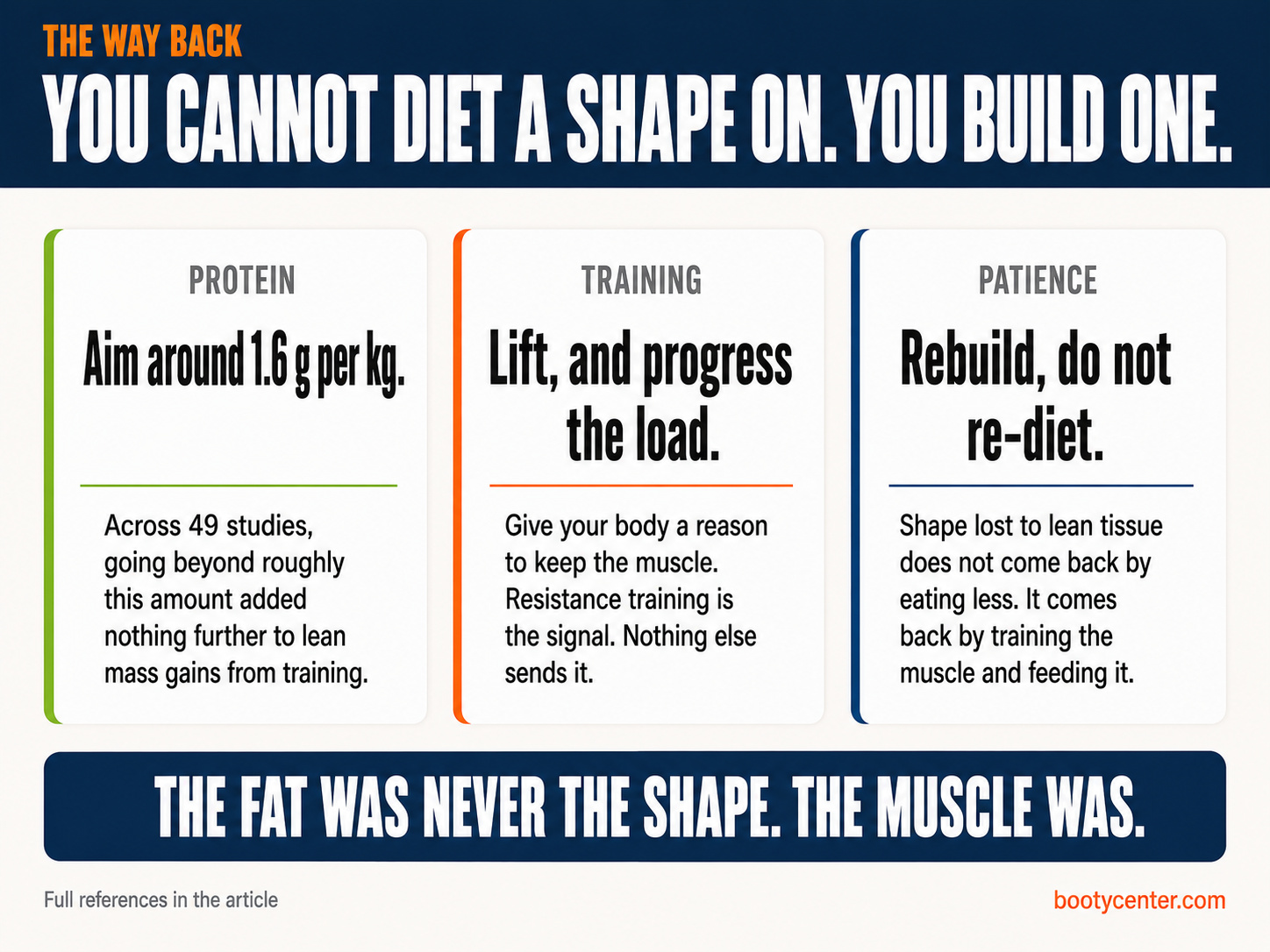 You cannot diet a shape on. You build one.
Rebuilding is a different job from dieting, and it needs different behaviour.
Eat enough protein. Around 1.6 grams per kilogram, spread across the day. This is the lever with the most evidence behind it.
Lift, and add load over time. Resistance training is the signal that tells your body the muscle is worth keeping and worth building. Nothing else sends that signal. In a trial that scanned people before and after nine weeks, both squats and hip thrusts grew the gluteus maximus across its upper, middle and lower regions [6]. Nine weeks, measured.
Stop re-dieting. Shape lost to lean tissue does not come back by eating less again. If you respond to a flat butt with another deficit, you will take more of the thing you are trying to get back. Start with the four movements that matter.
Key takeaway
The fat was never the shape. The muscle was.
Flat butt after weight loss FAQs
Why did my butt get flat after losing weight?
Because two things left together. Fat came off, and so did some lean tissue, and the gluteus maximus is the largest muscle you have, so it has the most to lose. Meanwhile hip and thigh fat leaves last, so the covering stayed while the shape underneath shrank.
Can you lose weight without losing your butt?
Largely, yes. In one trial, men in a steep deficit who ate 2.4 grams of protein per kilogram and trained hard gained lean mass rather than losing it. Protein and resistance training are the levers. Neither is optional if you want to keep your shape.
How much protein do I need to keep muscle while dieting?
A review of 49 studies found no further gains in lean mass beyond about 1.6 grams per kilogram of body weight per day. Aim near there, spread across your meals. Going higher has not been shown to add anything for most people.
Will squats bring my butt back after weight loss?
They will build the muscle, which is what creates the shape. In a nine week trial, squats and hip thrusts both grew the gluteus maximus across all three of its regions. That takes months rather than weeks, and it requires adding load over time.
Should I stop dieting to get my glutes back?
Building muscle and running a deep deficit pull against each other. If the shape matters more than the number right now, eat at or near maintenance with enough protein and train hard. You cannot subtract your way to a shape.
Why does my butt look flat but the scale says I lost fat?
Both can be true. The scale weighs everything and identifies nothing. You may have lost fat and lean tissue together, and the fat over your glutes is the slowest to go, so the covering remains while the muscle beneath it has shrunk.
References
- Blaak E. Gender differences in fat metabolism. Curr Opin Clin Nutr Metab Care. 2001;4(6):499-502.
- Merlotti C, Ceriani V, Morabito A, Pontiroli AE. Subcutaneous fat loss is greater than visceral fat loss with diet and exercise, weight-loss promoting drugs and bariatric surgery: a critical review and meta-analysis. Int J Obes (Lond). 2017;41(5):672-682.
- Longland TM, Oikawa SY, Mitchell CJ, Devries MC, Phillips SM. Higher compared with lower dietary protein during an energy deficit combined with intense exercise promotes greater lean mass gain and fat mass loss: a randomized trial. Am J Clin Nutr. 2016;103(3):738-746.
- Morton RW, Murphy KT, McKellar SR, Schoenfeld BJ, Henselmans M, Helms E, et al. A systematic review, meta-analysis and meta-regression of the effect of protein supplementation on resistance training-induced gains in muscle mass and strength in healthy adults. Br J Sports Med. 2018;52(6):376-384.
- Karastergiou K, Smith SR, Greenberg AS, Fried SK. Sex differences in human adipose tissues – the biology of pear shape. Biol Sex Differ. 2012;3(1):13.
- Plotkin DL, Rodas MA, Vigotsky AD, McIntosh MC, Breeze E, Ubrik R, et al. Hip thrust and back squat training elicit similar gluteus muscle hypertrophy and transfer similarly to the deadlift. Front Physiol. 2023;14:1279170.