
Search this question and you will be handed ab exercises, a list of fat-burning foods, and a supplement. None of those three things has been shown to remove fat from your abdomen. This article is the short list of what has, and it is five items long. Every one of them has a study behind it, and none of them targets your belly, which turns out to be the whole point.
| “Do these five exercises to burn belly fat.” |
The short answer
You lose belly fat by losing body fat, and you lose body fat by holding a calorie deficit you can actually sustain. Everything else on the list changes how much you lose, how fast, and crucially what you lose, but nothing replaces the deficit.
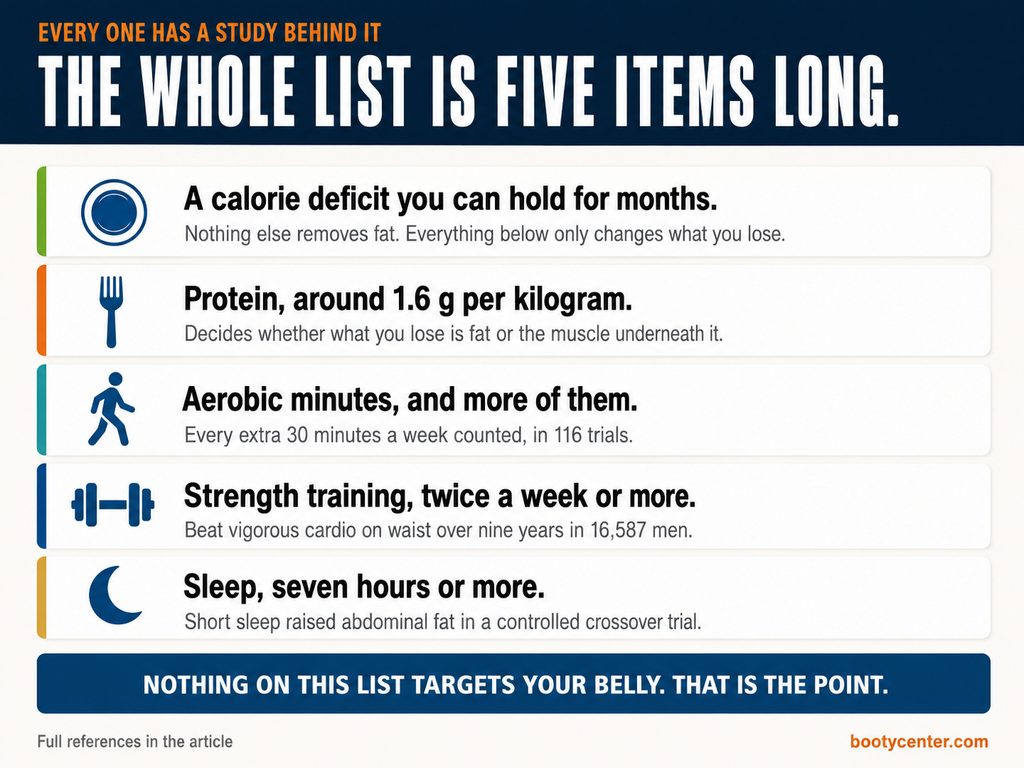 The whole evidence-backed list is five items long.
Why nothing on this list targets your belly
This is the part that makes people close the tab, so it is worth being direct about it.
You cannot choose where fat leaves your body. Training a body part does not reduce the fat covering it. That has been tested repeatedly for decades, including studies where people trained one arm or one leg for twelve weeks and left the other alone. Pooling 13 of those studies across 1,158 people, the combined effect was zero [1]. Six weeks of daily abdominal training changed abdominal fat by nothing at all [2].
Your genes and hormones set the order fat leaves in. Your deficit sets the amount [3].
There is one piece of good news buried in this. The deep fat around your organs, which is the fat that actually matters for your health, comes off faster than the layer you can pinch. Across 89 studies covering diet, exercise, drugs and surgery, the percentage drop in visceral fat was always larger than the drop in subcutaneous fat [4]. Your health improves before your mirror does. More on why the belly is first on and last off.
1. A calorie deficit you can hold for months
Nothing else on this page removes fat. This one does, and it is the only one that does.
We are deliberately not printing a calorie target. The right deficit is the one you can hold for months without your life falling apart, and the honest reason to keep it moderate is on this page already: steeper deficits cost you more lean tissue, and lean tissue is the thing holding your shape up.
If you take one number from this section, make it a timeframe rather than a calorie figure. Judge this in months.
What a sustainable deficit looks like in practice is unglamorous. Slightly smaller portions of the things you already eat, rather than a new diet with rules you will resent by February. The people who succeed at this are rarely the ones who started hardest. They are the ones who picked something they could still be doing in six months, and then were still doing it in six months.
There is one more reason to keep it moderate that most articles skip. A steep deficit does not only cost you more muscle, it makes every other item on this list harder. You train worse, you sleep worse, and you are hungrier, which is exactly when people abandon the whole thing and conclude it did not work.
2. Protein, around 1.6 grams per kilogram
The deficit decides how much you lose. Protein has a large say in what.
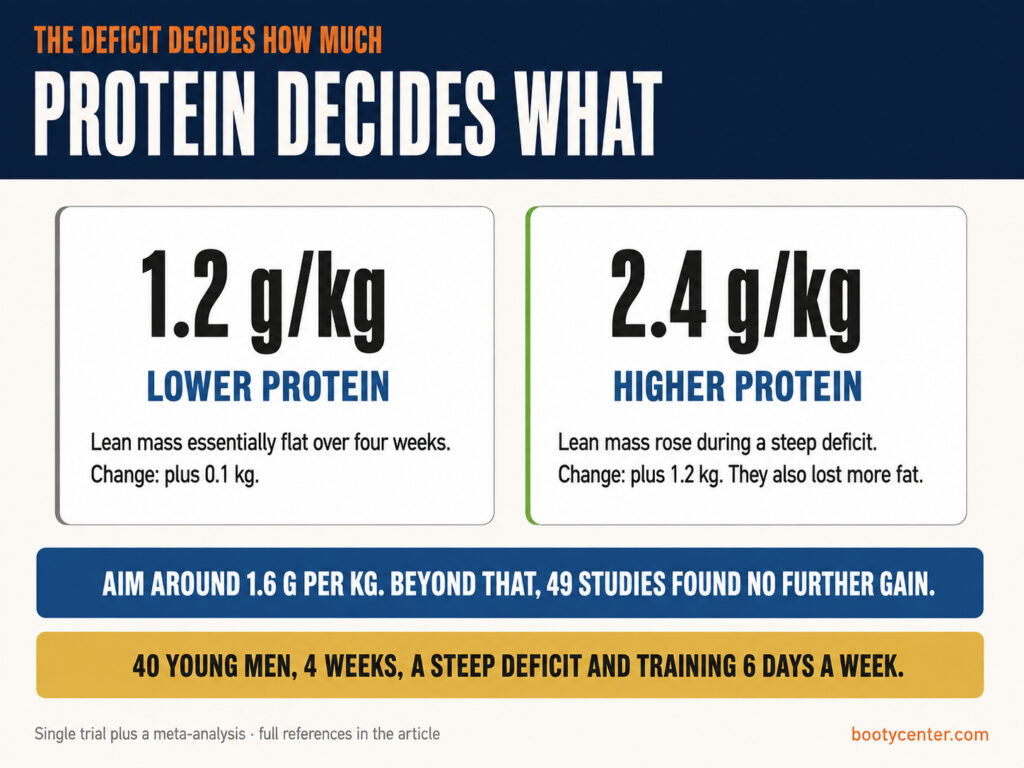 The deficit decides how much. Protein decides what.
Forty young men spent four weeks in a steep deficit, about 40 percent below their needs, training six days a week. One group ate 1.2 grams of protein per kilogram of body weight, the other 2.4. The lower group ended with lean mass essentially unchanged, up 0.1 kilograms. The higher group gained lean mass, up 1.2 kilograms, in a steep deficit, and lost more fat as well, 4.8 kilograms against 3.5 [5].
That is one short trial in young men training six days a week, so read it as proof that muscle loss is not automatic rather than as a promise about your own four weeks.
How much is enough? A review of 49 studies covering 1,863 people found that going beyond roughly 1.6 grams per kilogram per day added nothing further to lean mass gains from training [6]. Aim near that. More is not better.
3. Aerobic minutes, and more of them
This is where the evidence got a great deal stronger recently, and where most advice is still vague.
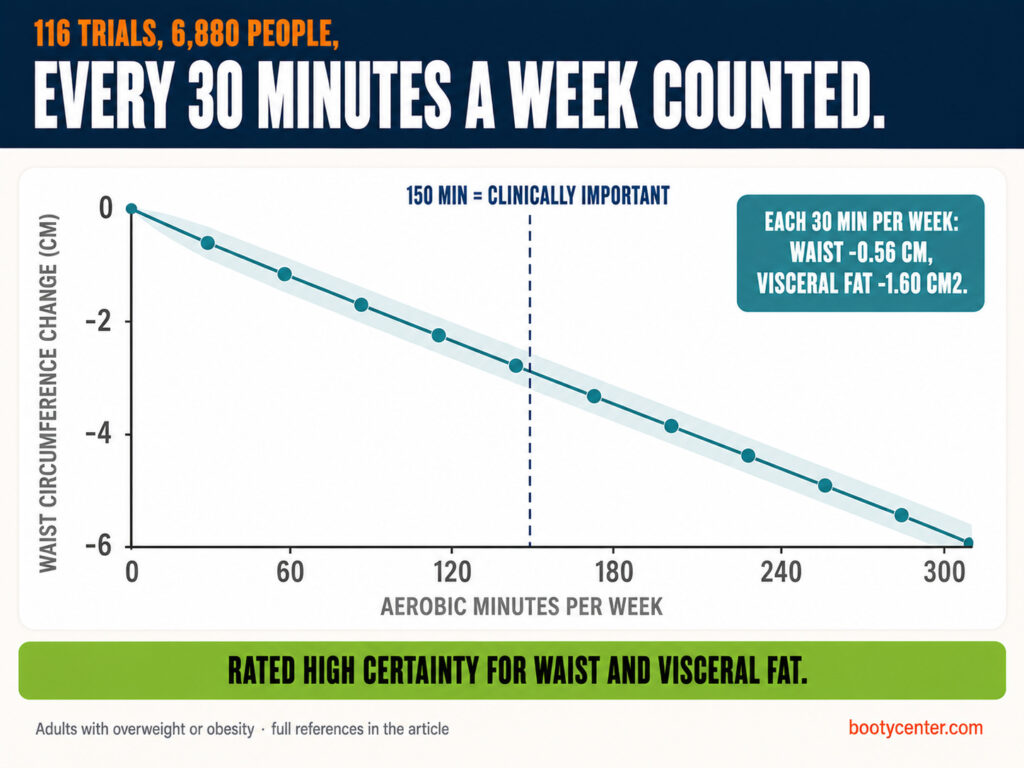 Every extra 30 minutes a week counted, across 116 trials.
A 2024 meta-analysis pooled 116 randomised trials covering 6,880 adults. Every additional 30 minutes of aerobic exercise per week was associated with waist circumference down 0.56 centimetres and visceral fat area down 1.60 square centimetres. Both of those were rated high certainty, which is as strong as this field gets [7].
Two things make that finding unusually useful. It is a dose-response relationship rather than a threshold, so every extra half hour a week is worth something. And the effect kept going up to 300 minutes a week, with 150 minutes at moderate to vigorous intensity producing what the authors called clinically important reductions in waist and body fat [7].
Brisk walking counts. It does not have to be running and it does not have to hurt.
That last point matters more than it sounds. A lot of people read “cardio” as high intensity intervals and then do nothing, because the version in their head is unpleasant and they cannot face it three times a week. The trials pooled here used supervised aerobic training of many kinds. Total weekly minutes is the variable that moved the needle.
4. Strength training
Most belly fat advice treats lifting as optional. A nine year study of 16,587 men suggests it should not be.
Adding half an hour or more of weight training per week was linked to about 0.91 centimetres less waist gain over those nine years. Increasing vigorous activity was linked to 0.38 centimetres. Weight training came out ahead of vigorous cardio for the waist in the same men, in the same study [8].
There is a second reason, and it is the one this brand cares about. Fat is not your shape. Fat sits on top of your shape. Muscle is the half you can aim exactly, and it is the half that is still there when the fat layer thins.
This is also insurance against the most common disappointment in fat loss. People arrive at their target weight and find they do not like how they look, because they removed the covering without building anything underneath it. Lifting during the deficit is what prevents that outcome, and it is far easier than trying to rebuild afterwards.
5. Sleep, seven hours or more
This is the lever people treat as optional, and it has a controlled experiment behind it.
Twelve healthy adults spent two weeks sleeping four hours a night and two weeks sleeping nine, with free access to food. On the short nights they ate more and burned the same. Total body fat did not differ between the two conditions. Abdominal fat rose only during the short sleep phase, in both the deep and the pinchable layers [9].
Small study, tightly controlled, and it points the same way as everything else in the sleep literature. Fix this before you buy anything.
What does not work
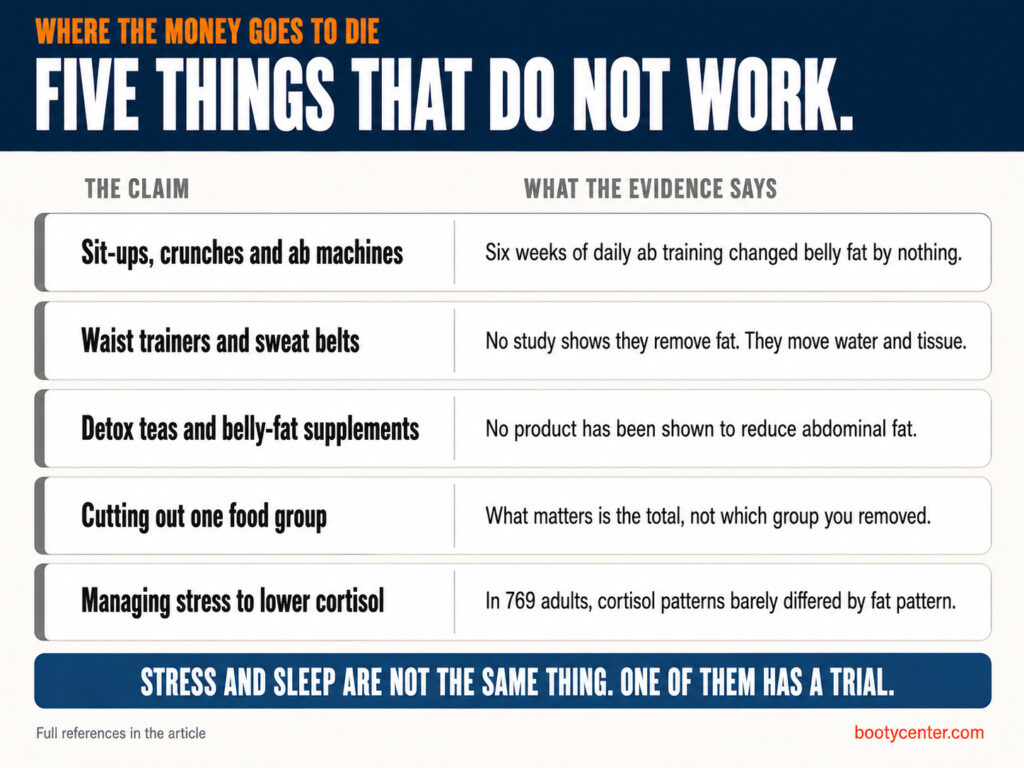 Five things that do not work, and why.
Ab exercises build the muscle wall between the two fat layers. They do not remove either one.
Waist trainers and sweat belts move water and compress tissue. No study shows them removing fat.
No supplement or tea has been shown to reduce abdominal fat.
Cutting one food group works only if it puts you in a deficit. The group you removed is not the mechanism.
And the cortisol story deserves its own line, because it is everywhere. In 769 older adults, cortisol patterns barely differed between people carrying general fat and people carrying abdominal fat, and the authors concluded their findings did not support a cortisol driven cause of obesity [10].
| THE DEBATE Be careful with what we just said. Stress and sleep get bundled together constantly and they are not the same claim. Poor sleep has a controlled trial showing it raises abdominal fat. The specific claim that stress hormones park fat on your waist does not have equivalent support. Manage stress for the many good reasons to manage stress. Do not expect it to be a fat loss lever. |
What one week actually looks like
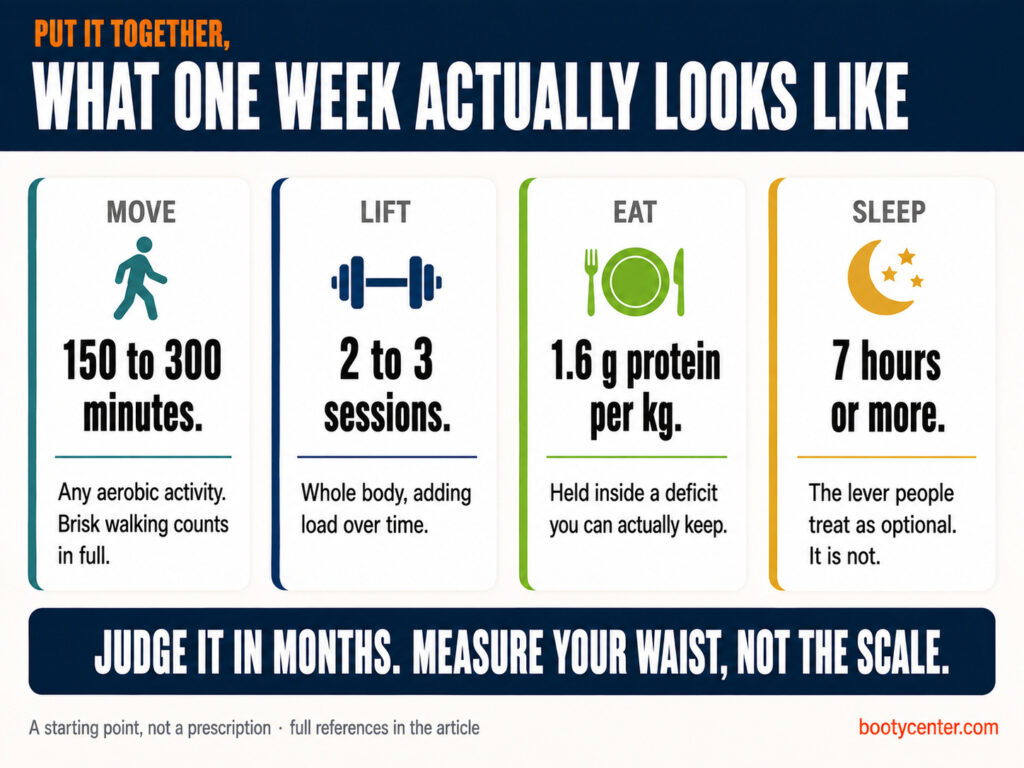 A starting point, not a prescription.
Nothing here is exotic and that is deliberate. Aerobic movement of 150 to 300 minutes, two or three whole-body strength sessions, protein near 1.6 grams per kilogram inside a deficit you can keep, and seven hours of sleep or more.
If you are starting from nothing, start with the aerobic minutes and the sleep. Both are free and both have high quality evidence. Add the lifting when the first two are habits.
| COACH’S TIP Do not start all five at once. People who change everything on a Monday are usually back to changing nothing by the third week. Pick the two you can hold and add from there. |
How to track it
Use a tape measure at navel level, once a week, same time of day. The waist is the measure the research uses, and it moves when the scale does not.
Take a photo once a month in the same light and the same place. Change at the middle is slow, and slow change is invisible day to day and obvious month to month.
Judge four weeks at a time. Food volume, salt and fluid swing daily numbers far more than fat does.
| KEY TAKEAWAY Nothing on this list targets your belly. That is why it works. |
How to lose belly fat: FAQs
What is the fastest way to lose belly fat?
There is no fast way that is also a lasting one. Belly fat leaves as part of total fat loss, driven by a calorie deficit held over months. Steep deficits cost you more lean tissue, which flattens your shape, so faster is often worse for how you end up looking.
Do ab exercises burn belly fat?
No. Six weeks of daily abdominal training changed abdominal fat by nothing in one trial, and one-arm and one-leg studies have shown the same for decades. Ab work builds the muscle wall sitting between the two fat layers. It does not remove either of them.
How much cardio should I do to lose belly fat?
More is better up to about 300 minutes a week. Across 116 trials, every extra 30 minutes weekly was linked to 0.56 centimetres off the waist, and 150 minutes at moderate to vigorous intensity produced clinically important reductions. Brisk walking counts in full.
How much protein do I need?
Around 1.6 grams per kilogram of body weight per day. A review of 49 studies found no further gains in lean mass beyond roughly that amount. Protein does not remove fat, but it strongly influences whether what you lose is fat or muscle.
Does stress cause belly fat?
The cortisol version of this claim is weaker than it sounds. In 769 adults, cortisol patterns barely differed between those carrying general and abdominal fat. Poor sleep, by contrast, does measurably raise abdominal fat in controlled conditions. Fix sleep first.
Do waist trainers or fat burners work?
No. Waist trainers compress tissue and temporarily move water, and no supplement or tea has been shown to reduce abdominal fat in humans. If any product genuinely worked, the trials demonstrating it would be among the most cited papers in the field. Those papers do not exist.
Why is my belly the last place to change?
Because your genes and hormones set the order fat leaves, and the layer you can pinch is the slower half of fat loss. Across 89 studies, deep fat around the organs dropped by a larger percentage than the fat under the skin, every single time.
How long does it take to lose belly fat?
Months, not weeks, and the honest answer depends on your deficit and starting point. Measure your waist weekly rather than your weight, photograph monthly, and judge four weeks at a time. Anyone promising a timeframe without knowing you is guessing.
References
- Ramirez-Campillo R, et al. A proposed model to test the hypothesis of exercise-induced localized fat reduction (spot reduction), including a systematic review with meta-analysis. Hum Mov. 2022;23(3):1-14.
- Vispute SS, Smith JD, LeCheminant JD, Hurley KS. The effect of abdominal exercise on abdominal fat. J Strength Cond Res. 2011;25(9):2559-2564.
- Karastergiou K, Smith SR, Greenberg AS, Fried SK. Sex differences in human adipose tissues – the biology of pear shape. Biol Sex Differ. 2012;3(1):13.
- Merlotti C, Ceriani V, Morabito A, Pontiroli AE. Subcutaneous fat loss is greater than visceral fat loss with diet and exercise, weight-loss promoting drugs and bariatric surgery: a critical review and meta-analysis. Int J Obes (Lond). 2017;41(5):672-682.
- Longland TM, Oikawa SY, Mitchell CJ, Devries MC, Phillips SM. Higher compared with lower dietary protein during an energy deficit combined with intense exercise promotes greater lean mass gain and fat mass loss: a randomized trial. Am J Clin Nutr. 2016;103(3):738-746.
- Morton RW, Murphy KT, McKellar SR, Schoenfeld BJ, Henselmans M, Helms E, et al. A systematic review, meta-analysis and meta-regression of the effect of protein supplementation on resistance training-induced gains in muscle mass and strength in healthy adults. Br J Sports Med. 2018;52(6):376-384.
- Jayedi A, Soltani S, Emadi A, Zargar MS, Najafi A. Aerobic exercise and weight loss in adults: a systematic review and dose-response meta-analysis. JAMA Netw Open. 2024;7(12):e2452185.
- Koh-Banerjee P, Chu NF, Spiegelman D, Rosner B, Colditz G, Willett W, Rimm E. Prospective study of the association of changes in dietary intake, physical activity, alcohol consumption, and smoking with 9-y gain in waist circumference among 16,587 US men. Am J Clin Nutr. 2003;78(4):719-727.
- Covassin N, Singh P, McCrady-Spitzer SK, St Louis EK, Calvin AD, Levine JA, Somers VK. Effects of experimental sleep restriction on energy intake, energy expenditure, and visceral obesity. J Am Coll Cardiol. 2022;79(13):1254-1265.
- Ladwig KH, Schriever SC, Atasoy S, Bidlingmaier M, Kruse J, Johar H. Association of generalized and central obesity with serum and salivary cortisol secretion patterns in the elderly: findings from the cross sectional KORA-Age study. Sci Rep. 2020;10(1):14321.