A glute bridge is a lower body pull. It is a hip extension exercise, and hip extension is the joint action that defines pulling in the lower body, even though the coaching cue tells you to press through your heels. The confusion is real, and the biomechanics settle it in about four sentences.
The short answer
Pull. The glute bridge is a hip extension exercise, so it belongs with your pulling or hip dominant work, next to hip thrusts and deadlifts.
It feels like a push because your feet press into the floor. That sensation is ground reaction force, not the joint action.
Table of Contents
Is a glute bridge a push or pull exercise?
A glute bridge is classified as a lower body pull because the movement is hip extension. Push and pull describe joint actions, not what your feet feel, and hip extension sits on the pull side of that split alongside deadlifts, hip thrusts and Romanian deadlifts.
The reason this question keeps circulating is that the glute bridge sends mixed signals. Your feet press into the floor, which feels exactly like a leg press. Your glutes and hamstrings do the work, and those are the muscles everyone associates with pulling. So the sensation says push and the muscle group says pull.
| What it feels likePUSHFeet drive into the floor. Heels loaded. Same sensation as a leg press. Unreliable witness | What the joint doesPULLHip travels from flexion to extension. One joint, one action, hip extension. This is the classification |
Sensation and classification are answering two different questions.
The sensation is the unreliable witness. Every closed chain lower body exercise involves your feet pressing into something, including deadlifts, which nobody calls a push. Pressing into the floor is how you generate force in almost any grounded movement. It tells you nothing about which joint is doing the work.
Why nobody has answered this properly
Most pages ranking for this question never use the words push or pull at all. The general classification pages that do address it contradict themselves inside a single article: they file glute bridges under lower body push, then define lower body pull as hip extension with knee flexion, which is the literal description of a glute bridge.
What is the actual joint action in a glute bridge?
The glute bridge is hip extension performed against gravity with the knee held in a fixed flexed position. Your pelvis travels from a flexed hip position on the floor to a neutral or fully extended hip at the top.
The prime mover is the gluteus maximus. Anatomically, the gluteus maximus extends and externally rotates the thigh, and its principal everyday role is as the chief antigravity muscle in sitting, controlling and counteracting hip flexion. Everything about a glute bridge is that job under load.
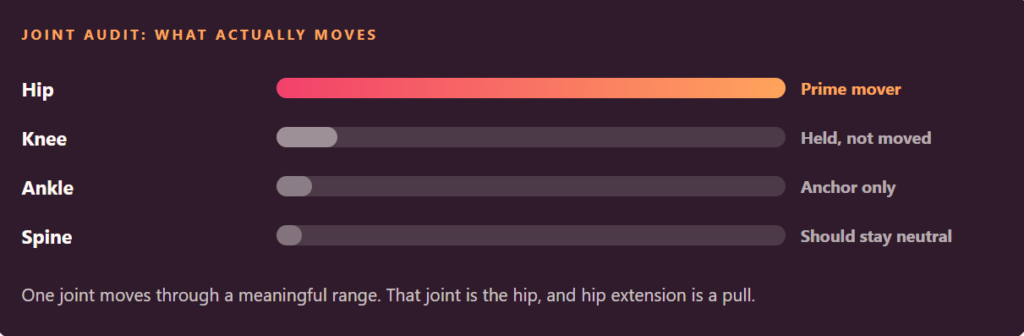
That is why classifying the glute bridge is simpler than the debate suggests. If a lift is defined by hip extension, it belongs with hip extension work. This is also why glute bridges cluster naturally with the other hip dominant patterns in a well built program. If you want the full framework, see how the four movements that build glutes are organised: how to train glutes.
Why does the push vs pull system break down in the lower body?
Push and pull is a load direction convention borrowed from upper body training, where the load visibly travels away from your torso or toward it. In a closed chain lower body exercise your feet are fixed and your pelvis is the segment that moves, so direction relative to the body stops being a usable test.
Think about the upper body cases where the system works perfectly. Bench press, the bar moves away from you, push. Row, the bar moves toward you, pull. The hands are free, the torso is anchored, and the direction is unambiguous.
| Where the label works, and where it collapses |
| Upper body: hands free, torso anchoredBench press moves the bar away from you. Row brings it toward you. Direction is obvious, so the label works. SYSTEM WORKS |
| Lower body: feet anchored, pelvis movesIn a glute bridge the load moves up, which is neither toward nor away from your torso. The test has no answer because it was never built for this shape of movement. SYSTEM BREAKS |
This is exactly why coaches who program seriously stopped using push and pull as the primary lower body sort. They use knee dominant versus hip dominant instead, which describes what is actually happening at the joints. Squats, leg presses and lunges are knee dominant. Glute bridges, hip thrusts, deadlifts and back extensions are hip dominant. That framework never produces a contradiction, and it maps cleanly onto push and pull when you need to translate: knee dominant behaves like a push, hip dominant behaves like a pull.
Why does a glute bridge feel like a push?
The glute bridge feels like a push because your foot presses into the floor, but that sensation is ground reaction force, not the joint action. The hip is closing behind you the entire time, and that is extension.
From the coaching floor
In my coaching, this is the single most common reason clients misfile the exercise. They feel their heels driving down, they hear “push through your heels,” and they conclude the whole lift is a push. What they are actually feeling is the anchor point, not the engine.
The cue I use to flip the perception is simple: stop pushing the floor away and start closing the hip. I ask the client to picture the top position first, glutes squeezed, hip fully extended, then work backwards to the floor. The moment they stop thinking about their feet and start thinking about their hip, two things change. The quads quiet down, and the glute contraction at the top gets noticeably sharper.
The heel pressure never goes away, and it should not. It is how you stay stable and transmit force. The mistake is treating the most obvious sensation as the definition of the exercise. Feel is a coaching tool, not a classification system.
Where does the glute bridge fit in a push, pull, legs split?
Put glute bridges on leg day, or on pull day if you run a strict push, pull, legs rotation. They belong with your hip extension work, not with your quad dominant pressing work.
If you train push, pull, legs, the practical answer is that glute bridges almost always live on leg day, because most people build leg day around both patterns. If you run the version where lower body work is split by pattern rather than lumped together, glute bridges go on pull day next to deadlifts and hamstring work.
| Exercise | Joint action | Prime mover | Chain | Classification |
|---|---|---|---|---|
| Glute bridge | Hip extension, knee fixed in flexion | Gluteus maximus | Closed | Pull, hip dominant |
| Hip thrust | Hip extension, longer range | Gluteus maximus | Closed | Pull, hip dominant |
| Romanian deadlift | Hip extension, knee near straight | Hamstrings and glutes | Closed | Pull, hip dominant |
| Back squat | Hip and knee extension | Quads and glutes | Closed | Push, knee dominant |
| Leg press | Hip and knee extension | Quads | Closed | Push, knee dominant |
| Leg curl | Knee flexion | Hamstrings | Open | Pull |
From the coaching floor
The programming reason this matters is recovery overlap, not semantics. I have seen clients running push, pull, legs with glute bridges parked on push day right after squats, then wondering why their glutes never recovered and never grew. Two heavy hip extension exposures separated by a single rest day is a fatigue problem, not a technique problem. Moving the bridges to sit with the rest of the hip dominant work usually fixes it inside a couple of weeks, because the glutes finally get a real recovery window between hard sessions.
If your lower back is the thing that keeps complaining after hip extension days, the split is not your problem. Read why you get lower back pain after hip thrusts first.
Is a hip thrust a push or pull exercise?
A hip thrust is a lower body pull, exactly like the glute bridge. Both are hip extension against resistance, and the hip thrust simply adds range of motion and load capacity by elevating your upper back.
The two lifts are close cousins, not the same exercise. The bench raises your torso, which puts your hip into deeper flexion at the bottom, so the glute travels through more range. That extra range is why the hip thrust becomes the loadable strength version while the bridge stays the accessible activation and volume version. The full breakdown is here: glute bridge vs hip thrust.
The activation data is striking. In a Journal of Applied Biomechanics study, barbell hip thrusts produced roughly double the gluteus maximus activation of back squats at matched relative loads.
Muscle activation, hip thrust vs back squat
Mean EMG as a percentage of maximum voluntary contraction, matched 10RM loads.
Upper gluteus maximus
- Hip thrust 69.5%
- Back squat 29.4%
Lower gluteus maximus
- Hip thrust 86.8%
- Back squat 45.4%
Vastus lateralis (quadriceps)
- Hip thrust 99.5%
- Back squat 110% (no significant difference)
The quiet finding: the squat did not out activate the hip thrust on quadriceps. If the hip thrust were really a leg press style push, it should have.
Read that last line again, because it quietly destroys the push argument. The lift is a hip extension movement with the quads acting as stabilisers, which is the profile of a pull. If you are ready to load it, start with how to do a barbell hip thrust.
Why does the glute bridge hit the glutes harder than the hamstrings?
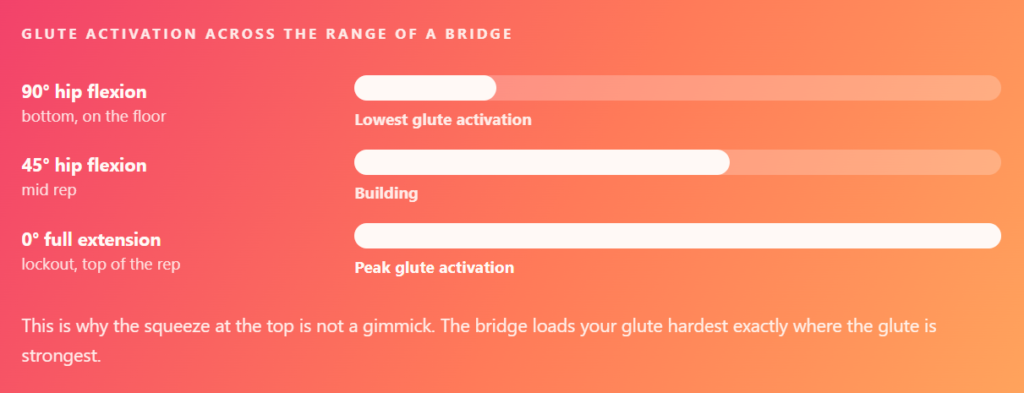
The bent knee shortens your hamstrings into active insufficiency, so they cannot contribute full hip extension torque, and the gluteus maximus has to take over. Glute activation is also highest near full hip extension, which is precisely where the top of a bridge puts you.
Both mechanisms are described in the same research. Gluteus maximus activation is lowest at 90 degrees of hip flexion and highest at 0 degrees, full extension, and because the knee stays bent throughout a bridge or thrust, the hamstrings are already shortened and cannot generate their usual share of hip extension force. The glute picks up the slack, at the exact joint angle where it is strongest.
From the coaching floor
This is the mechanism behind a complaint I hear constantly, which is hamstring cramping during bridges. When a client’s heels are parked too far from their glutes, the knee angle opens up, the hamstrings lengthen, and they start competing for the hip extension job. Sliding the heels closer usually resolves it in the same set. Same movement, same load, different muscle doing the work, purely because of knee angle.
That single detail is why the glute bridge earns its place. It is not just hip extension, it is hip extension engineered so the glute cannot hand the job off. Once you understand the mechanism, the single leg glute bridge becomes an obvious next progression rather than a random variation.
Does the push or pull label change how you should train?
No. The label is a scheduling tool, not a training variable. What actually changes your results is where your glute sits in its length tension curve, how much load you hold at lockout, and whether you are progressing that load over time.
I have watched more people stall from over engineering their split than from choosing the wrong one. The label tells you which day the exercise appears on. It does not tell you your rep range, your proximity to failure, your range of motion, or whether you added weight this month. Those four things decide whether your glutes grow.
Use the classification for what it is good for, which is building a schedule that lets each pattern recover. Then stop thinking about it and go add five kilos.
Frequently asked questions
Is a glute bridge a hip hinge?
Not quite. A hip hinge like a Romanian deadlift involves a large forward torso movement over a near straight knee, while a glute bridge keeps the knee bent and the torso in a fixed relationship to the pelvis, so it is better described as bent knee hip extension.
Can I do glute bridges on push day if that is how my program is written?
You can, and it will still build glutes, but check what else is on that day. If push day already includes squats or leg presses, you are stacking two heavy hip extension exposures close together and giving your glutes less recovery than they need.
Should I push through my heels or my toes?
Heels, or mid foot at the very least. Driving through the toes shifts the emphasis toward your quads and reduces the hip extension torque your glutes have to produce, which is the opposite of the point.
Is the glute bridge a compound or isolation exercise?
It sits in between, and most coaches call it a compound because it is a closed chain movement involving the hip and multiple muscle groups. Functionally it behaves more like a targeted hip extension exercise than a true multi joint compound such as a squat.
The bottom line
A glute bridge is a lower body pull, because it is a hip extension exercise and hip extension defines pulling in the lower body. The pushing sensation in your feet is ground reaction force, not the joint action, and the same logic applies to the hip thrust.
If the push and pull language keeps confusing you, drop it for the lower body and use hip dominant versus knee dominant instead. It never contradicts itself, it describes what your joints are actually doing, and it gives you a cleaner way to build a week of training. Then put your attention where it belongs: knee angle, range of motion, and load on the bar.
References
- Elzanie A, Borger J. Anatomy, Bony Pelvis and Lower Limb, Gluteus Maximus Muscle. StatPearls, National Library of Medicine, updated April 2023. ncbi.nlm.nih.gov/books/NBK538193
- Contreras B, Vigotsky AD, Schoenfeld BJ, Beardsley C, Cronin J. A Comparison of Gluteus Maximus, Biceps Femoris, and Vastus Lateralis Electromyographic Activity in the Back Squat and Barbell Hip Thrust Exercises. Journal of Applied Biomechanics, 2015;31(6):452-458. pubmed.ncbi.nlm.nih.gov/26214739