
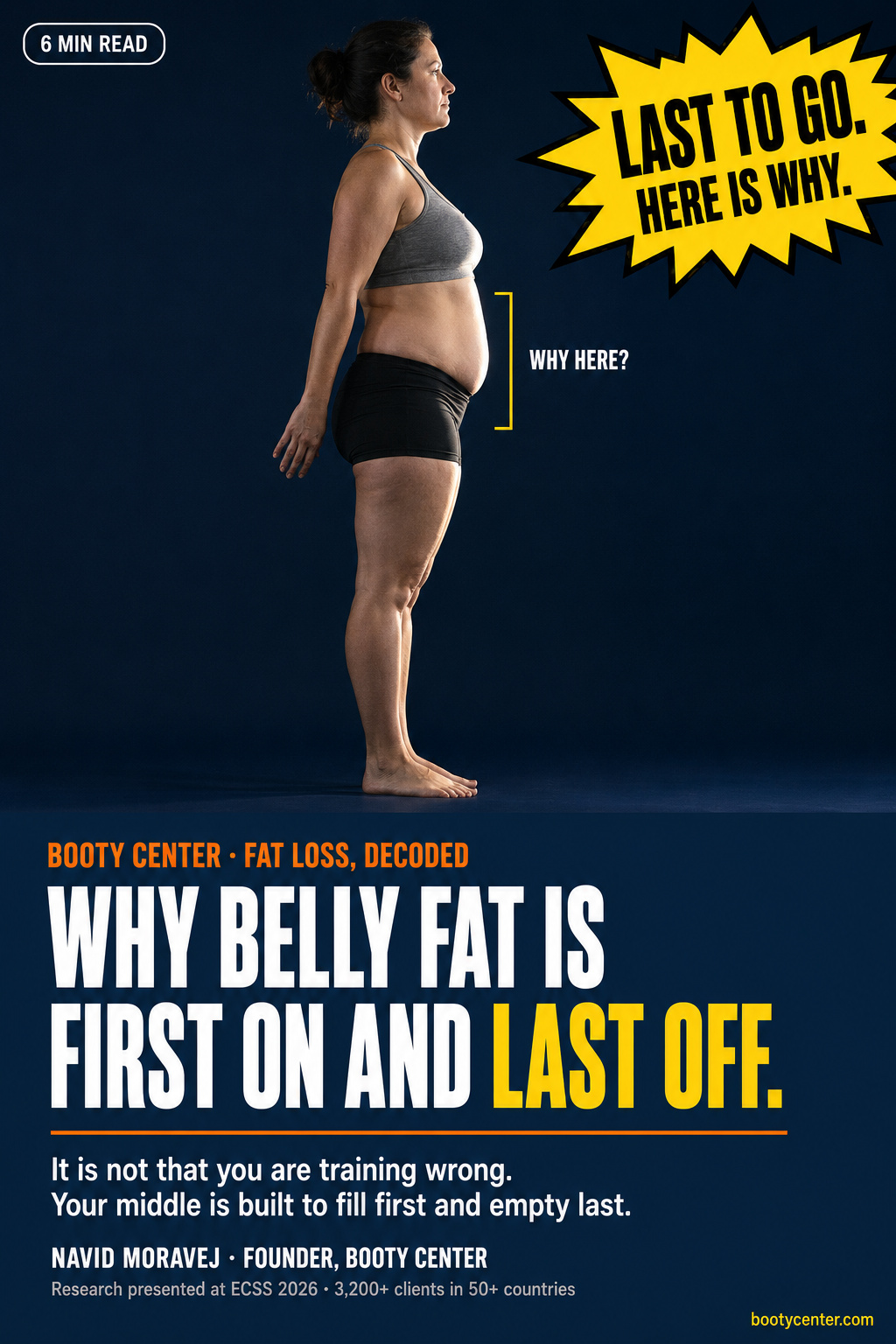
You lose weight. Your face changes. Your arms change. Your middle looks the same. This is the most common complaint in fat loss, and it is not a sign that you are doing it wrong. Your belly is built to fill first and empty last, and the reason has almost nothing to do with how many sit-ups you do.
“Belly fat is stubborn because you are not training your abs hard enough.”
Two different fats live in your belly
One sits under the skin and you can pinch it. The other sits deep around your organs and you cannot feel it at all. They behave differently, and most advice treats them as one thing.
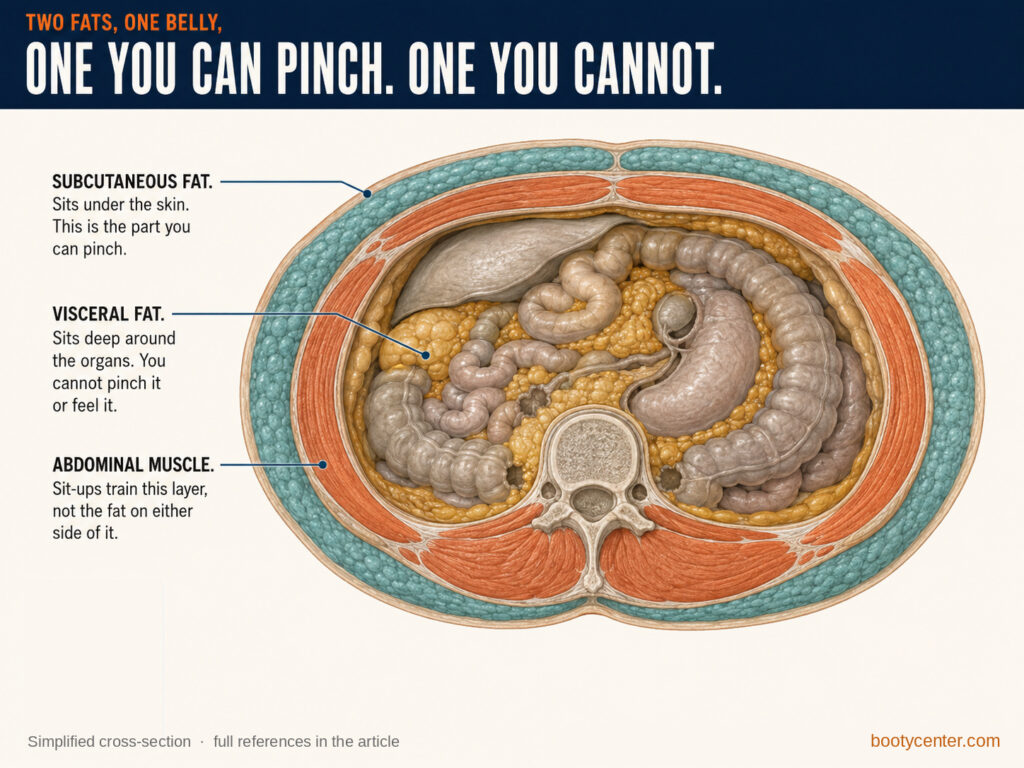 Two different fats, separated by the muscle wall that sit-ups actually train.
The pinchable layer is subcutaneous fat. It sits between your skin and your abdominal wall. When you grab your belly, this is what is in your hand.
Behind the muscle wall is visceral fat. It packs in around the intestines and organs. You cannot pinch it, and a very lean person can still carry a fair amount of it.
Your abdominal muscles sit between the two. That matters for the next part. Sit-ups train the wall in the middle. They do not touch the fat on either side of it.
Why the middle fills first
Four things set your storage order, and none of them are exercises.
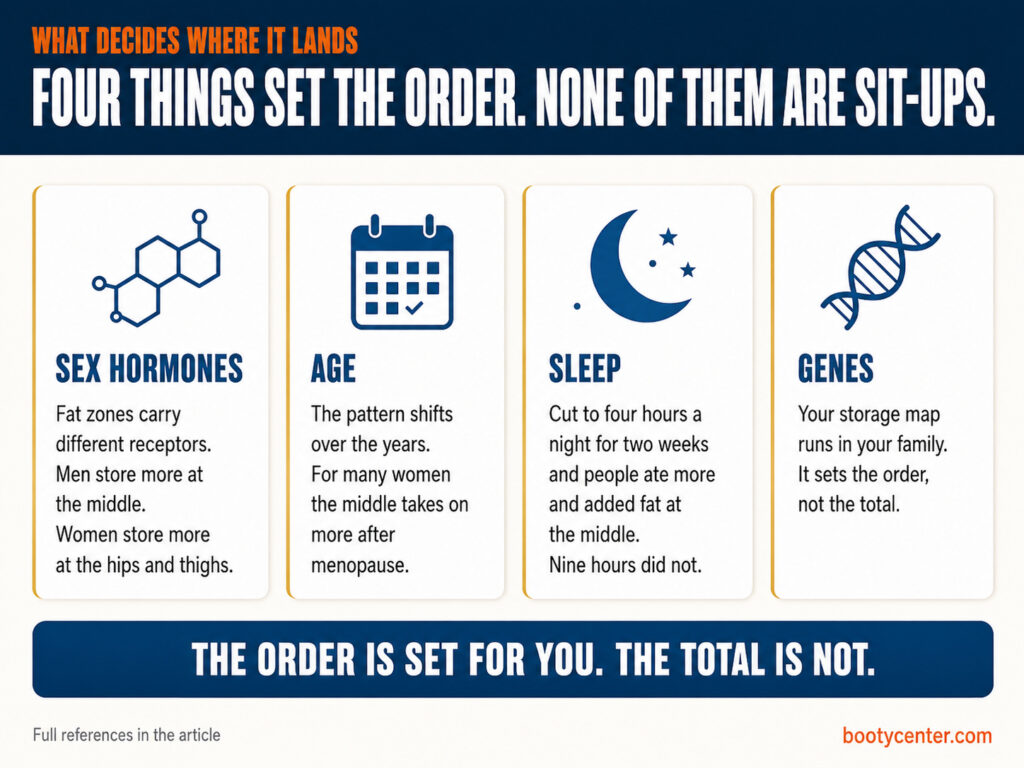 None of the four things that set your storage order is an exercise.
Fat zones are not identical tissue. Each carries its own mix of receptors and answers differently to hormones, which is why men tend to fill at the middle and many women fill at the hips and thighs first [1].
The pattern also shifts with age. In one comparison, women just past menopause carried 49 percent more deep abdominal fat and 36 percent more trunk fat than women just before it. The deep abdominal difference held even after the researchers adjusted for age and total fat [2]. This was a snapshot of two groups rather than the same women tracked over time, so read it as a pattern, not a stopwatch.
Sleep belongs here too, and the evidence is better than most people expect. Twelve healthy adults spent two weeks on four hours of sleep a night, then two weeks on nine, with free access to food. On the short nights they ate more, burned the same, and gained fat at the middle. Total body fat did not differ between the two conditions. Abdominal fat rose only on the short nights [3].
Then there is your family. Your storage map is inherited. It sets the order fat leaves, not the total.
The part nobody tells you: the deep fat goes first
Here is the surprise. When researchers pooled 89 studies covering diet, exercise, weight loss drugs and surgery, the percentage drop in visceral fat was always larger than the percentage drop in subcutaneous fat. No method targeted the deep fat specially. It simply gives ground faster [4].
So the fat that leaves first is the one you could never see. The layer you can actually pinch is the one that hangs on.
That is why the mirror lags behind the effort. Real change is happening behind the wall before it shows in front of it.
It also explains a complaint we hear constantly. Someone drops a clothing size, feels better, sleeps better, and still says their stomach has not moved. Both things are true at once. The fat that improved their blood work and their energy went first. The fat they were looking at in the mirror is still in the queue.
Coach’s tip
This also means progress can be invisible for weeks and still be real. Deep fat responds early. The pinchable layer follows.
What actually moves it
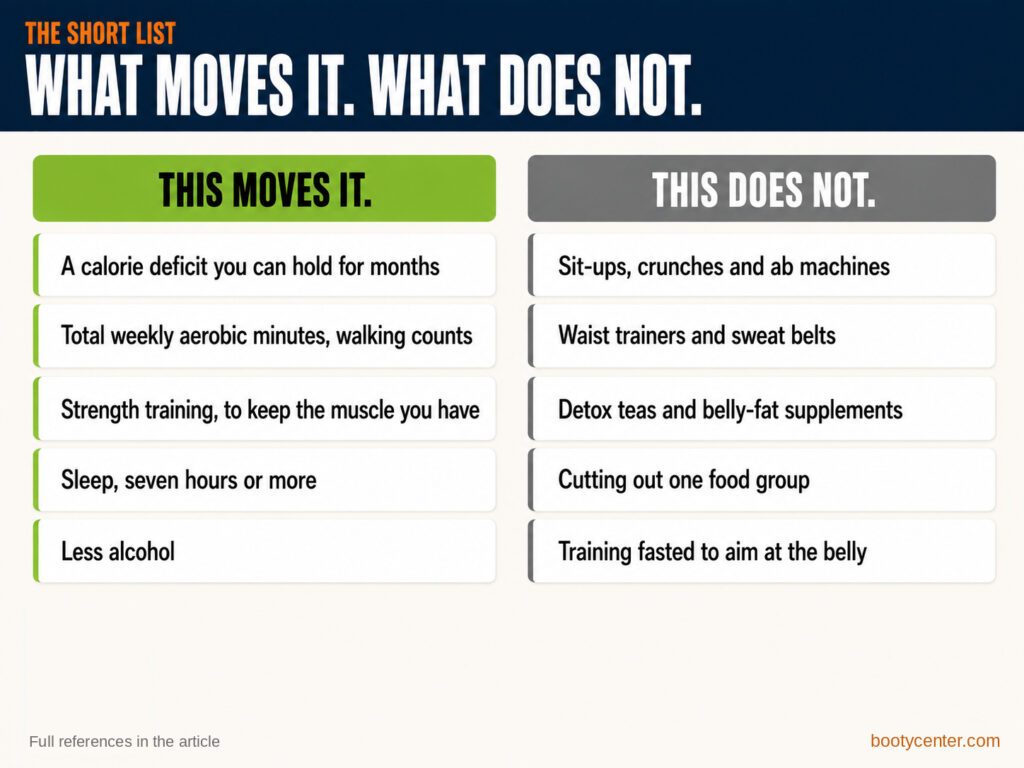 The short list. Nothing on the left targets the belly. All of it moves total fat.
A calorie deficit you can hold for months. Belly fat moves when total fat moves. There is no version of this that works without it.
Aerobic minutes, and enough of them. A review of trials put the threshold at about 10 METs-hours per week for visceral fat to fall, which is roughly two and a half hours of brisk walking. More gave more, in people without metabolic disease. Deep fat fell in some trials even when body weight barely moved [5].
Strength training. In a nine year study of 16,587 men, adding half an hour or more of weight training per week was linked to about 0.91 cm less waist gain. That was a larger association than vigorous cardio managed in the same men. Fibre helped too, and hours of television went the other way [6].
Sleep, seven hours or more. See the trial above. Of everything on this list, sleep is the one people treat as optional and it is the one with a controlled experiment behind it.
Alcohol, honestly. Heavy intake is linked to abdominal fat. Below roughly half a litre of beer a day, a review of 47 studies found the evidence inadequate either way, and the nine year study found changes in drinking were not significantly linked to waist gain [6][7]. Cutting back saves calories. Do not expect it to be the lever on its own.
The cortisol claim, and why this article will not repeat it
The debate
You have read that stress raises cortisol and cortisol parks fat on your belly. We checked it. In 769 older adults, cortisol patterns barely differed between people with general and abdominal fat, and the authors concluded their findings do not support a cortisol driven cause of obesity. An earlier study in women found only mild differences in overnight cortisol. Chronic stress is worth managing for many good reasons, and poor sleep genuinely does move abdominal fat. But the neat story that stress hormones aim fat at your waist is not supported well enough for us to print it as fact [3][8][9].
How to track it without losing your mind
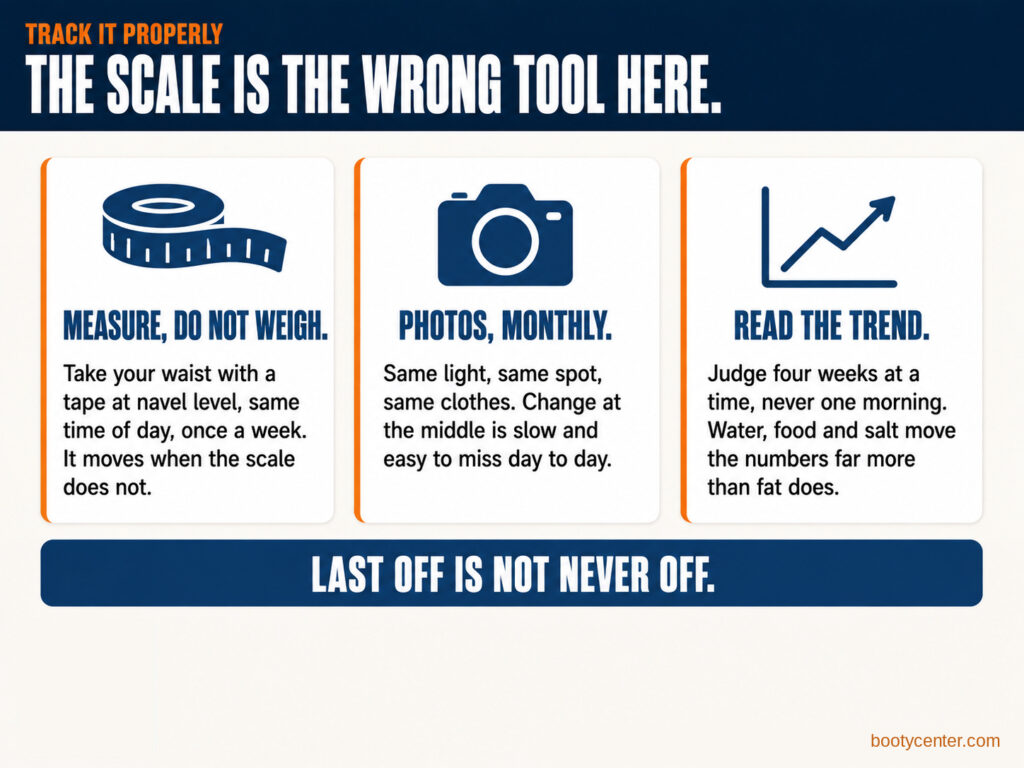 The scale cannot tell you which fat left, or from where.
The scale is the wrong tool for this job. It cannot tell you which fat left or from where. Worse, it moves for reasons that have nothing to do with fat, and those swings are large enough to hide a month of real progress.
Use a tape at navel level, same time of day, once a week. Take a photo once a month in the same light and the same spot. Then judge four weeks at a time. Water, food and salt swing the daily numbers far more than fat ever does.
And remember what you actually control. You cannot choose where fat leaves. You can choose where muscle grows. Strong glutes and a strong back change your shape whatever your middle decides to do.
Here is the full evidence on why you cannot target fat loss.
Key takeaway
Last off is not never off.
Stubborn belly fat FAQs
Why is belly fat so hard to lose?
It is not one problem. Two different fats sit in your midsection, separated by your abdominal wall, and they behave differently from each other. The layer you can actually see and pinch is the slower of the two, so the part you are watching is the part that responds last.
What is the difference between visceral and subcutaneous fat?
Subcutaneous fat sits between your skin and your abdominal muscles, and it is what you hold when you grab your belly. Visceral fat sits behind the muscle wall, packed around your organs. You cannot pinch it or feel it, and it carries the health risk.
Can you be slim and still carry belly fat?
Yes. Visceral fat sits deep around the organs rather than under the skin, so it does not always show in the mirror or on the scale. A person who looks lean can still carry a meaningful amount of it, which is why waist measurement beats appearance.
Which belly fat goes first, deep or pinchable?
The deep fat around your organs. Across 89 studies the percentage drop in visceral fat was always larger than the drop in the subcutaneous layer, whatever the method. The fat you can pinch is the one that holds on longest, which is why the mirror lags.
Why did my clothes get looser but my stomach look the same?
Because the fat that left first was the fat you could never see. Deep abdominal fat responds early and improves your health markers, while the pinchable layer above it is still in the queue. Both things are happening at once.
Why does my belly look bigger some days?
Food volume, salt, fluid and digestion all change how your abdomen sits, and none of it is fat. This is why a weekly tape measure and a monthly photo beat a daily mirror check. Judge four weeks at a time.
References
- Karastergiou K, Smith SR, Greenberg AS, Fried SK. Sex differences in human adipose tissues – the biology of pear shape. Biol Sex Differ. 2012;3(1):13.
- Toth MJ, Tchernof A, Sites CK, Poehlman ET. Menopause-related changes in body fat distribution. Ann N Y Acad Sci. 2000;904:502-506.
- Covassin N, Singh P, McCrady-Spitzer SK, St Louis EK, Calvin AD, Levine JA, Somers VK. Effects of experimental sleep restriction on energy intake, energy expenditure, and visceral obesity. J Am Coll Cardiol. 2022;79(13):1254-1265.
- Merlotti C, Ceriani V, Morabito A, Pontiroli AE. Subcutaneous fat loss is greater than visceral fat loss with diet and exercise, weight-loss promoting drugs and bariatric surgery: a critical review and meta-analysis. Int J Obes (Lond). 2017;41(5):672-682.
- Ohkawara K, Tanaka S, Miyachi M, Ishikawa-Takata K, Tabata I. A dose-response relation between aerobic exercise and visceral fat reduction: systematic review of clinical trials. Int J Obes (Lond). 2007;31(12):1786-1797.
- Koh-Banerjee P, Chu NF, Spiegelman D, Rosner B, Colditz G, Willett W, Rimm E. Prospective study of the association of changes in dietary intake, physical activity, alcohol consumption, and smoking with 9-y gain in waist circumference among 16,587 US men. Am J Clin Nutr. 2003;78(4):719-727.
- Bendsen NT, Christensen R, Bartels EM, Kok FJ, Sierksma A, Raben A, Astrup A. Is beer consumption related to measures of abdominal and general obesity? A systematic review and meta-analysis. Nutr Rev. 2013;71(2):67-87.
- Ladwig KH, Schriever SC, Atasoy S, Bidlingmaier M, Kruse J, Johar H. Association of generalized and central obesity with serum and salivary cortisol secretion patterns in the elderly: findings from the cross sectional KORA-Age study. Sci Rep. 2020;10(1):14321.
- Duclos M, Corcuff JB, Etcheverry N, Rashedi M, Tabarin A, Roger P. Abdominal obesity increases overnight cortisol excretion. J Endocrinol Invest. 1999;22(6):465-471.