Yes. Women can lose fat and build muscle at the same time. Researchers call it body recomposition, or recomp for short. It happens most easily in beginners, in women coming back after a break, and in women with more fat to lose. Lean, well-trained women can do it too, but they need a tighter plan.
Three things drive it: lifting weights, eating enough protein, and keeping any calorie deficit small. This guide to body recomposition for women shows you who it works for, how to set it up, and how to tell it is working when the scale barely moves.
Body recomposition
Losing body fat and gaining muscle over the same period. Your weight may drop a little, stay the same, or even go up, because muscle is added while fat is lost.
Table of Contents
Can women really lose fat and build muscle at the same time?
Yes, and it has been measured in women. In one 8-week study, 17 young women training for physique competitions followed the same lifting programme (Campbell 2018). The group that ate more protein gained 2.1 kg of fat-free mass and lost 1.1 kg of fat over those 8 weeks. The group that ate less protein gained 0.6 kg of fat-free mass, and their fat mass did not change in a meaningful way.
That is a small study, so treat it as a clear example, not the final word. But it fits the wider research. A review of recomp studies found that building muscle and losing fat together is common in beginners and in people with more body fat, and it also happens in people who already train (Barakat 2020).
One note on the words. Fat-free mass is not only muscle. It also includes water, bone and organs. Studies report it because it is what body scans can measure.
Who does body recomposition work best for?
Recomp works best for beginners, women returning after a break, and women with more fat to lose. It is still possible for lean, trained women. The leaner and more experienced you are, the more carefully your plan has to be set up.
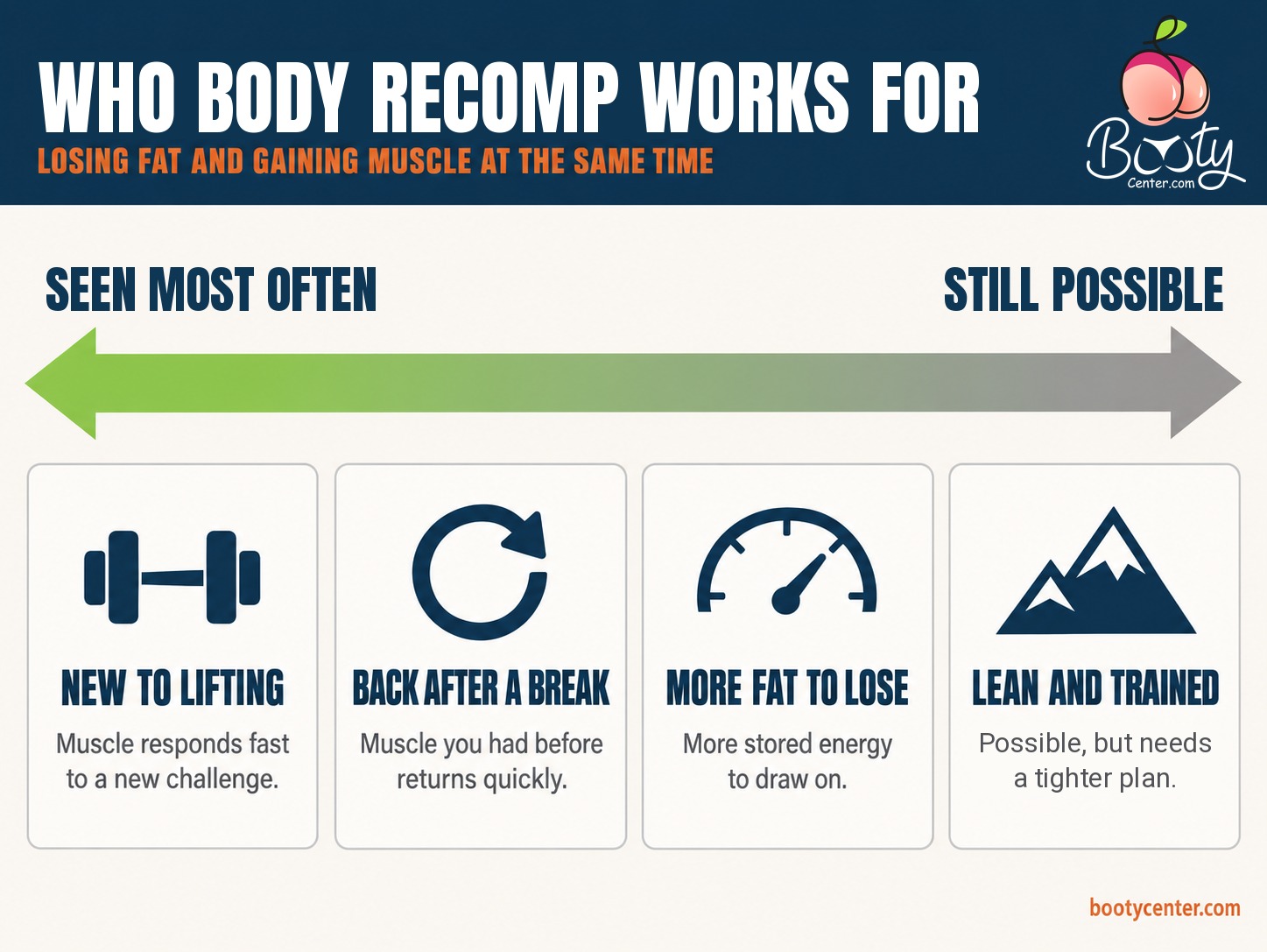 Recomp is seen most often in beginners and people with more fat to lose, and it is also shown in trained people (Barakat 2020).
New to lifting
If the weights room is new to you, your muscles respond quickly to the challenge. Women also build muscle just as well as men. A meta-analysis of 10 studies found no real difference in relative muscle growth between men and women on the same programme (Roberts 2020).
Lifting lowers body fat on its own, too. A review of 54 trials found that people who lifted lost about 1.5 percentage points of body fat compared with people who did not exercise (Wewege 2022). Being a man or a woman did not change that result.
Back after a break
If you trained before and stopped, you are in a good spot. In one study, women lifted for 20 weeks and then stopped for about 7 months (Staron 1991). Their muscle fibres kept much of their size during the break. When they started again, their fast muscle fibres grew again within 6 weeks. Some of what you built stays with you, and that helps you get back to form quickly.
More fat to lose
If you carry more body fat, your body has more stored energy to draw on while you eat a little less. That is one likely reason recomp is so common in people with more to lose (Barakat 2020). This reason has not been tested directly in women, so treat it as sensible thinking, not proof.
Lean and trained
If you are already lean and have lifted for years, recomp is still possible. The Barakat review collected studies that showed it in trained people. The difference is that there is less room for error. Training, protein and a small deficit all need to be in place at once.
For some lean women, a period of eating a little more is the better route to bigger glutes. Our guide to surplus vs recomp for glute growth helps you make that choice.
What drives body recomposition?
Three things drive recomp: lifting weights with progressive overload, eating enough protein, and keeping any calorie deficit small. You need all three at the same time. Leave one out and the results shrink.
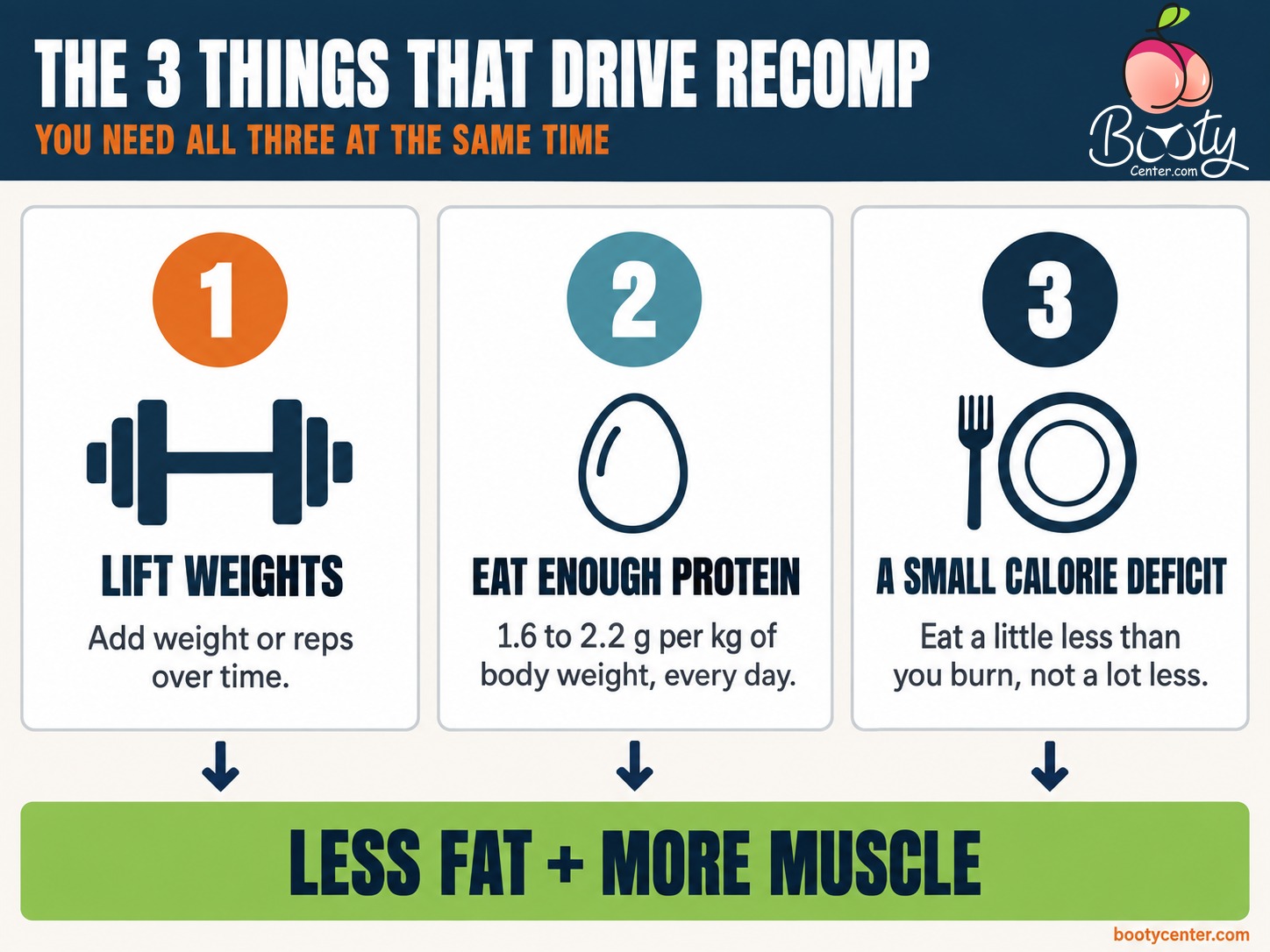 Recomp needs all three at once. Protein range from Morton 2018.
1. Lift weights, and keep adding to them
Lifting is the signal that tells your body to keep and build muscle. Without it, eating less does not build muscle. The key is progressive overload. Over the weeks, add a little weight, or a rep or two, on the same lifts.
For your glutes and butt, build the plan around the four movement patterns in our guide on how to train glutes. Random exercise hopping makes progress hard to measure. Repeating the same lifts lets you see your strength go up.
2. Eat enough protein
Protein supplies the building blocks for new muscle. A large meta-analysis of 49 studies found that muscle gains from lifting levelled off at about 1.6 g of protein per kg of body weight per day (Morton 2018). The likely range around that number reached 2.2 g, so the authors suggested about 2.2 g for anyone who wants to be sure.
In real life, a woman who weighs 65 kg needs about 105 to 145 g of protein a day. In the women's study above, the group that did better ate 2.5 g per kg a day. The other group ate only 0.9 g per kg (Campbell 2018).
Protein matters even more when you eat less. In a 4-week study, men on a hard diet who ate 2.4 g per kg a day gained 1.2 kg of lean mass and lost 4.8 kg of fat. Men who ate 1.2 g per kg gained almost no lean mass and lost 3.5 kg of fat (Longland 2016). That study was in men, with a very large deficit and training 6 days a week. It shows the principle. It is not a plan to copy.
Coach's tip
Spread your protein over 3 or 4 meals. Hitting the daily total is the part the research supports. Splitting it up just makes the total easier to reach.
3. Keep the calorie deficit small
To lose fat, you need to eat a bit less than you burn. Eat too little, though, and muscle growth stops. A meta-analysis of lifting studies found that a deficit of about 500 calories a day was enough to block gains in lean mass (Murphy and Koehler 2022). Strength still went up, but muscle did not.
So keep the gap smaller than that. If you are a beginner, you may not need a deficit at all. Lifting alone lowers body fat, as the Wewege review showed.
How do you know recomp is working if the scale does not move?
Track your waist, progress photos, your strength and how your clothes fit, not just the scale. During recomp, fat loss and muscle gain can cancel each other out. The number stays still while your body changes. Our guide on weight loss vs fat loss explains why the scale can mislead you.
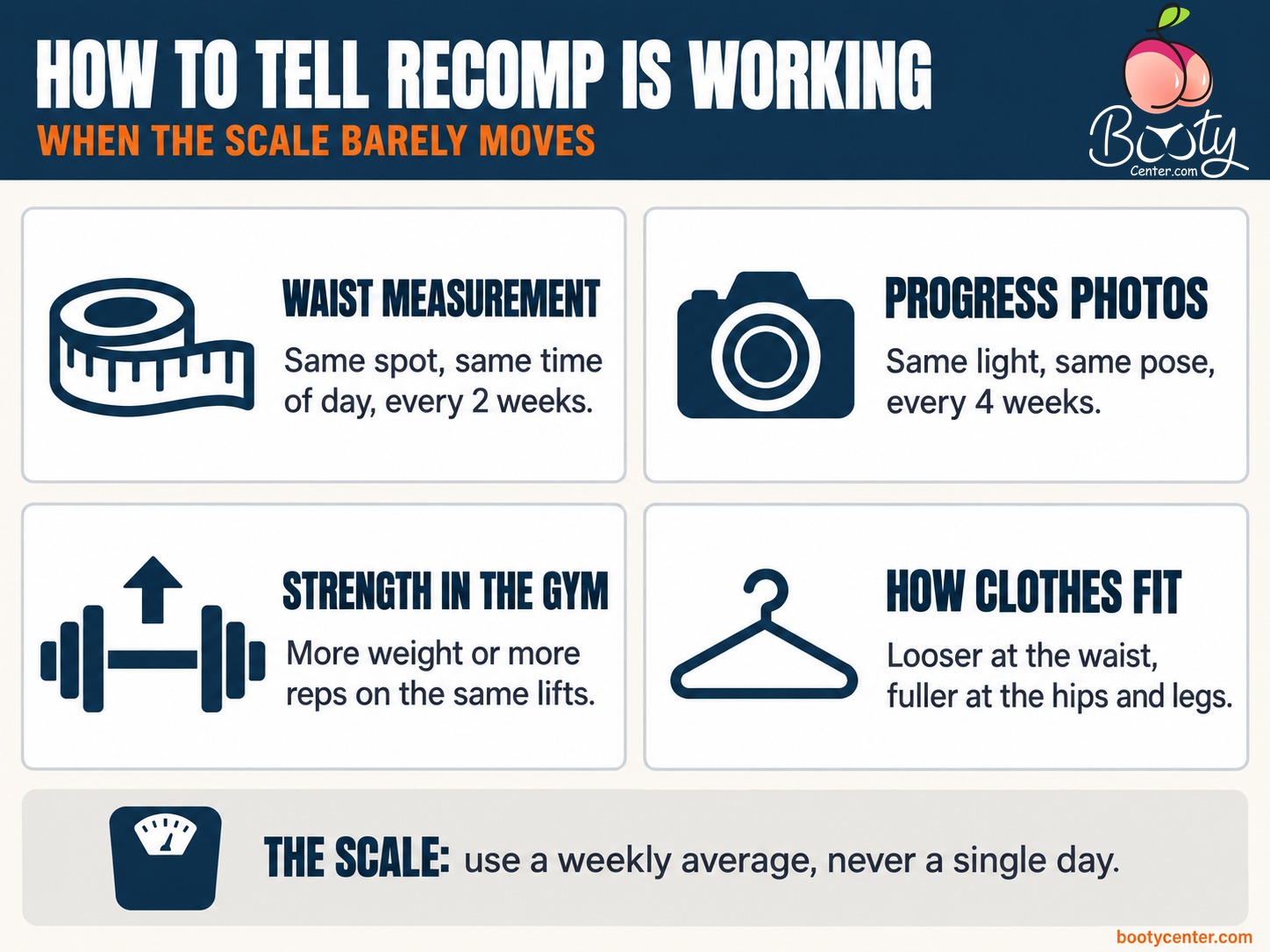 When fat loss and muscle gain cancel out, the scale stays still. These four measures do not.
Measure your waist at the same spot and the same time of day every 2 weeks. Take photos every 4 weeks in the same light and the same pose. Write down every lift, so you can see the weights go up. Notice how your jeans fit around your waist, your hips and your butt.
If you use the scale, weigh yourself a few mornings a week and look at the weekly average. One day on its own tells you almost nothing. Water, salt and your cycle can move it up or down from one day to the next.
Home body fat scales are not accurate enough to track small changes. Even lab scans have a margin of error, and the Barakat review names this as a real limit of recomp research.
How long does body recomposition take?
Give it at least 8 weeks before you judge it. In the women's study above, the changes were clear after 8 weeks of training (Campbell 2018). Small changes show up on a scan before you can see them in the mirror, so be patient with your photos.
Recomp is slower than a hard diet on the scale, because you are building while you lose. That is the point. You end up with more muscle, not just a smaller version of the body you started with.
What is the biggest mistake with body recomposition?
The biggest mistake is cutting calories too hard. A big deficit feels like faster progress because the scale drops quickly. But it takes away the energy your body needs to build muscle (Murphy and Koehler 2022). You end up lighter, not more muscular.
The second mistake is judging by the scale alone. Many women give up after a few weeks because the number has not moved, just as recomp starts to work. Trust the tape, the photos and the logbook.
Body recomposition by the numbers
These are the key figures from the studies in this guide, all in one place.
- 2.1 kg of fat-free mass gained in 8 weeks by women eating more protein, while they also lost 1.1 kg of fat (Campbell 2018).
- 1.6 g of protein per kg a day is where muscle gains from lifting levelled off. 2.2 g covers the upper end of the range (Morton 2018).
- 500 calories a day was a large enough deficit to block gains in lean mass (Murphy and Koehler 2022).
- 1.5 percentage points of body fat lost from lifting, compared with not exercising (Wewege 2022).
- Similar relative muscle growth in men and women on the same programme (Roberts 2020).
Where the evidence runs thin
Most recomp studies are short and small, and many include only men. The best women-only example in this guide had 17 people. Body scans have a margin of error that is large next to the changes recomp produces. The idea that more body fat makes recomp easier is reasonable, but it has not been tested head to head in women. None of this changes the plan. It means you should judge your progress over months, not days.
Bottom line
Women can lose fat and build muscle at the same time. Body recomposition for women works best for beginners, returners and women with more fat to lose, and it is still possible if you are lean and trained. Lift with progressive overload, eat 1.6 to 2.2 g of protein per kg a day, keep any deficit small, and track your body, not just the scale. The goal is not a smaller number. It is more muscle and stronger glutes.
Frequently asked questions
Can beginners build muscle while losing fat?
Yes. Beginners are the group where recomp is seen most often. New muscle responds quickly to lifting, and lifting on its own lowers body fat. A review of 54 trials found that people who lifted lost about 1.5 percentage points of body fat compared with people who did not exercise.
How much protein do women need for body recomposition?
Aim for 1.6 to 2.2 g of protein per kg of body weight each day. Muscle gains from lifting level off at about 1.6 g per kg, and 2.2 g covers the upper end of the likely range. For a 65 kg woman, that is about 105 to 145 g a day.
Do you need a calorie deficit for body recomposition?
Not always. Beginners can lose fat through lifting alone. If you do eat less, keep the deficit small. A meta-analysis of lifting studies found that a deficit of about 500 calories a day was enough to block muscle gains, even though strength still improved.
Why is my weight the same even though I work out?
During recomp, the fat you lose and the muscle you gain can cancel each other out on the scale. Daily water changes add more noise. Track your waist, photos and strength instead, and look at your weekly average weight rather than any single day.
Should I recomp or eat in a surplus to grow my glutes?
If you are new to lifting, coming back after a break, or have fat to lose, recomp is usually the better start. If you are already lean and have trained for years, eating a little more for a while can build muscle faster. Our surplus vs recomp guide walks through that choice.
Want a plan built for recomp?
Booty Center coaching sets your training, protein and calorie targets for your starting point and adjusts them as you progress.
References
- Campbell BI, Aguilar D, Conlin L, Vargas A, Schoenfeld BJ, Corson A, et al. Effects of high versus low protein intake on body composition and maximal strength in aspiring female physique athletes engaging in an 8-week resistance training program. Int J Sport Nutr Exerc Metab. 2018;28(6):580-5. doi:10.1123/ijsnem.2017-0389
- Barakat C, Pearson J, Escalante G, Campbell B, De Souza EO. Body recomposition: can trained individuals build muscle and lose fat at the same time? Strength Cond J. 2020;42(5):7-21. doi:10.1519/SSC.0000000000000584
- Roberts BM, Nuckols G, Krieger JW. Sex differences in resistance training: a systematic review and meta-analysis. J Strength Cond Res. 2020;34(5):1448-60. doi:10.1519/JSC.0000000000003521
- Wewege MA, Desai I, Honey C, Coorie B, Jones MD, Clifford BK, et al. The effect of resistance training in healthy adults on body fat percentage, fat mass and visceral fat: a systematic review and meta-analysis. Sports Med. 2022;52(2):287-300. doi:10.1007/s40279-021-01562-2
- Staron RS, Leonardi MJ, Karapondo DL, Malicky ES, Falkel JE, Hagerman FC, et al. Strength and skeletal muscle adaptations in heavy-resistance-trained women after detraining and retraining. J Appl Physiol. 1991;70(2):631-40. doi:10.1152/jappl.1991.70.2.631
- Morton RW, Murphy KT, McKellar SR, Schoenfeld BJ, Henselmans M, Helms E, et al. A systematic review, meta-analysis and meta-regression of the effect of protein supplementation on resistance training-induced gains in muscle mass and strength in healthy adults. Br J Sports Med. 2018;52(6):376-84. doi:10.1136/bjsports-2017-097608
- Longland TM, Oikawa SY, Mitchell CJ, Devries MC, Phillips SM. Higher compared with lower dietary protein during an energy deficit combined with intense exercise promotes greater lean mass gain and fat mass loss: a randomized trial. Am J Clin Nutr. 2016;103(3):738-46. doi:10.3945/ajcn.115.119339
- Murphy C, Koehler K. Energy deficiency impairs resistance training gains in lean mass but not strength: a meta-analysis and meta-regression. Scand J Med Sci Sports. 2022;32(1):125-37. doi:10.1111/sms.14075