
Hip thrust vs squat is one of the oldest arguments in glute training, and the best study on it has a boring answer: same glute growth. In a 9-week MRI trial, both lifts grew the glutes by about the same amount. The difference was everywhere else. Squats also grew the front and inner thighs. Hip thrusts did not. So the right choice depends on what you want from your legs, not just your butt. Here is the evidence and how to use it.
Define: Muscle activity (EMG)
Small sensors on the skin measure how much electrical activity a muscle shows during a lift. High activity means the muscle is working hard in that moment. It does not prove the muscle will grow more over weeks of training.
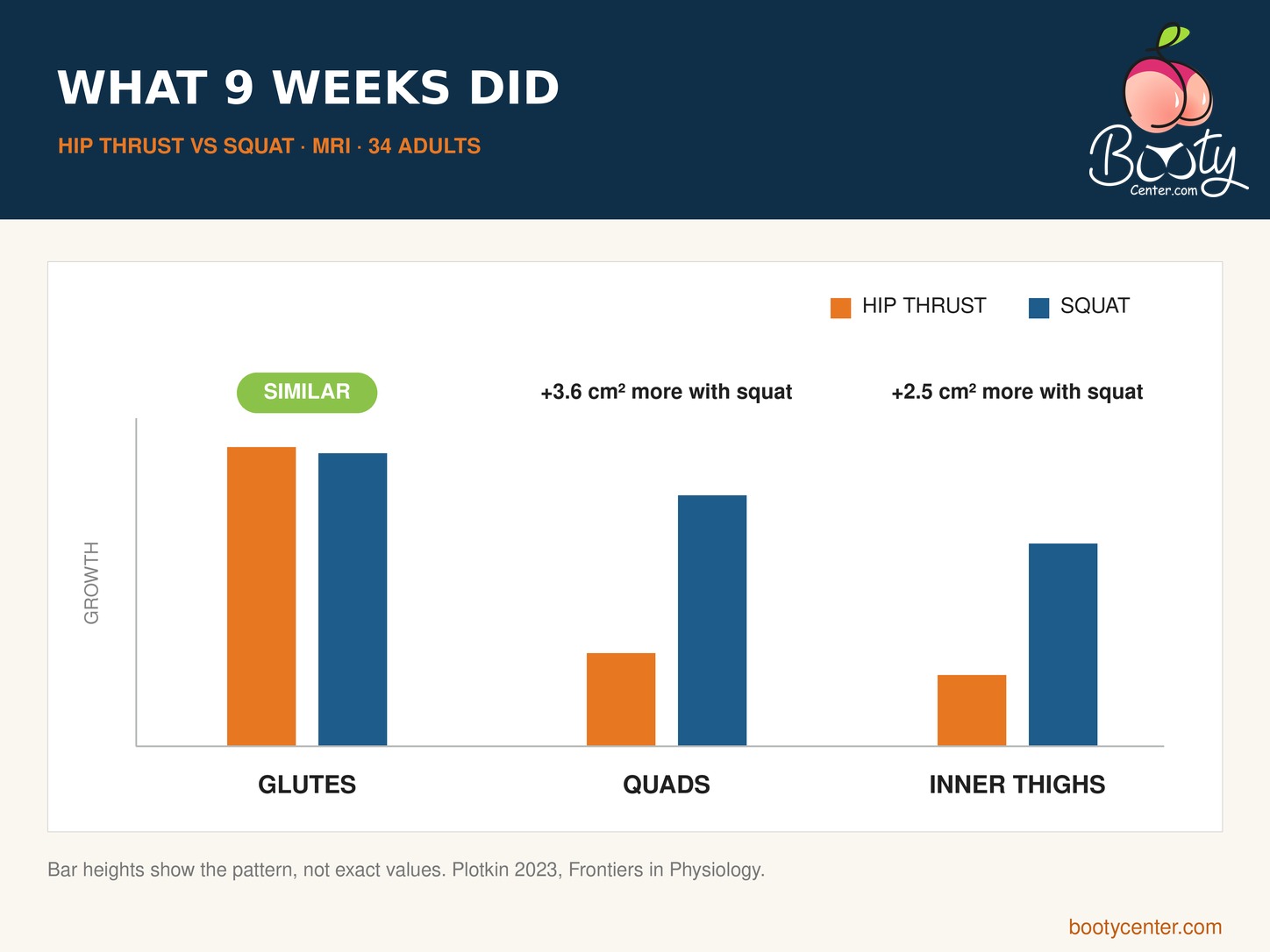 Same glute growth, different thighs. 34 untrained adults, 9 weeks (Plotkin 2023).
Which builds bigger glutes, hip thrust or squat?
Neither, clearly. In the only well-run trial that compared them directly, 34 untrained young adults were split into a hip thrust group and a back squat group. Both trained for 9 weeks, 15 to 17 supervised sessions, with the same number of sets. MRI scans before and after showed similar glute growth in the lower, middle and upper glutes. The numbers leaned slightly toward the hip thrust, but the uncertainty was larger than the difference (Plotkin 2023).
The thighs told a different story. The squat group grew their quads by about 3.6 cm2 more and their inner thighs, the adductors, by about 2.5 cm2 more than the hip thrust group (Plotkin 2023). One of the authors is Bret Contreras, the coach who made the hip thrust popular, and the result did not favour his lift. That is a good sign the study was run fairly.
A wider 2025 review of 12 studies found that many hip extension exercises grow gluteus maximus, alone or combined, with a moderate effect overall. The hip thrust stood out when the goal is glutes with less growth elsewhere, and deep squats also grew the glutes well (Krause Neto 2025).
Why do hip thrusts feel stronger in your glutes?
Because your glutes work harder at the top of a hip thrust than in any part of a squat. In 13 trained women lifting their 10-rep max, the hip thrust produced more than double the average upper glute activity of the back squat, 69.5% against 29.4%, and much more lower glute activity, 86.8% against 45.4% (Contreras 2015).
But feeling it more did not mean growing more. In the 9-week trial, the hip thrust also showed higher glute activity, yet that did not predict who grew the most (Plotkin 2023). The burn is real. It is just not the scoreboard. If you cannot feel your glutes in either lift, our guide on how to do a barbell hip thrust covers the set-up.
Does squat depth matter for your glutes?
Yes, a lot. In 17 men who squatted 2 times a week for 10 weeks, full squats grew gluteus maximus by 6.7%, against 2.2% for half squats. The inner thighs followed the same pattern (Kubo 2019). If you squat for your glutes, squat to parallel or below. Bar position matters less than depth, and our guide on high bar vs low bar squats for glutes covers it.
Which is better for strength and sport?
Each one makes you stronger at itself. In the 9-week trial, the squat group gained about 14 kg more on the squat, and the hip thrust group gained about 26 kg more on the hip thrust. Both groups improved their deadlift by the same amount (Plotkin 2023).
For sport, the direction of force seems to matter. In adolescent male athletes over 6 weeks, front squats were likely better for vertical jump height, while hip thrusts were likely better for 10 m and 20 m sprint times (Contreras 2017). Squats push you up. Hip thrusts push you forward.
Should you do hip thrusts, squats, or both?
Both, for most people. The review found that single exercises and combinations of hip extension exercises all grew gluteus maximus (Krause Neto 2025), and each lift brings something the other does not. Pick the balance by your goal:
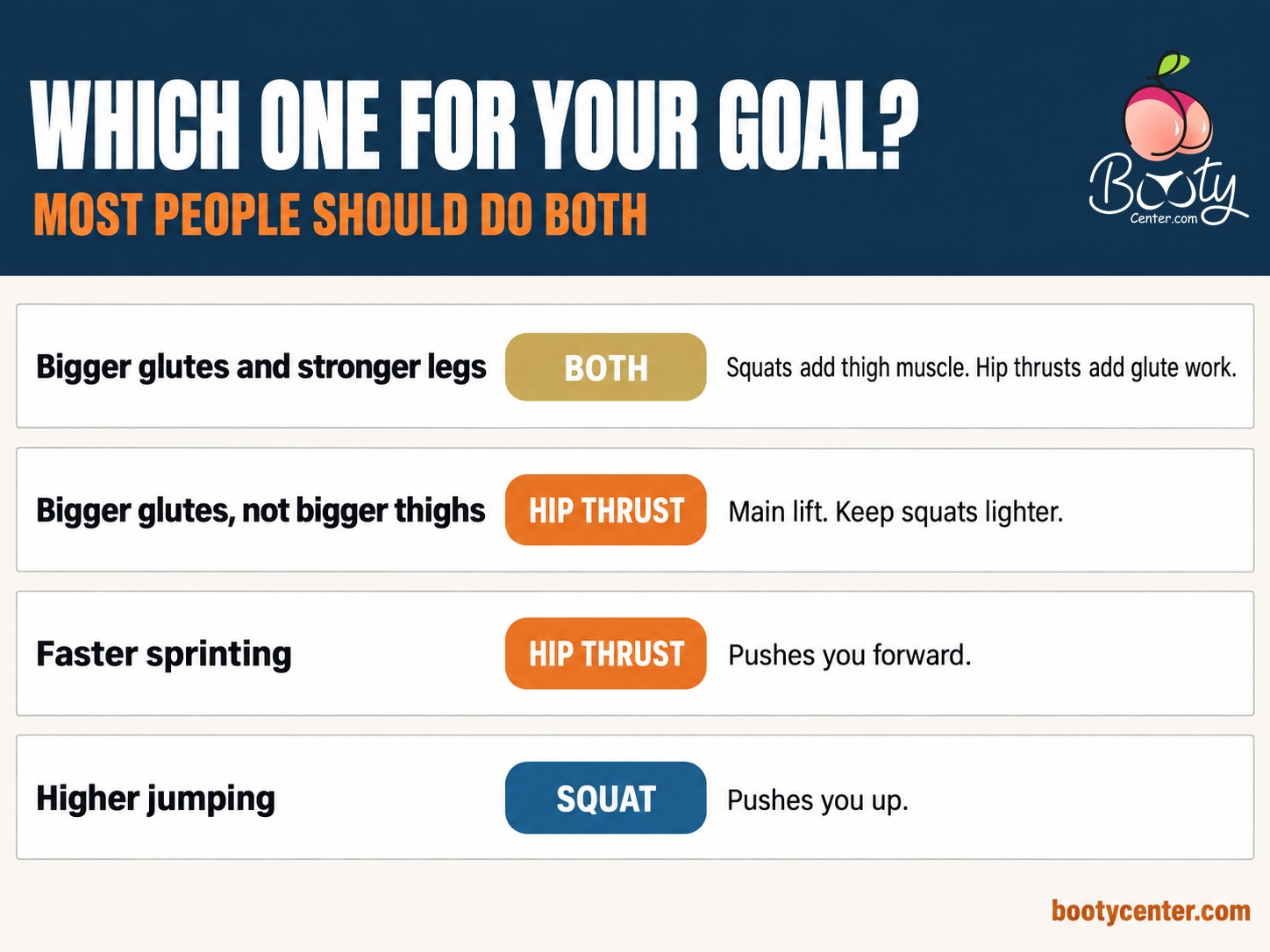 Pick the balance by your goal. Most people do both.
- Bigger glutes and stronger legs overall: do both. Squats add thigh muscle and jump power. Hip thrusts add glute work with less thigh growth.
- Bigger glutes without bigger thighs: make the hip thrust your main lift and keep squats lighter or less frequent. Our guide on how to grow glutes without growing your legs goes deeper.
- Faster sprinting: lean on hip thrusts (Contreras 2017).
- Higher jumping: lean on squats (Contreras 2017).
- Lower back complaints in one lift: fix the set-up first. Our guide on lower back pain after hip thrusts covers the hip thrust side.
A weekly plan with both lifts
A coach's template built on the studies above, not a tested program. Two sessions a week, at least 48 hours apart, each lift trained twice. Warm up with 5 minutes of easy cardio and 2 lighter sets of your first lift: 8 reps at about 50% and 5 reps at about 75% of your working weight, 60 seconds of rest between them.
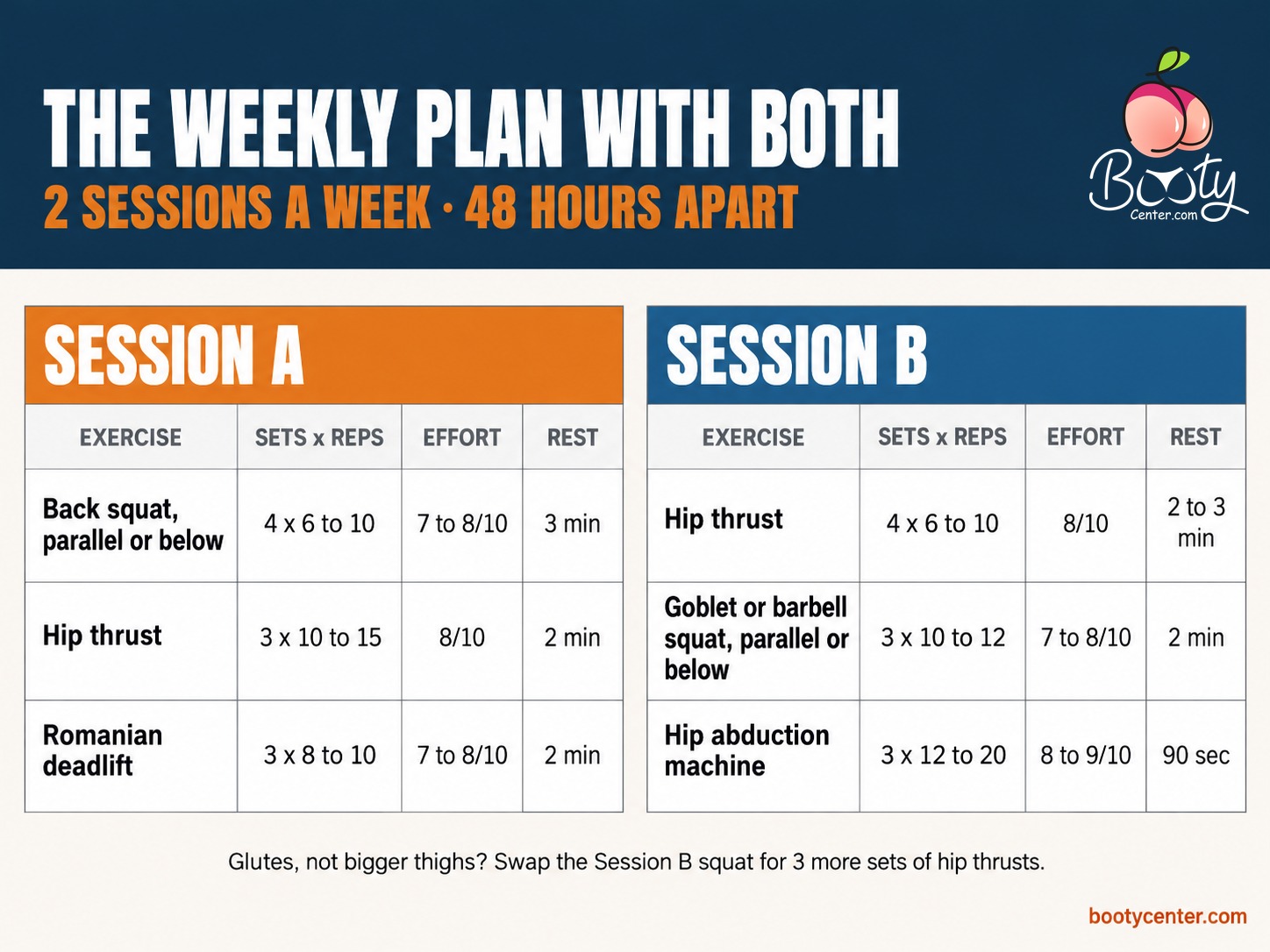 A coach's template. Two sessions a week, at least 48 hours apart.
Session A
- Back squat, to parallel or below: 4 sets of 6 to 10 reps, 7 to 8 out of 10 effort. Rest 3 minutes.
- Hip thrust: 3 sets of 10 to 15 reps, 8 out of 10 effort. Rest 2 minutes.
- Romanian deadlift: 3 sets of 8 to 10 reps, 7 to 8 out of 10 effort. Rest 2 minutes.
Session B
- Hip thrust: 4 sets of 6 to 10 reps, 8 out of 10 effort. Rest 2 to 3 minutes.
- Goblet squat or barbell squat, to parallel or below: 3 sets of 10 to 12 reps, 7 to 8 out of 10 effort. Rest 2 minutes.
- Seated hip abduction machine: 3 sets of 12 to 20 reps, 8 to 9 out of 10 effort. Rest 90 seconds.
When you reach the top of the rep range on every set at 8 out of 10 effort or easier, add weight next session: 2.5 to 5 kg on the squat and hip thrust. If you want glutes without bigger thighs, drop the Session B squat and do 3 more sets of hip thrusts. Our pillar guide on how to train glutes shows where these lifts fit in a full week.
Coach's tip
Put the lift you most want to improve first in the session, when you are freshest. That is coaching practice, not a study result.
Hip thrust vs squat, by the numbers
- 9 weeks, 34 adults: similar glute growth with hip thrusts and back squats (Plotkin 2023).
- 3.6 cm2 and 2.5 cm2: extra quad and inner thigh growth in the squat group (Plotkin 2023).
- 69.5% vs 29.4%: average upper glute activity, hip thrust against back squat, in 13 trained women (Contreras 2015).
- 6.7% vs 2.2%: glute growth from full squats against half squats over 10 weeks (Kubo 2019).
- 26 kg and 14 kg: extra strength gain on the trained lift for the hip thrust and squat groups (Plotkin 2023).
- 12 studies: in the 2025 review showing many hip extension exercises grow gluteus maximus (Krause Neto 2025).
Where the evidence runs thin
Only one solid trial has compared the two lifts for glute growth, in untrained young adults over 9 weeks. Trained lifters, women only, and longer programs have not been tested in a trial we trust. A 2020 trial in trained women found squats grew the glutes more, but its research group has had several papers retracted, so we do not use it. The squat depth study was in men. The sprint and jump study was in adolescent boys. The weekly plan and exercise order are coaching practice.
Bottom line
For a bigger butt, hip thrusts and squats came out about even. Squats also grow your thighs and help you jump. Hip thrusts hit the glutes harder in the moment and help you sprint. Do both, squat deep, and shift the balance toward hip thrusts if you want glutes without bigger thighs.
Frequently asked questions
Are hip thrusts better than squats for glutes?
Not for size, based on the best trial so far. In 34 untrained adults, 9 weeks of hip thrusts or back squats produced similar glute growth (Plotkin 2023). Hip thrusts are better if you want glutes with less thigh growth.
Do squats or hip thrusts make your thighs bigger?
Squats. In the same trial, the squat group grew their quads about 3.6 cm2 more and their inner thighs about 2.5 cm2 more than the hip thrust group (Plotkin 2023). Hip thrusts kept most of the growth in the glutes.
Can I just do hip thrusts and skip squats?
For butt size, yes. Hip thrusts alone grew the glutes as well as squats in a 9-week trial (Plotkin 2023). You would give up some thigh growth and squat strength, which is fine if that is not your goal.
Why do I feel hip thrusts more than squats?
Your glutes are more active in a hip thrust, about 69.5% against 29.4% for the upper glutes in trained women (Contreras 2015). But higher activity did not predict more growth over 9 weeks (Plotkin 2023), so feeling it more does not mean growing more.
How deep should I squat for glutes?
To parallel or below. Full squats grew gluteus maximus by 6.7% over 10 weeks, against 2.2% for half squats (Kubo 2019). Go as deep as you can while keeping a neutral back.
Are hip thrusts or squats better for beginners?
Both work. The 9-week trial was in untrained adults, and both groups grew their glutes and got stronger (Plotkin 2023). In our coaching experience, many beginners find the hip thrust easier to learn. Start with whichever you can do with good form, and add the other within a few weeks.
References
- Plotkin DL, Rodas MA, Vigotsky AD, McIntosh MC, Breeze E, Ubrik R, et al. Hip thrust and back squat training elicit similar gluteus muscle hypertrophy and transfer similarly to the deadlift. Front Physiol. 2023;14:1279170. doi:10.3389/fphys.2023.1279170
- Krause Neto W, Krause TLV, Gama EF. The impact of resistance training on gluteus maximus hypertrophy: a systematic review and meta-analysis. Front Physiol. 2025;16:1542334. doi:10.3389/fphys.2025.1542334
- Contreras B, Vigotsky AD, Schoenfeld BJ, Beardsley C, Cronin J. A comparison of gluteus maximus, biceps femoris, and vastus lateralis electromyographic activity in the back squat and barbell hip thrust exercises. J Appl Biomech. 2015;31(6):452-8. doi:10.1123/jab.2014-0301
- Kubo K, Ikebukuro T, Yata H. Effects of squat training with different depths on lower limb muscle volumes. Eur J Appl Physiol. 2019;119(9):1933-42. doi:10.1007/s00421-019-04181-y
- Contreras B, Vigotsky AD, Schoenfeld BJ, Beardsley C, McMaster DT, Reyneke JH, et al. Effects of a six-week hip thrust vs. front squat resistance training program on performance in adolescent males: a randomized controlled trial. J Strength Cond Res. 2017;31(4):999-1008. doi:10.1519/JSC.0000000000001510