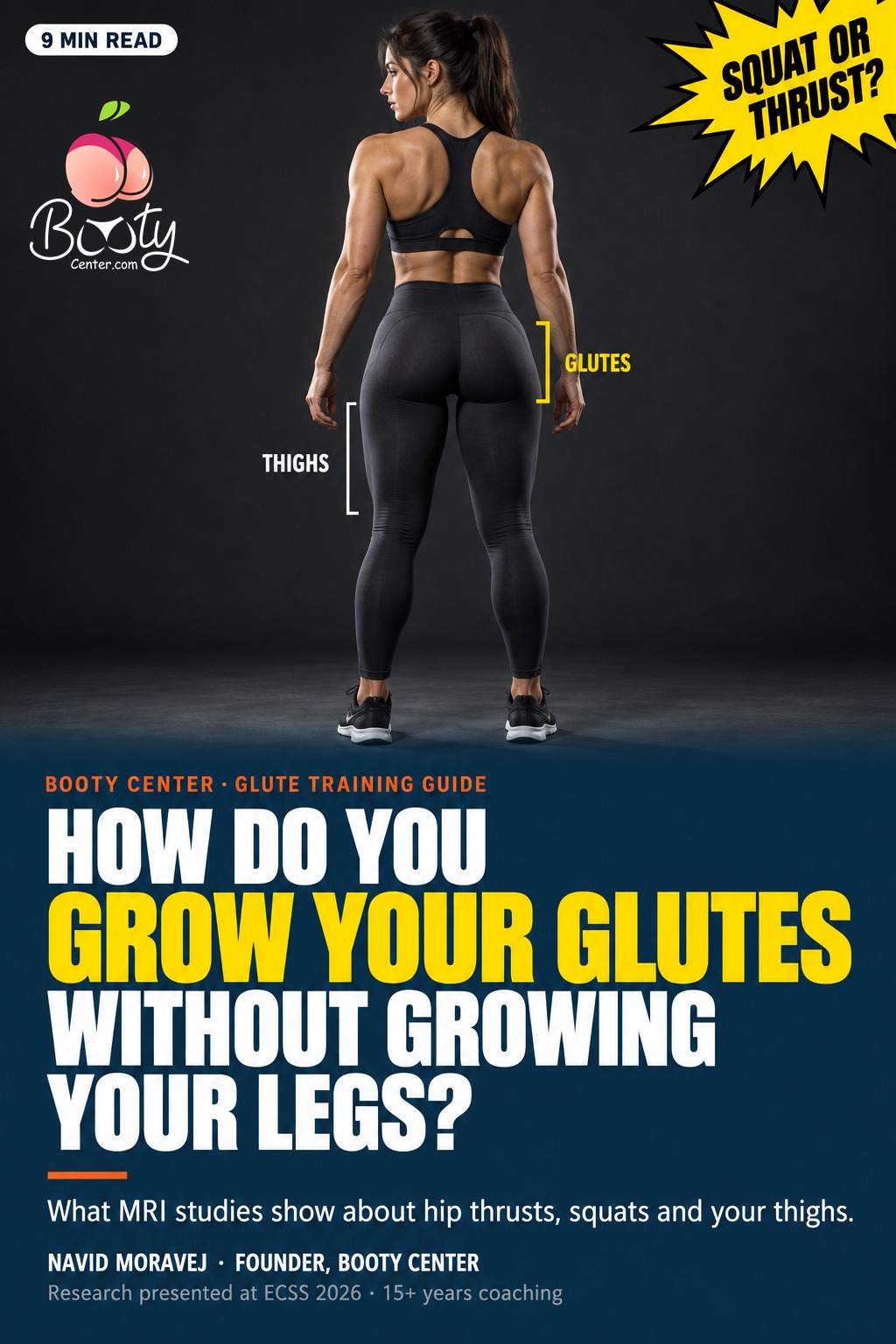
Make hip moves like the hip thrust your main lifts, and treat squats and leg press as extras. In an MRI study, hip thrusts grew the glutes as much as squats did, but squats also grew the front and inner thighs more (Plotkin 2023). You cannot switch your thigh muscles off completely. You can choose lifts that put most of the growth into your butt instead.
This guide on how to grow glutes without growing legs shows what each lift actually grew when researchers scanned the muscles, how to build a glute-first plan, and how to tell if bigger thighs are muscle or fat.
Hip-dominant vs knee-dominant
A hip-dominant move bends mostly at the hip, like a hip thrust. A knee-dominant move bends a lot at the knee too, like a squat or a leg press. The more the knee bends under load, the more your front thighs have to work.
Table of Contents
Why do your legs grow when you train your glutes?
Your legs grow because the most popular butt exercises also train your thighs. Squats and leg press bend the hip and the knee together, so the front thighs (quads) and inner thighs (adductors) work hard as well.
In one MRI study, men who did full squats for 10 weeks grew their glutes by 6.7%, their inner thighs by 6.2% and their front thighs by 4.9% (Kubo 2019). Squats are a great glute builder. They are just not a glutes-only builder.
The leg press works the same way. In a 2026 MRI study, adults trained one leg on the leg press for 12 weeks. That leg grew its glutes by 15.4%, its front thigh by 4.9% and part of its inner thigh by 6.2% (Kinoshita 2026).
Hip thrust or squat: which grows glutes without growing legs?
The hip thrust is the better pick if you want to limit thigh growth. In a 9-week MRI study of 34 untrained adults, hip thrusts and squats grew the glutes by a similar amount. The squat group grew more front thigh and more inner thigh muscle (Plotkin 2023). The hamstrings barely grew in either group.
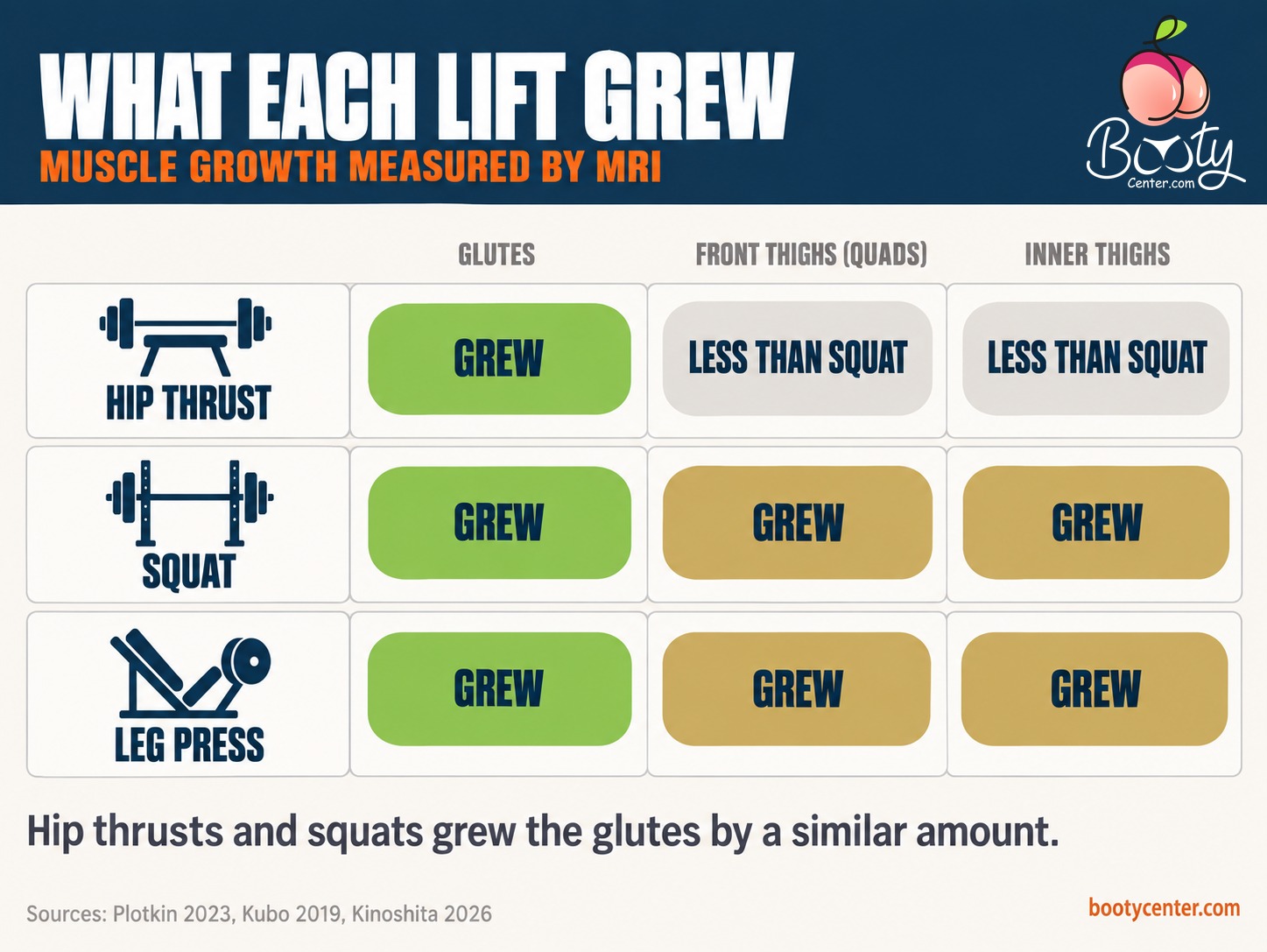 All three lifts grew the glutes. Squats and leg press also grew the thighs (Plotkin 2023, Kubo 2019, Kinoshita 2026).
One study points the other way on glute size. In 22 trained women, 12 weeks of squats grew the glutes more than hip thrusts, by 9.4% against 3.7% (Barbalho 2020). But squats also grew the front thighs by 12.2%, against 2% for hip thrusts. So even here, the hip thrust group gained almost no thigh size.
Treat that study with some care. It measured muscle thickness with ultrasound at single points, not the whole muscle, and its lead author has had four other papers retracted. Put together, squats may win on glute size for some people, but in every study here they brought thigh growth with them.
Which exercises grow glutes but not legs?
Hip thrusts and kneeling hip extensions are the best picks. A 2025 review of 12 training studies found that both grew the glutes (Krause Neto 2025). When the goal is to grow the glutes more than other muscles, the review advised putting single-joint hip moves like the hip thrust first.
A cable kickback on all fours is one version of the kneeling hip extension. If you are new to the hip thrust, start with our step-by-step guide on how to do a barbell hip thrust.
Squats and leg press still have a place. They are strong glute builders. Just keep them as extras in your week, not the base of it, if thigh size is the thing you want to limit. For the full picture of how to grow your glutes, see our guide on how to train glutes.
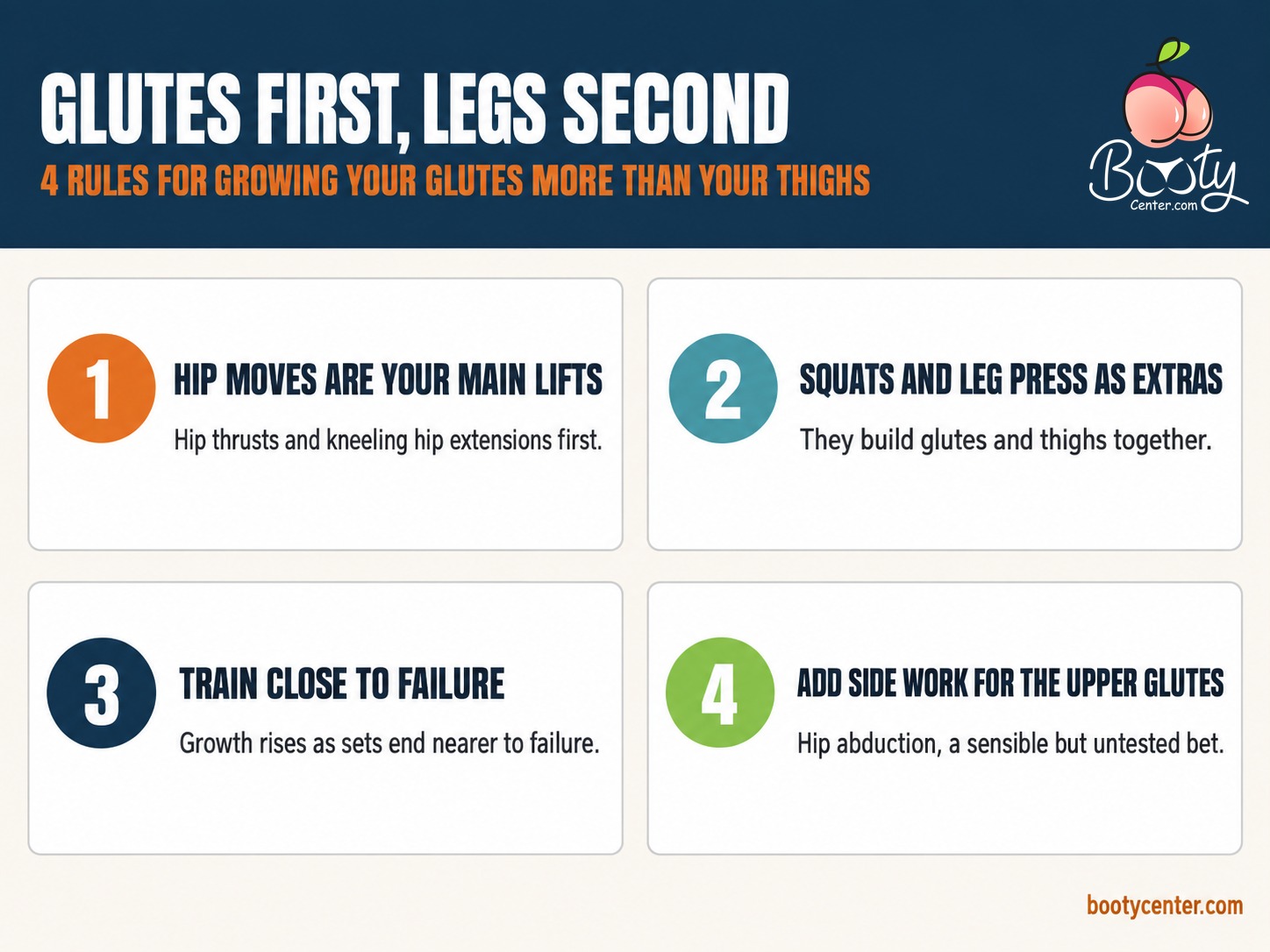 A glute-first plan. Rule 4 is a sensible bet that has not yet been tested for growth.
How hard and how much should you train your glutes?
Train close to failure and add sets over time. A 2024 analysis found that muscle growth rose as sets ended closer to failure, while strength gains stayed much the same (Robinson 2024). A 2026 analysis of 67 studies found that more weekly sets led to more growth, with smaller returns as the number of sets climbed (Pelland 2026). How many days you spread those sets over mattered much less.
In practice, pick 2 or 3 glute-first lifts. Work each set to within a few reps of failure. Every few weeks, add a set or a little weight. That steady push is what makes the butt grow, whichever lifts you choose.
Coach's tip
Log every hip thrust set with the weight and reps. If the numbers climb for months, your glutes are getting the signal. If they stall for 4 weeks or more, change one thing: the weight, the sets or how close to failure you go.
What does a glute-first week look like?
Here is an example week for how to grow glutes without growing legs. It is a coach's template built on the studies above, not a plan tested in a trial. Train these two days each week, with at least 2 rest days between them. If you are new to lifting, start with 2 sets per exercise and build up.
Day A
- Barbell hip thrust: 4 sets of 8 to 12 reps. Stop 1 to 2 reps before failure. Rest 2 to 3 minutes.
- Kneeling cable kickback: 3 sets of 12 to 15 reps on each leg. Stop 1 to 2 reps before failure. Rest 90 seconds.
- Seated hip abduction machine: 3 sets of 15 to 20 reps. Stop 0 to 2 reps before failure. Rest 60 to 90 seconds.
Day B
- Barbell hip thrust: 3 sets of 12 to 15 reps. Stop 1 to 2 reps before failure. Rest 2 minutes.
- Kneeling cable kickback: 3 sets of 12 to 15 reps on each leg. Stop 1 to 2 reps before failure. Rest 90 seconds.
- Seated hip abduction machine: 3 sets of 15 to 20 reps. Stop 0 to 2 reps before failure. Rest 60 to 90 seconds.
- Leg press (optional): 2 sets of 10 to 12 reps. Stop 2 reps before failure. Rest 2 minutes. Leave it out if you want the least thigh growth.
That is 19 hard sets for your butt each week, before any leg press. Add one set or a little weight every 2 to 3 weeks while your numbers keep climbing.
What about the upper glutes?
Squats and hip thrusts barely grew the upper glutes, the gluteus medius and minimus, in the MRI study (Plotkin 2023). These muscles move the leg out to the side, so side work like hip abduction is the logical fix. No study has tested it for growth in healthy people yet, so treat it as a sensible bet, not a proven one. Our hip dips guide explains this in more detail.
Is it muscle or fat on your thighs?
Sometimes bigger thighs come from fat, not muscle. Women tend to store more fat on the hips and thighs than men do (Karastergiou 2012). If you eat in a calorie surplus to build your glutes, some of the extra energy is likely to be stored there.
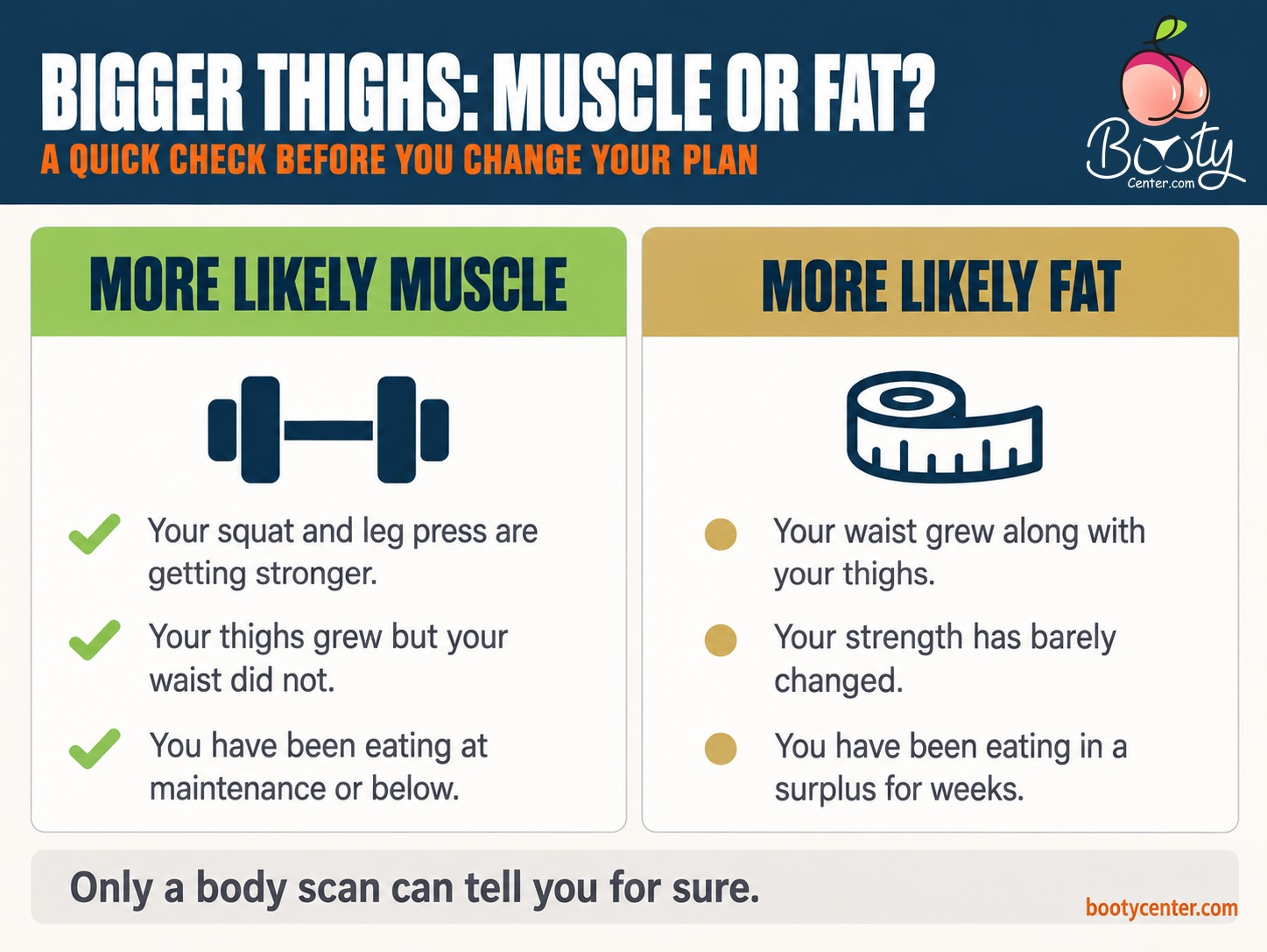 A coach's rule of thumb, not a test. Only a body scan can tell for sure.
The check in the figure is a coach's rule of thumb, not a test. If your leg strength is climbing and your waist is steady, the growth is more likely muscle. If your waist is growing too and your lifts are stuck, it is more likely fat. Only a body scan can tell you for sure.
If fat gain is the issue, the fix is in your eating, not your exercise list. Our guide to surplus vs recomp for glute growth helps you choose how much to eat.
Should you stop squatting?
No, not unless thigh size really bothers you. Squats grew the glutes more than hip thrusts in one study (Barbalho 2020), and the leg press grew them by 15.4% in another (Kinoshita 2026). The choice is about balance. Use more hip moves if you want glutes first. Use more squats and leg press if you are happy for your legs to grow as well.
What is the biggest mistake?
The biggest mistake is choosing exercises by the burn. In the MRI study, the hip thrust made the glutes fire harder than the squat in the first session, but that did not predict who grew more (Plotkin 2023). Feeling a muscle work is not the same as growing it. Pick lifts based on what they grew in studies, then push them hard and track your numbers.
Growing glutes, not legs, by the numbers
These are the key figures from the studies in this guide, all in one place.
- Similar glute growth from hip thrusts and squats over 9 weeks, with more thigh growth from squats (Plotkin 2023).
- 6.7% glute growth from 10 weeks of full squats, alongside 6.2% inner thigh and 4.9% front thigh growth (Kubo 2019).
- 15.4% glute growth from 12 weeks of leg press, alongside 4.9% front thigh growth (Kinoshita 2026).
- 12.2% vs 2% front thigh growth from squats vs hip thrusts in trained women (Barbalho 2020).
- 67 studies showing that more weekly sets lead to more muscle growth, with smaller returns at the top end (Pelland 2026).
Where the evidence runs thin
No study has put women on a glutes-only plan and measured whether their thighs stayed the same size. Most of the MRI studies here were short and used people new to lifting, and one was in men only. Two authors of the hip thrust study sell exercise products and helped fund it, although the result was a tie, not a win for the hip thrust. The upper-glute advice is untested. None of this changes the plan. It means the plan is the best bet we have, not a guarantee.
Bottom line
You can grow your glutes more than your legs, but not your butt alone. Make hip thrusts and kneeling hip extensions your main lifts, keep squats and leg press as extras, train close to failure and add side work for the upper glutes. If your thighs still grow, check whether it is muscle or fat before you change the plan.
Frequently asked questions
Do hip thrusts make your legs bigger?
Much less than squats do. In an MRI study, hip thrusts grew the glutes as much as squats but grew the front and inner thighs less. In trained women, 12 weeks of hip thrusts grew the front thighs by about 2%, against about 12% for squats.
Do squats grow your glutes or your quads?
Both. Ten weeks of full squats grew the glutes by 6.7% and the front thighs by 4.9%, and full squats grew the glutes more than half squats. If you want glutes without much thigh growth, make hip moves your main lifts and use squats as extras.
Can you grow your glutes without squats?
Yes. In an MRI study, hip thrusts grew the glutes as much as squats over 9 weeks. A 2025 review also found glute growth from kneeling hip extensions. Squats help, but they are not required to build your glutes.
Why are my thighs growing and not my glutes?
Either your plan leans on knee-heavy lifts like squats and leg press, or some of the growth is fat rather than muscle. Check your exercise list first. Then check whether your waist is growing too and whether you have been eating in a surplus.
Does the leg press grow your glutes?
Yes. In a 12-week MRI study, the leg press grew the glutes by 15.4%. It also grew the front thigh by 4.9% and part of the inner thigh by 6.2%, so it builds your glutes and your legs together.
How long does it take to see glute growth?
Give it at least 9 to 12 weeks. The MRI studies in this guide found measurable glute growth after 9 weeks of hip thrusts or squats, 10 weeks of full squats and 12 weeks of leg press. Changes show up on a scan before you see them in the mirror, so track your lifts and take photos every 4 weeks.
References
- Plotkin DL, Rodas MA, Vigotsky AD, McIntosh MC, Breeze E, Ubrik R, et al. Hip thrust and back squat training elicit similar gluteus muscle hypertrophy and transfer similarly to the deadlift. Front Physiol. 2023;14:1279170. doi:10.3389/fphys.2023.1279170
- Kubo K, Ikebukuro T, Yata H. Effects of squat training with different depths on lower limb muscle volumes. Eur J Appl Physiol. 2019;119(9):1933-42. doi:10.1007/s00421-019-04181-y
- Kinoshita M, Maeo S, Kobayashi Y, Eihara Y, Nishizawa N, Kusagawa Y, et al. Hypertrophic effects of single- versus multi-joint exercise: a direct comparison between knee extension and leg press. Med Sci Sports Exerc. 2026;58(7):1566-80. doi:10.1249/MSS.0000000000003957
- Barbalho M, Coswig V, Souza D, Serrao JC, Hebling Campos M, Gentil P. Back squat vs. hip thrust resistance-training programs in well-trained women. Int J Sports Med. 2020;41(5):306-10. doi:10.1055/a-1082-1126
- Krause Neto W, Krause TLV, Gama EF. The impact of resistance training on gluteus maximus hypertrophy: a systematic review and meta-analysis. Front Physiol. 2025;16:1542334. doi:10.3389/fphys.2025.1542334
- Robinson ZP, Pelland JC, Remmert JF, Refalo MC, Jukic I, Steele J, et al. Exploring the dose-response relationship between estimated resistance training proximity to failure, strength gain, and muscle hypertrophy: a series of meta-regressions. Sports Med. 2024;54(9):2209-31. doi:10.1007/s40279-024-02069-2
- Pelland JC, Remmert JF, Robinson ZP, Hinson SR, Zourdos MC. The resistance training dose response: meta-regressions exploring the effects of weekly volume and frequency on muscle hypertrophy and strength gains. Sports Med. 2026;56(2):481-505. doi:10.1007/s40279-025-02344-w
- Karastergiou K, Smith SR, Greenberg AS, Fried SK. Sex differences in human adipose tissues: the biology of pear shape. Biol Sex Differ. 2012;3(1):13. doi:10.1186/2042-6410-3-13