
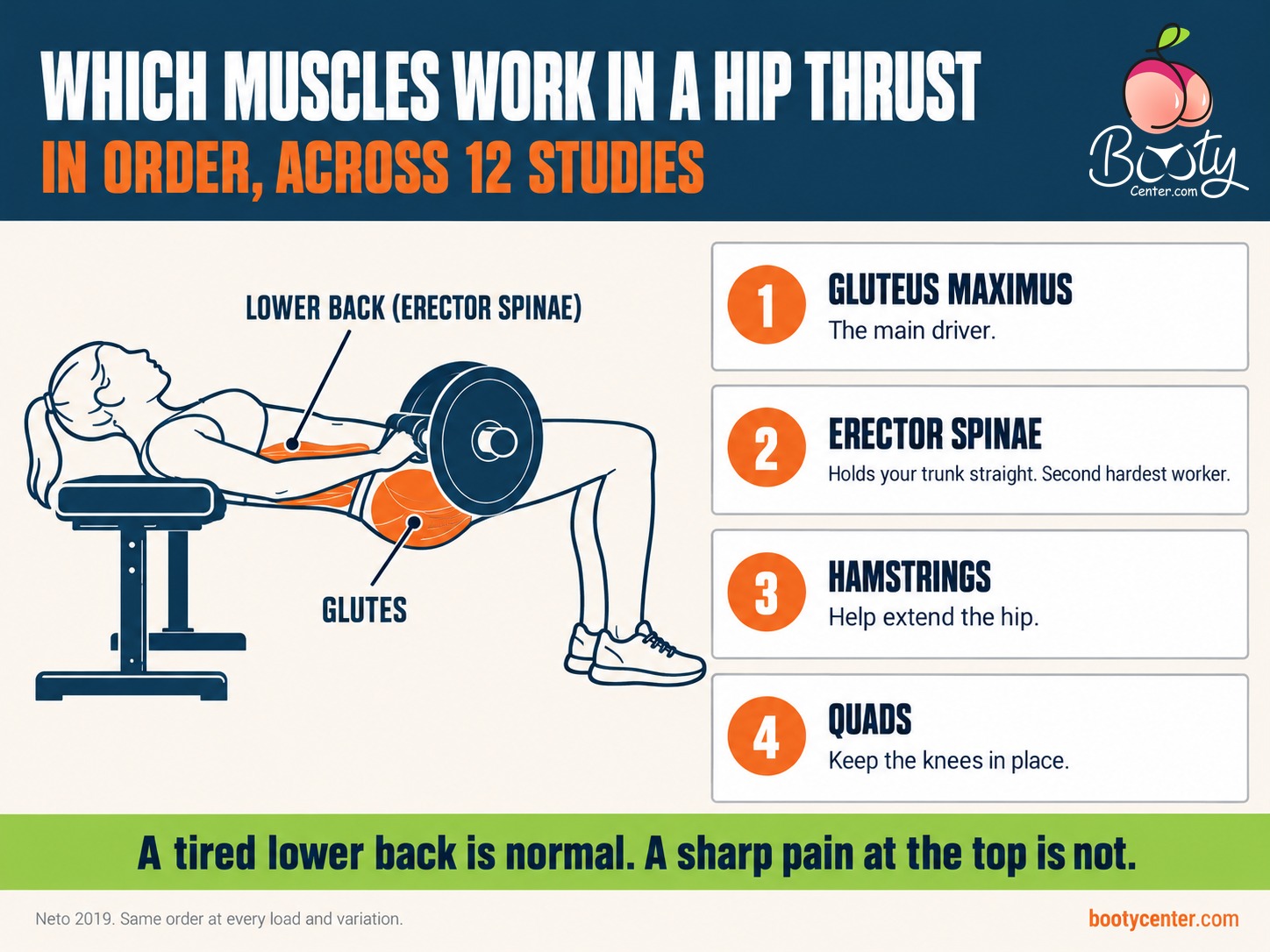
Lower back pain after hip thrusts is one of the most common complaints in glute training, and most advice gets the first fact wrong. Your lower back is supposed to work hard in a hip thrust. In the research, it is the second most active muscle in the lift, after the glutes. A tired back is not a sign you did it wrong. A sharp pain at the top of the rep is. Here is how to tell them apart and how to fix the bad kind.
Read the red flags section first. Some back pain needs a doctor, not a form cue.
Define: Soreness and pain
Soreness arrives 1 to 3 days after training, feels dull and spread out, sits on both sides, and fades on its own. Pain is sharp or pinching, often one spot, shows up during the lift, usually at the top, and can linger. Soreness is normal. Pain is a signal to change something.
Is it normal to feel hip thrusts in your lower back?
Yes, to a point. A 2019 review of 12 studies found that across every hip thrust variation and load, the muscles fire in the same order: gluteus maximus first, then the erector spinae, the long muscles beside your spine, then the hamstrings and quads (Neto 2019). Your lower back is the second hardest worker in this lift. It holds your trunk straight while your butt drives a heavy bar.
It works as hard as it does in a deadlift. In 13 trained men lifting their 1-rep max, erector spinae activity was the same in the hip thrust, the barbell deadlift and the hex bar deadlift (Andersen 2018). So if your lower back feels tired after a heavy set, that is the lift doing what it does. If it hurts, the next section explains why.
Why does your lower back hurt after hip thrusts?
The usual cause is that the rep ends with the back, not the hips. At the top, the hips should be fully open and the spine straight. Many lifters push past that point, arch the lower back and lift the chest. Now the back muscles are extending the spine under load instead of holding it still. Active trunk extension produces the highest loads on the lumbar spine of any back exercise in a lab model (Callaghan 1998). That is the pinch you feel at the top.
The pelvis is the switch. In 25 healthy adults doing bridges, tilting the pelvis backwards, which flattens the lower back, raised gluteus maximus activity and lowered multifidus activity, a deep spine muscle, compared with tilting it forwards (Jang 2024). Tilt forward and the back takes over. Tilt back and your butt takes over. The same mechanism applies to the hip thrust, though that study was on the floor bridge.
Three set-up problems push you into the arch:
- Bench too high or too low on your back. If the bench sits under your neck, your spine has to bend to reach the top. If it sits at your waist, there is no support. The edge belongs just under your shoulder blades.
- Feet too far out or too close. Foot position changes which muscles do the work. In 7 experienced trainers, moving the feet changed activity in every muscle measured except the side glute (Collazo García 2020). Too far away and the hamstrings take over. Too close and the pelvis tips.
- Too much weight, too soon. When the glutes cannot finish the rep, the back finishes it. Most back pain here is a load problem.
Coach's tip
Film one set from the side and watch the last 10 cm of the rep. If your ribs rise and your lower back arches before your hips reach the top, that is the problem.
How do you fix it?
Five changes, in this order. Do all of them with 60% to 70% of your usual weight for 2 sessions before loading back up.
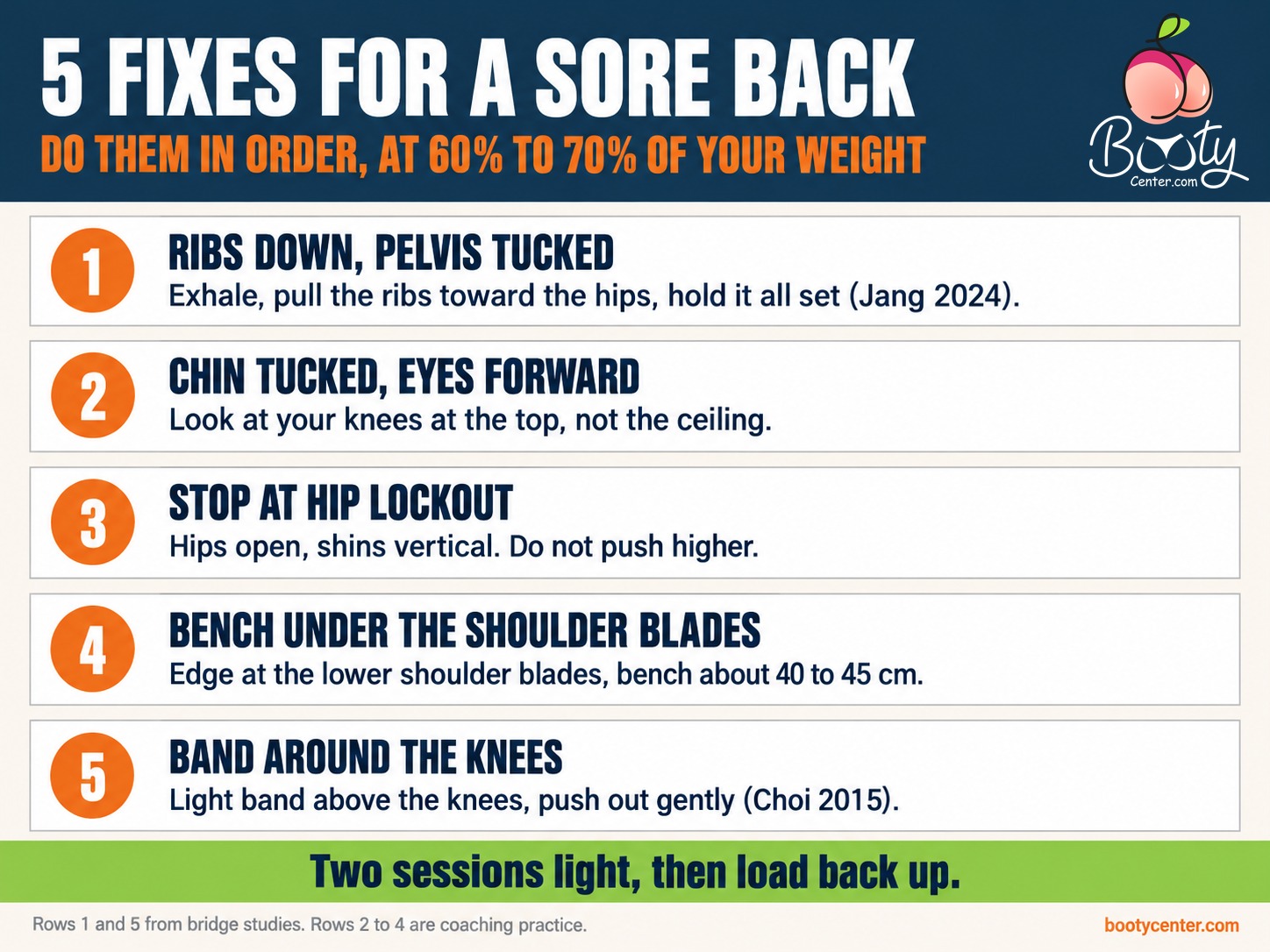 Five fixes, in order. Two are backed by bridge studies, three are coaching practice.
- 1. Ribs down, pelvis tucked. Before the first rep, exhale and pull your ribs toward your hips. Hold it for the whole set. This is the pelvic tilt that moved the work from the back to the glutes in the bridge study (Jang 2024).
- 2. Chin tucked, eyes forward. Looking at the ceiling pulls the spine into extension. Look at your knees at the top of each rep. Coaching practice, not a study result.
- 3. Stop at hip lockout. The rep ends when your hips are open and your shins are vertical. Do not push the hips higher than that. If your knees are past vertical at the top, your feet are too close.
- 4. Bench edge under the shoulder blades. Sit with your back against a standard bench, about 40 to 45 cm high. The edge should press into the lower part of your shoulder blades, not your neck.
- 5. Band around the knees. A light band above the knees, pushed out gently, raised gluteus maximus activity and reduced forward pelvic tilt in 21 adults doing bridges (Choi 2015). It also stops the knees caving in.
For the full set-up, see our guide on how to do a barbell hip thrust. If you fix the form and still cannot feel your glutes, our guide on why you can't feel your glutes covers the next step.
Is a sore back the next day normal?
Usually, yes. Delayed onset muscle soreness peaks 1 to 3 days after unfamiliar or hard training and affects any muscle that worked, including the erector spinae (Cheung 2003). It feels dull, sits on both sides, and improves with light movement. If you just started hip thrusts, added a lot of weight, or came back from a break, expect it. If the feeling is sharp, on one side, or still there after a week, treat it as pain, not soreness.
When should you see a doctor?
Most back pain from training settles with rest and better form. Guidelines list a small set of warning signs that need a doctor, not a form fix (Verhagen 2016, Oliveira 2018). See a doctor or physio soon if you have any of these:
- Pain that spreads down one or both legs, or numbness or tingling in a leg or foot.
- Weakness in a leg, or trouble lifting your foot.
- Any change in bladder or bowel control, or numbness around the groin. This one is urgent.
- Pain that started with a fall or a heavy load dropping on you.
- Fever, unexplained weight loss, or pain that is worse at night and does not change with position.
- Pain that is not improving after 4 weeks, or that keeps coming back every session.
Not a complete list, and we are coaches, not doctors. When in doubt, get it checked.
Should you switch to glute bridges?
It can help while you relearn the pattern, but it is a workaround, not a fix. The floor bridge has about half the bar travel of the hip thrust, so there is less room to overextend at the top. No study has compared back pain between the two. Our guide on glute bridge vs hip thrust covers when to use each. If the bridge feels fine and the thrust does not, use the bridge for 2 to 3 weeks, then return with the five fixes.
Do weak glutes cause the back pain?
Maybe. A 2019 review of 24 studies found that people with low back pain tend to have weaker side glutes, but the studies could not show which came first (Sadler 2019). In the hip thrust the simpler explanation is load: if your butt cannot finish the rep, your back does. Our guide on signs of weak glutes covers the bigger picture.
A 3-session reset
A coach's template built on the studies above, not a tested protocol. Run it over one week with at least 48 hours between sessions. If any session produces sharp pain, stop and see a physio.
- Session 1: bodyweight glute bridges, 3 sets of 12 reps with a 2-second hold at the top, ribs down the whole time. Rest 60 seconds. Then hip thrusts at 50% of your usual weight, 3 sets of 10, stopping at hip lockout. Rest 2 minutes. Film the last set.
- Session 2: banded glute bridges, 2 sets of 12, rest 60 seconds. Hip thrusts at 60% to 70% of your usual weight, 3 sets of 8 to 10 with a 1-second pause at lockout, about 7 out of 10 effort. Rest 2 to 3 minutes.
- Session 3: hip thrusts at 80% of your usual weight, 3 to 4 sets of 6 to 10, stopping 2 reps before failure, about 8 out of 10 effort. Rest 2 to 3 minutes. If the back is quiet, add 2.5 to 5 kg next week.
Keep the band, the ribs-down cue and the chin tuck at full weight. Our pillar guide on how to train glutes shows where the hip thrust fits in a full week.
Lower back pain after hip thrusts, by the numbers
- Second: where the erector spinae ranks for activity in the hip thrust, after the glutes, across 12 studies (Neto 2019).
- No difference: erector spinae activity in the hip thrust against the barbell and hex bar deadlift, in 13 trained men at 1RM (Andersen 2018).
- Pelvis back: higher glute max and lower multifidus activity than pelvis forward, in 25 adults doing bridges (Jang 2024).
- 21 adults: a band around the knees raised glute activity and reduced forward pelvic tilt in the bridge (Choi 2015).
- 1 to 3 days: when normal muscle soreness peaks after hard or new training (Cheung 2003).
- 4 weeks: the point at which guidelines say back pain that is not improving needs a specialist (Oliveira 2018).
Where the evidence runs thin
No study has measured back pain or spine load in the hip thrust itself. The pelvic tilt and band studies were on the floor bridge in healthy people, and the spine load model was built from trunk extension exercises, not hip thrusts. The bench height, chin tuck and lockout cues are coaching practice. The 3-session reset is a coach's template. We are coaches, not clinicians: the red flags list comes from guidelines but is not complete.
Bottom line
Your lower back is meant to work in a hip thrust, so a tired back after a heavy set is normal. Sharp pain at the top of the rep usually means the back is finishing the lift because the pelvis tipped forward or the load is too heavy. Ribs down, chin tucked, stop at lockout, bench under the shoulder blades, band on the knees, and 2 sessions at lighter weight. If you have numbness, leg pain, or pain that lasts past 4 weeks, see a doctor.
Frequently asked questions
Why do I feel hip thrusts in my lower back instead of my glutes?
Because the back is the second most active muscle in the lift (Neto 2019), and if the pelvis tips forward at the top, it takes over from the glutes (Jang 2024). Tuck the pelvis, keep the ribs down, and stop the rep at hip lockout.
Is it normal for my lower back to be sore after hip thrusts?
Dull soreness on both sides 1 to 3 days later is normal muscle soreness and fades on its own (Cheung 2003). Sharp pain, one-sided pain, or pain during the lift is not soreness. Fix the form, and see a physio if it stays.
Can hip thrusts cause lower back pain?
They can when the rep ends with a back arch under heavy load. Active spine extension carries the highest lumbar loads of any back exercise in a lab model (Callaghan 1998). Done with a tucked pelvis and a stop at lockout, the hip thrust loads the back about as much as a deadlift does (Andersen 2018).
Where should the bench be on my back?
The edge should sit just under your shoulder blades, on a bench about 40 to 45 cm high. Too high and your neck bends. Too low and your back has no support. Coaching practice, not a study result.
Should I use a band for hip thrusts if my back hurts?
It is worth trying. In 21 adults doing bridges, a band above the knees raised glute activity and reduced forward pelvic tilt (Choi 2015). Push the knees out gently through the whole rep.
How long should I wait before going heavy again?
Two sessions at 60% to 70% of your usual weight with the five fixes above, then one session at 80%. If the back stays quiet, add 2.5 to 5 kg a week. If sharp pain returns at any point, stop and see a physio.
References
- Neto WK, Vieira TL, Gama EF. Barbell hip thrust, muscular activation and performance: a systematic review. J Sports Sci Med. 2019;18(2):198-206.
- Andersen V, Fimland MS, Mo DA, Iversen VM, Vederhus T, Rockland Hellebø LR, et al. Electromyographic comparison of barbell deadlift, hex bar deadlift, and hip thrust exercises: a cross-over study. J Strength Cond Res. 2018;32(3):587-93. doi:10.1519/JSC.0000000000001826
- Callaghan JP, Gunning JL, McGill SM. The relationship between lumbar spine load and muscle activity during extensor exercises. Phys Ther. 1998;78(1):8-18. doi:10.1093/ptj/78.1.8
- Jang TJ, Jeon IC. Effects of pelvic tilt control using visual biofeedback on gluteus maximus, multifidus, and hamstring activities during three different bridge exercises. Physiother Theory Pract. 2024;40(12):2795-804. doi:10.1080/09593985.2023.2297001
- Collazo García CL, Rueda J, Suárez Luginick B, Navarro E. Differences in the electromyographic activity of lower-body muscles in hip thrust variations. J Strength Cond Res. 2020;34(9):2449-55. doi:10.1519/JSC.0000000000002859
- Choi SA, Cynn HS, Yi CH, Kwon OY, Yoon TL, Choi WJ, et al. Isometric hip abduction using a Thera-Band alters gluteus maximus muscle activity and the anterior pelvic tilt angle during bridging exercise. J Electromyogr Kinesiol. 2015;25(2):310-5. doi:10.1016/j.jelekin.2014.09.005
- Cheung K, Hume P, Maxwell L. Delayed onset muscle soreness: treatment strategies and performance factors. Sports Med. 2003;33(2):145-64. doi:10.2165/00007256-200333020-00005
- Verhagen AP, Downie A, Popal N, Maher C, Koes BW. Red flags presented in current low back pain guidelines: a review. Eur Spine J. 2016;25(9):2788-802. doi:10.1007/s00586-016-4684-0
- Oliveira CB, Maher CG, Pinto RZ, Traeger AC, Lin CC, Chenot JF, et al. Clinical practice guidelines for the management of non-specific low back pain in primary care: an updated overview. Eur Spine J. 2018;27(11):2791-803. doi:10.1007/s00586-018-5673-2
- Sadler S, Cassidy S, Peterson B, Spink M, Chuter V. Gluteus medius muscle function in people with and without low back pain: a systematic review. BMC Musculoskelet Disord. 2019;20(1):463. doi:10.1186/s12891-019-2833-4