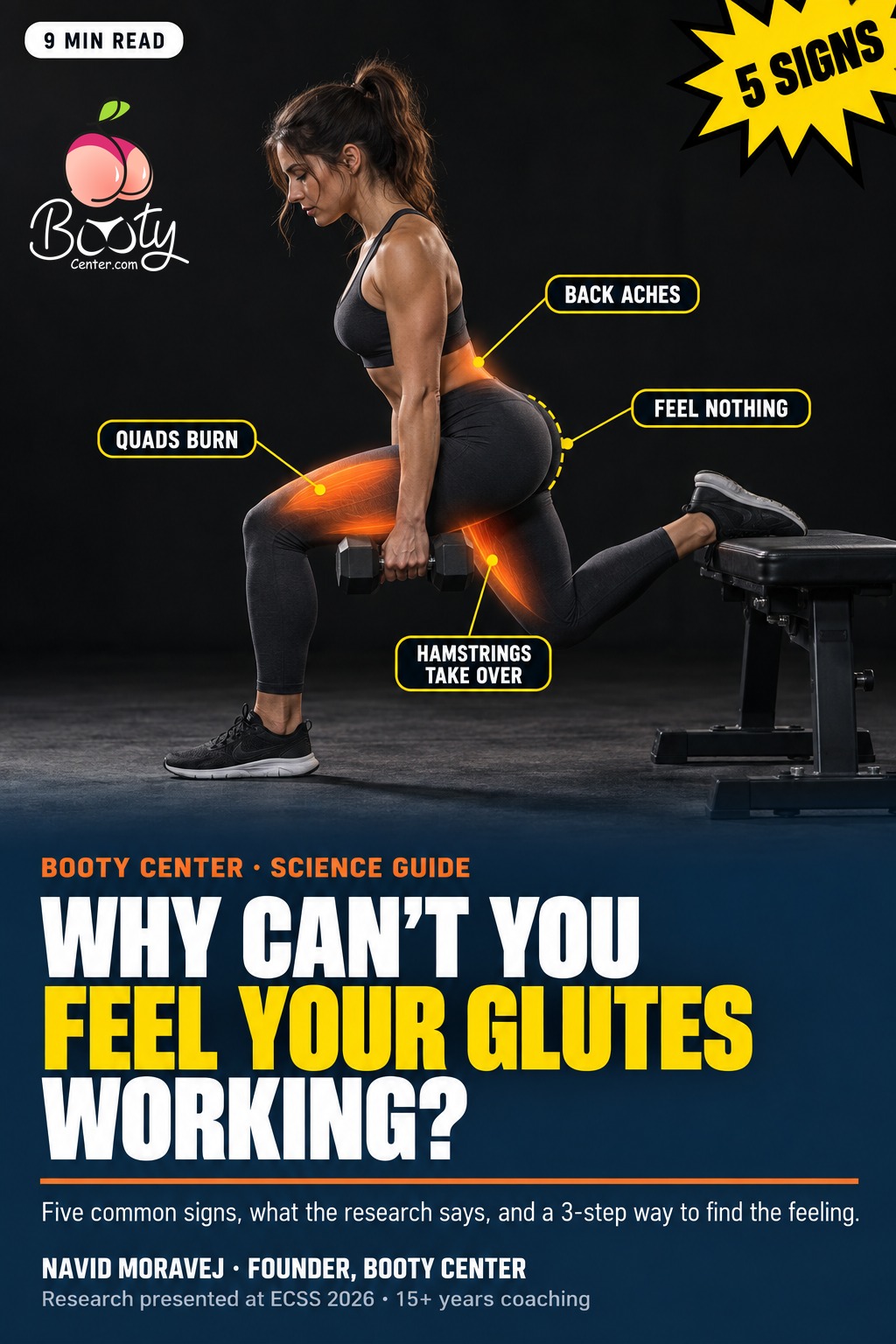
Why can't I feel my glutes? Often it is because your quads and hamstrings share the job, and your set-up, your weight and your focus all change where you feel the work. Not feeling it does not mean your glutes are switched off. It does not mean your butt is not growing either.
If you keep asking why can't I feel my glutes, this guide shows what the research says about the feeling, which cues help and which do not, and a 3-step check you can run in one workout.
Feel, activation and growth
Feel is the sensation you notice. Activation is the electrical signal a lab measures with EMG. Growth is the change in muscle size, measured on a scan or with ultrasound after weeks of training. They are three different things.
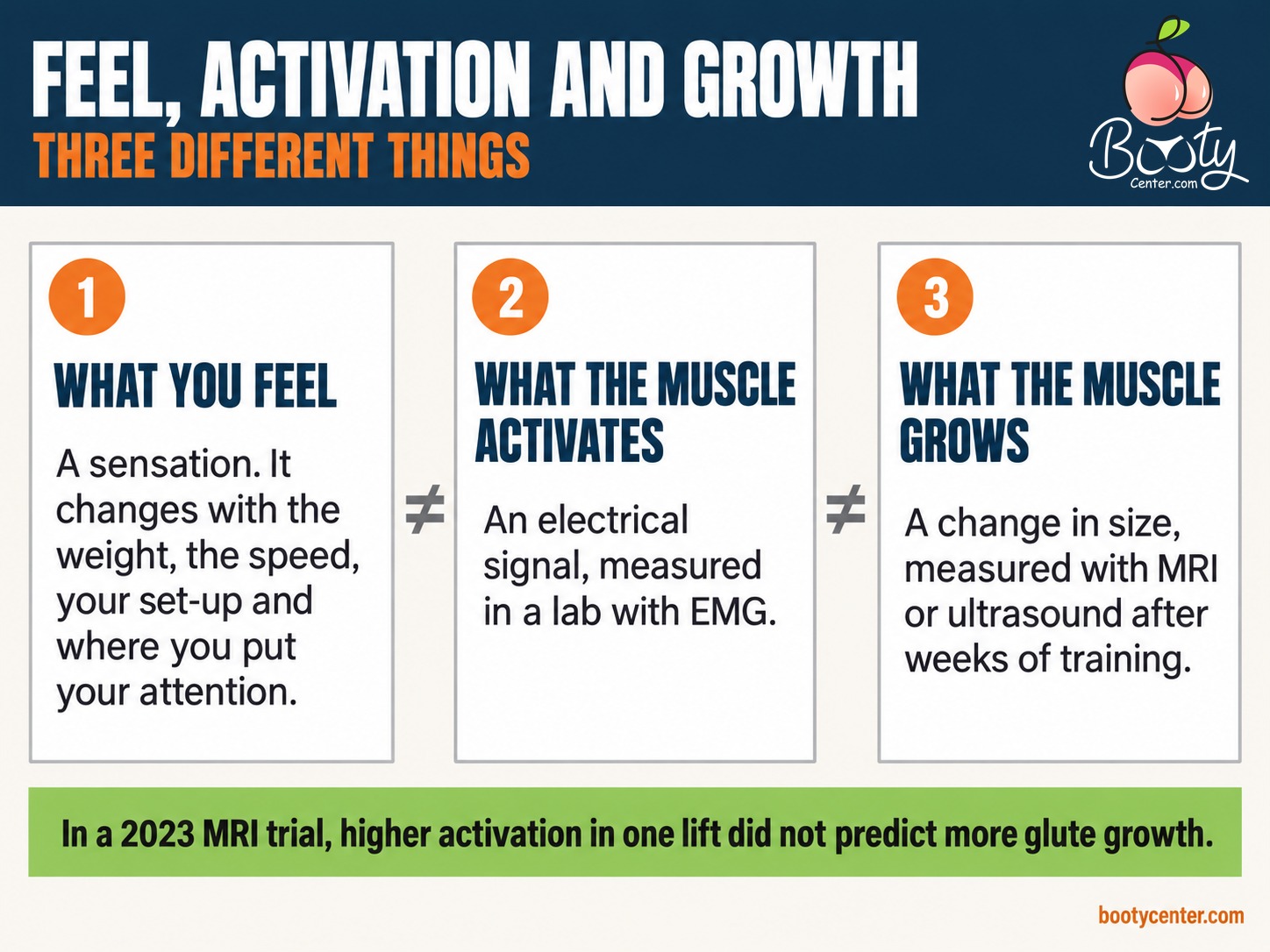 Feel, activation and growth are not the same. In one MRI trial, higher activation did not predict more glute growth (Plotkin 2023).
Table of Contents
What are the signs you are not feeling your glutes?
These are the five most common reports from lifters on fitness sites and forums. They are self-reports, not a test.
- Your quads burn first. You squat, lunge or do split squats and the front of your thighs feel it most.
- Your hamstrings take over. You hip thrust or bridge and the back of your thighs burn or cramp.
- Your lower back takes the load. The set ends with an ache in your back, not a squeeze in your butt.
- Only your thighs are sore the next day. Your quads hurt, but your glutes never do.
- You feel nothing at all. You finish the set and cannot tell where the work went.
If you tick one or more, you are not alone. Signs 1 and 2 are normal, because those muscles work too. For sign 3, see our guide on why your lower back hurts after hip thrusts. Signs 4 and 5 do not tell you if your glutes are growing.
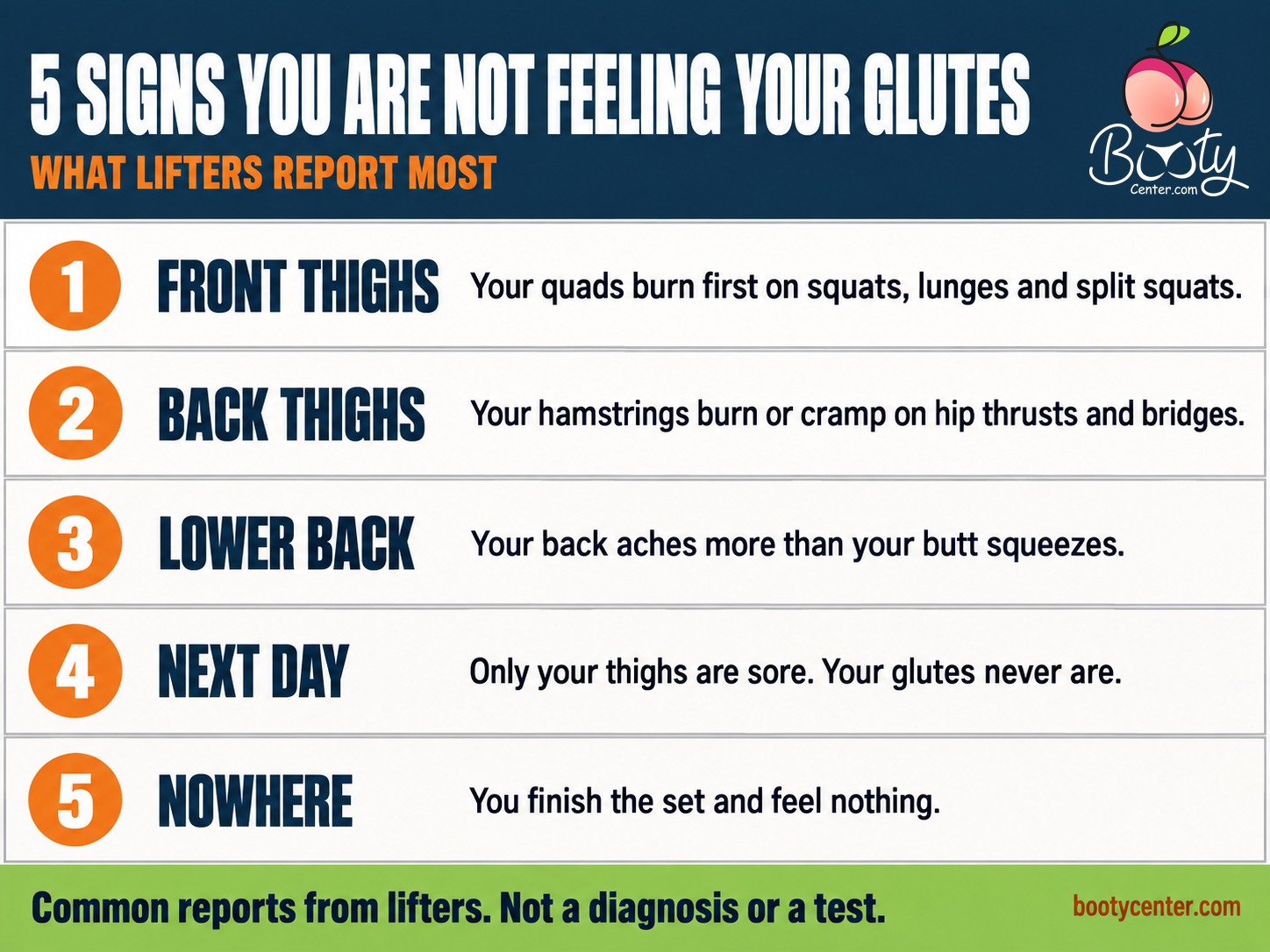 Five common reports from lifters who cannot feel their glutes. Self-reports, not a test.
Why do you feel your quads or hamstrings instead?
Because the lifts that train your glutes train those muscles too. In 20 women with some lifting experience, both the hip thrust and the rear-foot-elevated split squat (also called the Bulgarian split squat) worked the glutes, hamstrings and quads (McCurdy 2021). The hip thrust worked all of them hardest at the top of the lift. The split squat worked all of them hardest at the bottom.
Over the whole rep, the split squat used the outer front thigh more, with an average activation of 59.4% against 43.6% for the hip thrust. So feeling your hamstrings or quads in these lifts is normal. They really are working. It also tells you where to look for your glutes: at the top of a hip thrust and at the bottom of a split squat.
Can your set-up change where you feel it?
Probably, but the evidence is small. In 7 experienced personal trainers, moving the feet further from the body and changing the direction of effort in the hip thrust changed how hard the glutes, hamstrings and quads worked (Collazo García 2020). The load was light, about 40% of their maximum.
Seven people is a hint, not proof. It does suggest that small changes can shift the feeling, so test a few positions. Our guide on how to do a barbell hip thrust shows a good starting set-up.
Which lift is easiest to feel in your glutes?
There is no guaranteed winner. A 2020 review of 16 studies found that many lifts take the glutes above 60% of their maximum in the lab, including the hip thrust, split squat, lunge, step-up and conventional deadlift. Step-up variations scored highest (Neto 2020).
Activation is not growth, so this does not tell you which lift builds the most muscle. It does tell you that if one lift gives you nothing, others may work for you. Try a step-up or a split squat for 3 workouts before you decide.
Does thinking about your glutes help?
Sometimes. In 15 trained men, focusing on the back of the legs during a back squat raised glute and hamstring activity and lowered quad activity, at both 50% and 80% of their max (Coratella 2022). In a bench press study, a muscle focus raised target muscle activity at 20% to 60% of max but not at 80% (Calatayud 2016). The two lifts were different.
Does it help growth? In an 8-week trial of 30 untrained men, thinking about contracting the muscle grew the muscles that bend the elbow more than thinking about the lift, 12.4% against 6.9%. Thigh growth was similar in both groups (Schoenfeld 2018). We could not find a trial that tested it on glute growth.
Thinking about moving the bar has its own benefit. In a 2021 meta-analysis, an outside focus gave bigger gains in lower-body strength than an inside focus (Grgic 2021). So it makes sense to use both, in different places.
Does a squeeze cue isolate your glutes?
No. In 30 young women doing a bridge, verbal and touch cues aimed at the glutes raised glute activity from about 17% to 33% of maximum. Hamstring activity rose almost as much, from about 17% to 30%. The control group did not change (Hollman 2018). A cue can turn the whole hip up, not just your butt.
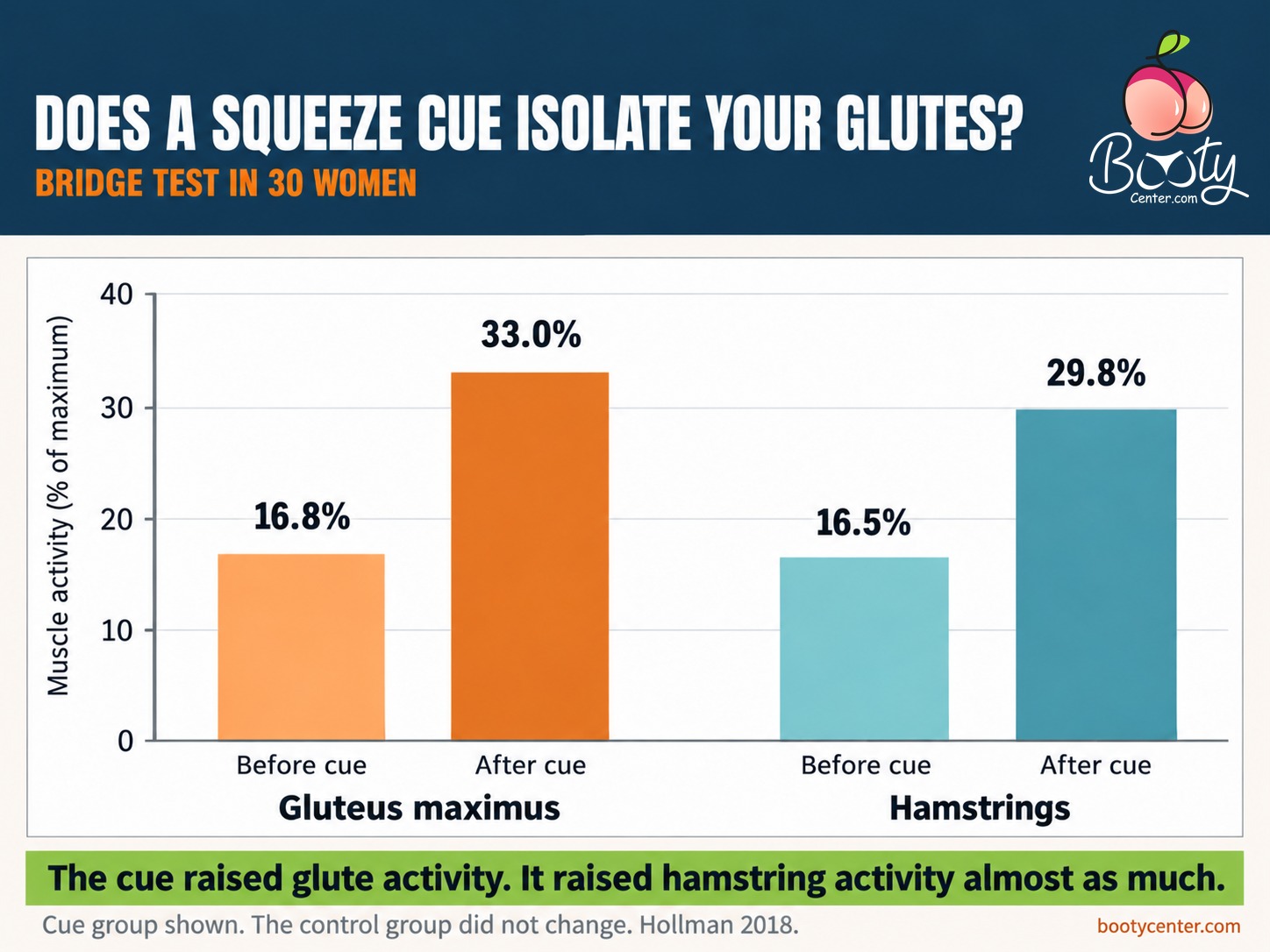 A cue turned up the glutes and the hamstrings together (Hollman 2018).
Coach's tip
Do not judge a cue by whether it feels strong. Judge it by whether you feel your glutes more than your hamstrings in the same set. If both rise together, that is normal.
Is it gluteal amnesia or dead butt syndrome?
Those are popular names, not proven diagnoses. In our search, we could not find an agreed definition or a validated test for them. A 2019 clinical commentary says the gluteus maximus can be weak or inhibited, but it also says little research exists on how to assess and treat it (Buckthorpe 2019). That paper is expert opinion, not a trial.
See a doctor or physio if you have sharp or lasting pain in your back, hip or knee, numbness or tingling, or pain that spreads down your leg. Do not try to fix pain with a glute exercise you saw online.
Does not feeling your glutes mean they are not growing?
No. In an MRI trial of 34 untrained adults, the hip thrust fired the glutes harder than the squat in the first session. After 9 weeks, both lifts had grown the glutes by a similar amount, so the extra activity did not consistently predict extra growth (Plotkin 2023). A 2022 paper in Sports Medicine also concluded that surface EMG is not a validated predictor of muscle growth (Vigotsky 2022).
Soreness is no better a guide. In an 8-week eccentric cycling study, a group that avoided soreness by ramping up slowly gained as much muscle as a group that got sore (Flann 2011). No burn, no pump and no soreness is not proof of no growth. Your numbers are a better check: more weight or more reps over several weeks.
How can you find your glutes in one workout?
Run this 3-step check on a hip thrust or glute bridge. It is a coach's template built on the studies above, not a plan tested in a trial. Warm up first with 1 set of 12 bodyweight reps.
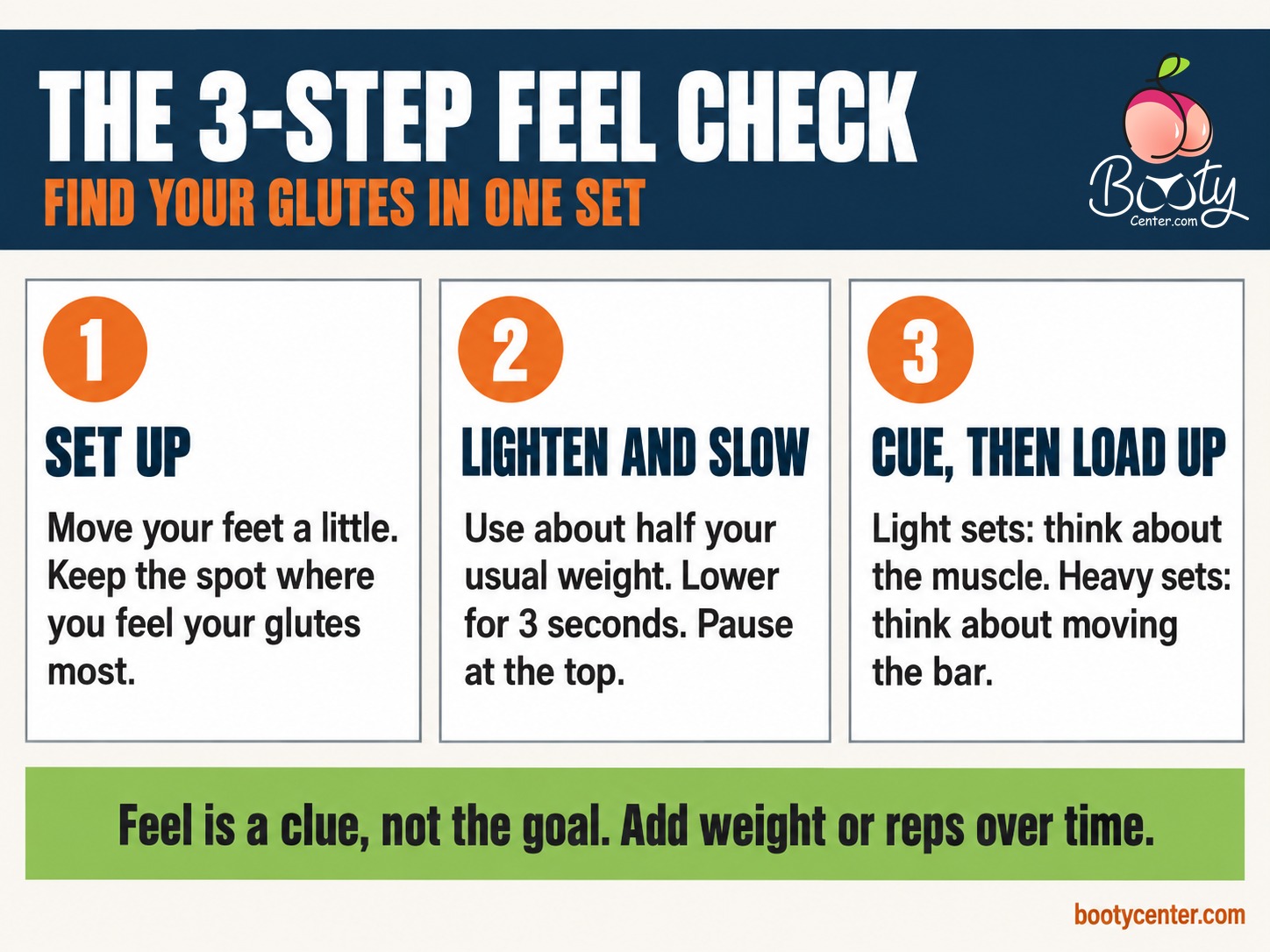 A coach's template built on the studies in this guide, not a plan tested in a trial.
- Step 1, set up: do 3 sets of 6 slow reps with a light weight, about half your usual working weight. Change your foot position each set: close to your hips, your usual spot, then a little further away. Rest 60 seconds between sets. Keep the spot where you feel your glutes most.
- Step 2, lighten and slow: do 2 sets of 12 reps at about half your usual working weight. Take 3 seconds to lower, pause for 2 seconds at the top and take 1 second to lift. Stop 3 reps before failure, about 7 out of 10 effort. Rest 90 seconds. Think about your glutes squeezing.
- Step 3, cue, then load up: do 3 to 4 sets of 8 to 12 reps at your normal working weight. Stop 1 to 2 reps before failure, about 8 to 9 out of 10 effort. Rest 2 to 3 minutes. This time, think about driving the bar up.
Repeat this for 3 workouts. Then ask one question: do I feel my glutes more than my hamstrings in the light sets? If yes, keep that foot position and use the light sets as your warm-up. If no, it is fine. Keep training hard and track your numbers. For more on hip moves, see our guides on glute bridge vs hip thrust and how to train glutes.
Coach's tip
After each workout, write down your foot position, the weight you used, and whether you felt your glutes more than your hamstrings. After 3 workouts, the pattern shows what works for you.
What is the biggest mistake?
The biggest mistake is staying light to chase the feeling. Light, slow sets are a tool to find your glutes. They are not the whole plan. A 2024 analysis found that muscle growth rose as sets ended closer to failure, while strength gains stayed much the same (Robinson 2024). Once you know where your glutes are, add weight or reps over the weeks.
A close second is swapping exercises every week to find a burn. We explain why feel is a poor way to pick lifts in our guide on how to grow glutes without growing legs.
Feeling your glutes, by the numbers
- 33.0% vs 16.8%: glute activity after and before a cue in a bridge. Hamstrings rose from 16.5% to 29.8% (Hollman 2018).
- 59.4% vs 43.6%: average outer front thigh activity over a full rep, split squat against hip thrust (McCurdy 2021).
- 12.4% vs 6.9%: growth of the muscles that bend the elbow with an inside focus against an outside focus. Thigh growth was similar (Schoenfeld 2018).
- 7 people: the size of the foot-position study, so treat it as a hint (Collazo García 2020).
Where the evidence runs thin
Most studies here measured muscle activity in a lab, not how strongly people felt their glutes. We did not find a study that measured both at the same time. The cue studies were small, the squat cue study was in men only, and the growth trial of mind-muscle focus used untrained men and did not test the glutes. The foot-position study had 7 people. The 3-step check is a sensible bet, not a proven method.
Bottom line
Feeling your glutes is a clue, not the goal, and not feeling it is not proof your butt is not growing. Expect your quads and hamstrings to join in, test your foot position, use light slow sets to find the feeling, then go heavy with a bar focus and track your numbers. If you have pain, see a clinician.
Frequently asked questions
Why can't I feel my glutes when I squat?
Because squats work your quads and hips at the same time, and the quads are easier to feel. In men, a focus on the back of the legs raised glute activity in the squat (Coratella 2022). Try the 3-step check above with a light squat first.
Why do I feel hip thrusts in my hamstrings?
Because your hamstrings work in the hip thrust too. In 20 women, hamstring activity was highest at the top of the lift, just like the glutes (McCurdy 2021). Moving your feet a little can change the feeling (Collazo García 2020), so test two or three positions with a light weight.
Do I need to feel my glutes to grow them?
No. In an MRI trial, the hip thrust fired the glutes harder than the squat, yet both grew them by a similar amount (Plotkin 2023). Soreness is not required either (Flann 2011). Track your weights and reps over weeks instead.
Does mind-muscle connection work for glutes?
Sometimes. A muscle focus raised target muscle activity in several lab studies, and it grew the muscles that bend the elbow more in one 8-week trial in untrained men (Schoenfeld 2018). Thigh growth was the same either way. We could not find a glute growth trial. Use it on light sets and a bar focus on heavy sets.
Is glute amnesia real?
It is a popular term, not a proven diagnosis. In our search we could not find an agreed definition or a validated test. A 2019 clinical commentary says the gluteus maximus can be weak or inhibited but notes little research on assessing it (Buckthorpe 2019). See a physio if you have pain.
Why do I feel hip thrusts in my lower back?
A sore lower back after hip thrusts is a common complaint. If the pain is sharp, lasts, or spreads down your leg, stop and see a clinician. Otherwise, our lower back guide explains common fixes.
References
- McCurdy K, Walker J, Kelly C, Polinski M. Hip and knee extensor activation during the hip thrust and rear-foot-elevated split squat in trained females. J Strength Cond Res. 2021;35(5):1201-7. doi:10.1519/JSC.0000000000004035
- Collazo García CL, Rueda J, Suárez Luginick B, Navarro E. Differences in the electromyographic activity of lower-body muscles in hip thrust variations. J Strength Cond Res. 2020;34(9):2449-55. doi:10.1519/JSC.0000000000002859
- Coratella G, Tornatore G, Longo S, Borrelli M, Doria C, Esposito F, et al. The effects of verbal instructions on lower limb muscles' excitation in back-squat. Res Q Exerc Sport. 2022;93(2):429-35. doi:10.1080/02701367.2020.1840496
- Calatayud J, Vinstrup J, Jakobsen MD, Sundstrup E, Brandt M, Jay K, et al. Importance of mind-muscle connection during progressive resistance training. Eur J Appl Physiol. 2016;116(3):527-33. doi:10.1007/s00421-015-3305-7
- Schoenfeld BJ, Vigotsky A, Contreras B, Golden S, Alto A, Larson R, et al. Differential effects of attentional focus strategies during long-term resistance training. Eur J Sport Sci. 2018;18(5):705-12. doi:10.1080/17461391.2018.1447020
- Grgic J, Mikulic I, Mikulic P. Acute and long-term effects of attentional focus strategies on muscular strength: a meta-analysis. Sports (Basel). 2021;9(11):153. doi:10.3390/sports9110153
- Neto WK, Soares EG, Vieira TL, Aguiar R, Chola TA, Sampaio VL, et al. Gluteus maximus activation during common strength and hypertrophy exercises: a systematic review. J Sports Sci Med. 2020;19(1):195-203.
- Hollman JH, Berling TA, Crum EO, Miller KM, Simmons BT, Youdas JW. Do verbal and tactile cueing selectively alter gluteus maximus and hamstring recruitment during a supine bridging exercise in active females? A randomized controlled trial. J Sport Rehabil. 2018;27(2):138-43. doi:10.1123/jsr.2016-0130
- Buckthorpe M, Stride M, Villa FD. Assessing and treating gluteus maximus weakness: a clinical commentary. Int J Sports Phys Ther. 2019;14(4):655-69.
- Plotkin DL, Rodas MA, Vigotsky AD, McIntosh MC, Breeze E, Ubrik R, et al. Hip thrust and back squat training elicit similar gluteus muscle hypertrophy and transfer similarly to the deadlift. Front Physiol. 2023;14:1279170. doi:10.3389/fphys.2023.1279170
- Vigotsky AD, Halperin I, Trajano GS, Vieira TM. Longing for a longitudinal proxy: acutely measured surface EMG amplitude is not a validated predictor of muscle hypertrophy. Sports Med. 2022;52(2):193-9. doi:10.1007/s40279-021-01619-2
- Flann KL, LaStayo PC, McClain DA, Hazel M, Lindstedt SL. Muscle damage and muscle remodeling: no pain, no gain? J Exp Biol. 2011;214(Pt 4):674-9. doi:10.1242/jeb.050112
- Robinson ZP, Pelland JC, Remmert JF, Refalo MC, Jukic I, Steele J, et al. Exploring the dose-response relationship between estimated resistance training proximity to failure, strength gain, and muscle hypertrophy: a series of meta-regressions. Sports Med. 2024;54(9):2209-31. doi:10.1007/s40279-024-02069-2