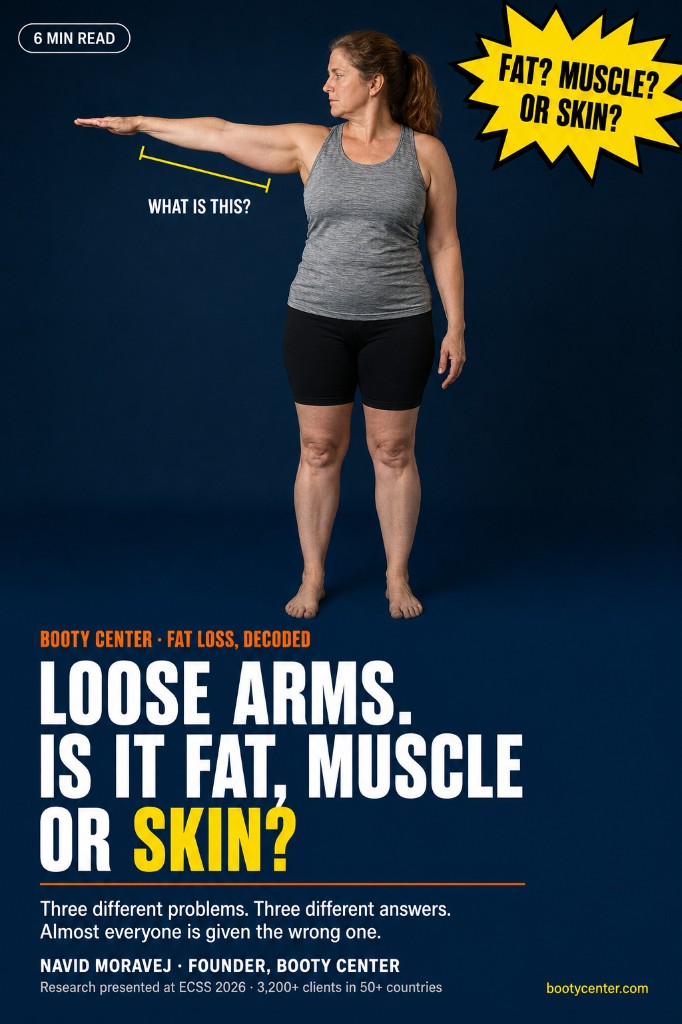
You raise your arm to wave and something moves that you would rather did not. Then you search for a fix and every result says the same thing: do more arm exercises. That advice fails for most people, and it fails for a specific reason. The back of your upper arm can look loose for three completely different reasons, and only one of them answers to arm exercises.
"Tricep kickbacks will tone your arms."
Three problems wearing one name
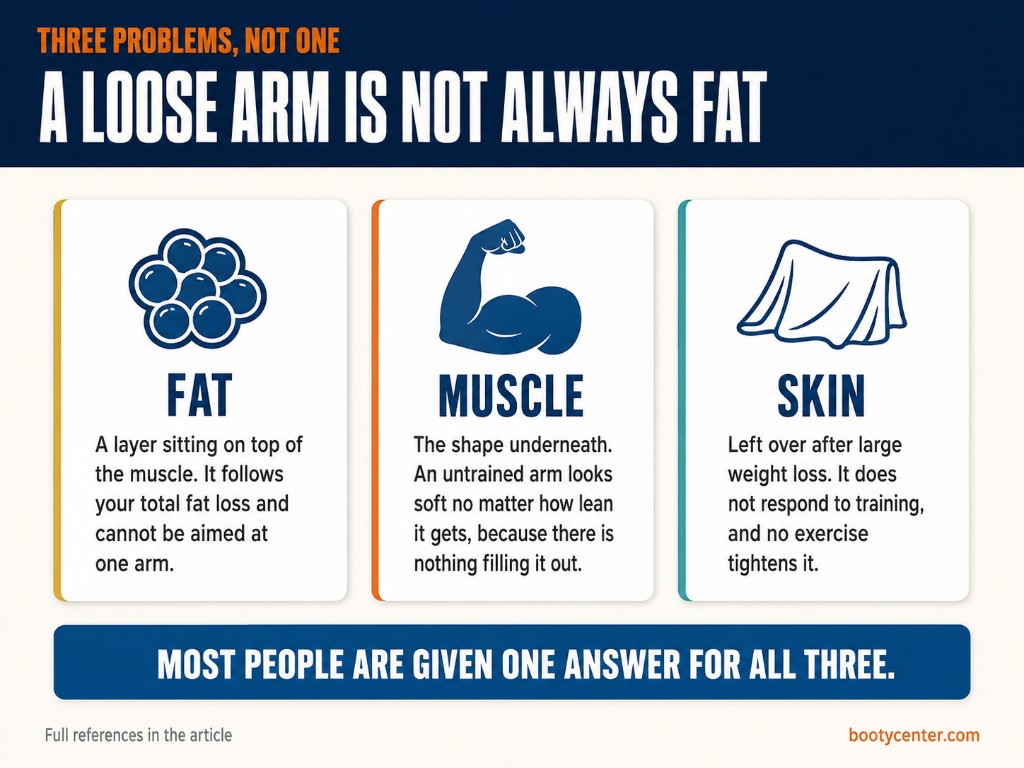 Three different problems, and most advice prescribes for only one of them.
Fat is a layer sitting on top of the muscle. It comes off when your total comes off, in the order your biology chose.
Muscle is the shape underneath. An arm with very little muscle looks soft however lean it gets, because there is nothing filling it out. Hip dips work the same way: the dip is space the muscle has not filled, not a pocket of fat you can aim at.
Skin is what is left over after large weight loss. It is not fat and it is not muscle, and it does not answer to training at all.
Most advice picks one of these, usually fat, and prescribes for it regardless of which one you actually have. If you are given a fat solution for a skin problem, it will not work, and you will conclude you did not try hard enough. You did.
Which one is yours
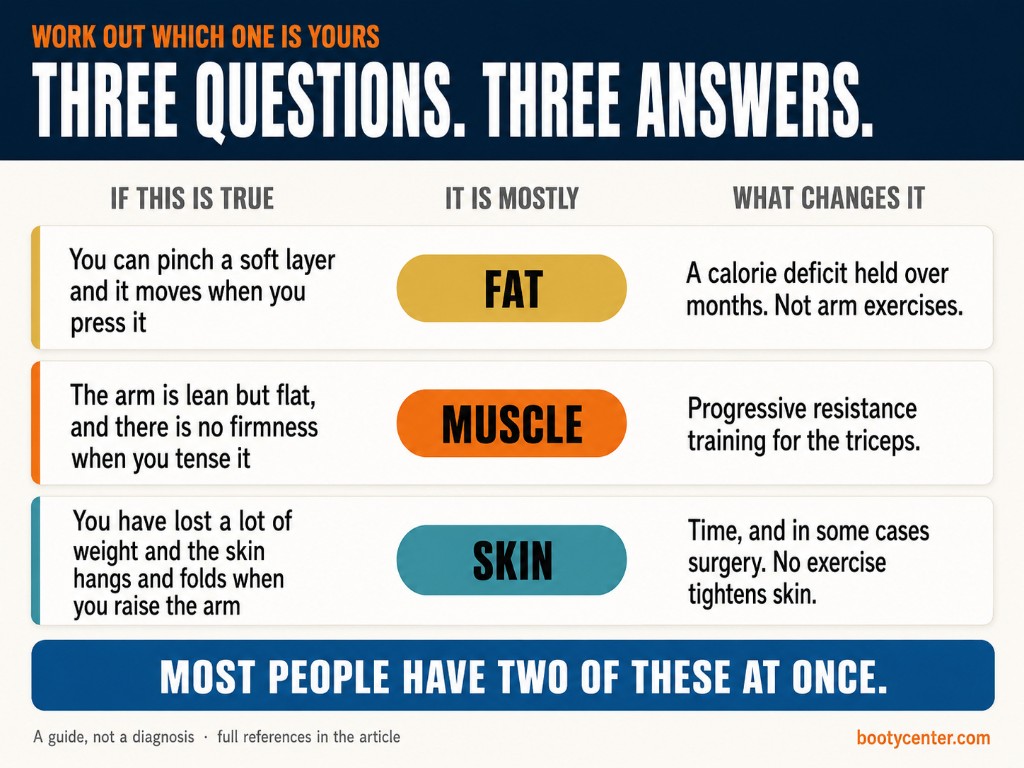 A guide, not a diagnosis. Most people have two of these at once.
Pinch the back of your upper arm. If you can take hold of a soft layer that moves when you press it, there is fat there.
Now tense the arm as if pushing a door closed. If nothing firms up underneath, the muscle is undertrained.
Now raise the arm out to the side. If you have lost a large amount of weight and the skin hangs and folds rather than sitting against the arm, that is skin.
Most people have two of these at once, and the mix decides what actually helps.
The fat: what the one-arm study showed
This one has been tested directly, and the test was clever.
Researchers had 104 people train one arm and leave the other alone for twelve weeks. Calipers, which measure a pinch of skin and fat, seemed to show extra fat loss on the trained arm. MRI, which sees the whole arm, found no difference at all between the trained arm and the untrained one [1].
Twelve weeks is a real training block. Here is what 12 weeks of training actually changes when the work is on the muscle, not on a spot-fat promise.
The same result has come back again and again. Pooling 13 of these one-sided studies, covering 1,158 people, the combined effect of training a limb on the fat covering it was zero [2].
So arm exercises do not remove arm fat. Your deficit removes fat, and your biology picks the order it leaves in [3]. Here is the full evidence on why you cannot target fat loss.
There is one genuinely useful thing in that first study. The cheap measurement flattered the myth and the accurate one killed it. If a claim only survives when someone measures with calipers, be suspicious of the claim.
The muscle: the part that is actually yours
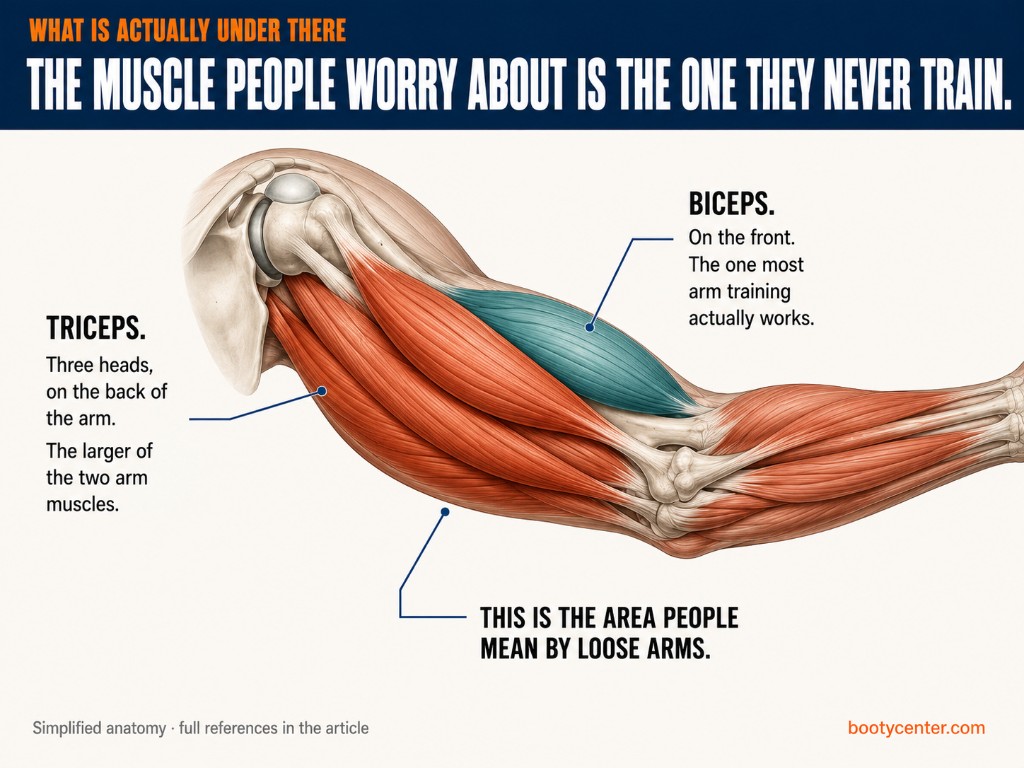 The area people worry about is the part they never train.
The muscle at the back of your upper arm is the triceps. It has three heads and it runs the length of the arm, and it is the larger of the two arm muscles. Biceps curls, which are what most arm training consists of, work the front instead.
That is the mismatch. The area people worry about is the back of the arm, and the back of the arm is the part they never train.
This is the half of the problem you can aim exactly. Every rep lands on the muscle you chose. Nothing decides that for you. The same rule holds for loaded split squats for the glutes: the muscle you train is the muscle that changes.
That only works if the joint can take the load. If hip thrusts dump into your lower back, you are not loading the muscle you meant to train. Tight hip flexors and anterior pelvic tilt steal the work the same way.
The debate
An honest caveat on speed. In a trial of 41 middle-aged women that measured triceps thickness directly, strength rose in every group over ten weeks, but muscle thickness gains showed up in the women who had not yet been through menopause and not in the women who had, at six to eight sets per muscle per week [4]. That is one short study at modest volume, and it does not overturn a large literature showing muscle grows in response to training. It does suggest that if you are past menopause you may need more time and more volume than a ten week block, not that the door is closed. Glute training after 40 is the same problem with a longer clock.
The skin: the part nobody says out loud
If you have lost a great deal of weight, some of what you see is skin, and this is where the fitness industry starts lying to you.
There is no exercise that tightens skin. There is no cream, no supplement, no wrap and no massage protocol shown to do it either. When we searched the literature for non-surgical treatments for skin laxity after weight loss, and for any effect of exercise on skin elasticity, we found nothing to report. That is not us being harsh. That is the state of the evidence.
Time does some work. In a study that followed people for five years after major weight loss, the severity of hanging skin improved over the first 24 months and then stopped changing [5]. So there is a window, and after it, what you have is what you have.
Surgery is the treatment with outcomes behind it. In the same group, every person who had the excess skin surgically removed had their skin-related symptoms resolve. It is also frequently out of reach: most of those who wanted the procedure and had not had it named cost as the barrier [6].
Coach's tip
Be careful with this section. Nearly all of the research on loose skin after weight loss looks at the abdomen, not the arm. The principle carries across, but arm-specific data is thin, so treat the detail as a reasonable read rather than a measured fact. The belly has the same two-layer problem.
The honest bottom line
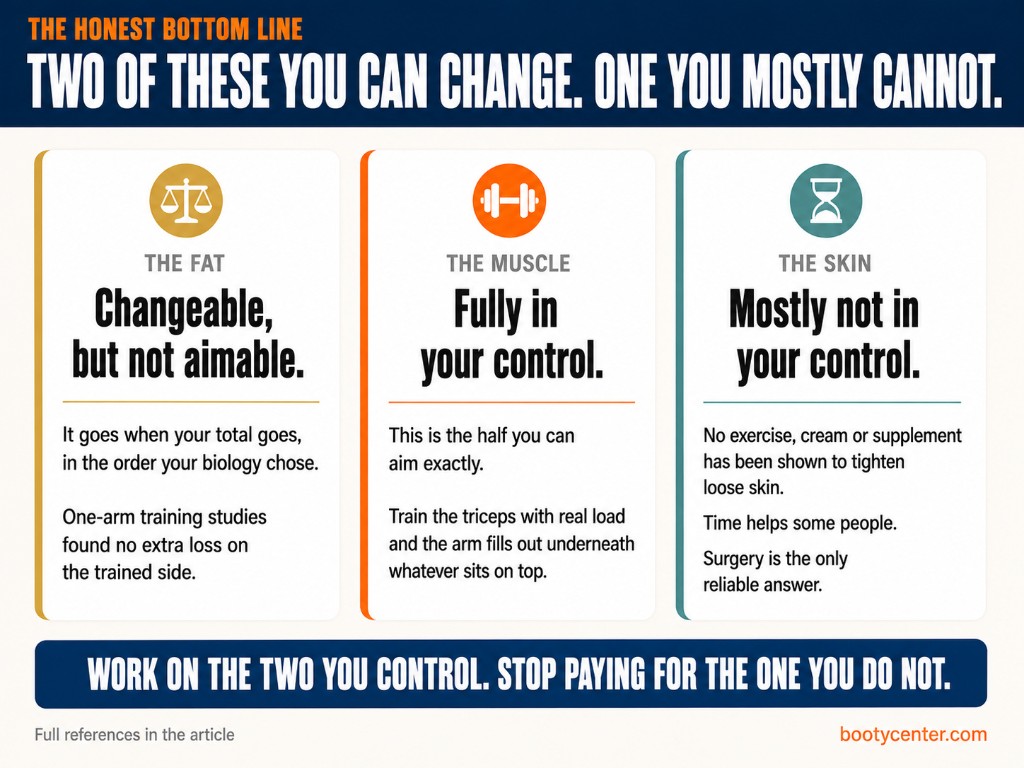 Two of these you can change. One you mostly cannot.
Two of these three you can change, and one you mostly cannot.
The fat is changeable but not aimable. The muscle is entirely in your control and it is the piece almost nobody works on. The skin is largely outside your control and no amount of spending will change that.
The practical version is simple. Hold a deficit you can actually keep for the fat. Train the triceps with real load for the muscle. And for the skin, know what you are looking at, so you stop buying solutions to a problem that does not have one.
Key takeaway
Work on the two you control. Stop paying for the one you do not.
Arm fat FAQs
How do I lose arm fat?
By losing fat overall. When 104 people trained one arm for twelve weeks, MRI found no difference in fat between the trained and untrained arm. A calorie deficit held over months is what removes it, and your biology decides the order it comes off in.
Do tricep exercises get rid of arm fat?
No. They build the muscle underneath, which changes the shape of the arm, but they do not remove the fat sitting on top of it. That has been tested with one-arm training studies for decades and the answer has not changed.
Why do my arms still look loose after losing weight?
Probably because what is left is not fat. After large weight loss, loose skin is common, and skin does not respond to training. Pinch it and raise the arm: fat moves and can be gripped, while loose skin hangs and folds.
Can loose arm skin tighten on its own?
Partly, and only for a while. In people followed for five years after major weight loss, hanging skin improved over the first two years and then stopped changing. No exercise, cream or supplement has been shown to tighten it beyond that.
Which arm muscle should I train for the back of my arm?
The triceps. It has three heads, runs the length of the upper arm and is the larger of the two arm muscles. Most arm training is biceps curls, which work the front of the arm instead, which is not the area people are worried about.
How long until my arms change?
Fat is on your deficit's timeline, which is months. Six weeks is usually too soon to judge. Muscle is on the training timeline, and one trial found thickness gains within ten weeks in pre-menopausal women, though not in post-menopausal women at that volume. Skin, if any, is largely settled after two years.
References
- Kostek MA, Pescatello LS, Seip RL, Angelopoulos TJ, Clarkson PM, Gordon PM, et al. Subcutaneous fat alterations resulting from an upper-body resistance training program. Med Sci Sports Exerc. 2007;39(7):1177-1185.
- Ramirez-Campillo R, et al. A proposed model to test the hypothesis of exercise-induced localized fat reduction (spot reduction), including a systematic review with meta-analysis. Hum Mov. 2022;23(3):1-14.
- Karastergiou K, Smith SR, Greenberg AS, Fried SK. Sex differences in human adipose tissues - the biology of pear shape. Biol Sex Differ. 2012;3(1):13.
- Isenmann E, Kaluza D, Havers T, Elbeshausen A, Geisler S, Hofmann K, et al. Resistance training alters body composition in middle-aged women depending on menopause - a 20-week control trial. BMC Womens Health. 2023;23(1):526.
- Derderian SC, Dewberry LC, Patten L, Sitzman TJ, Kaizer AM, Jenkins TM, et al. Excess skin problems among adolescents after bariatric surgery. Surg Obes Relat Dis. 2020;16(8):993-998.
- Derderian SC, Patten L, Kaizer AM, Inge TH, Jenkins TM, Michalsky MP, et al. Body contouring in adolescents after bariatric surgery. Surg Obes Relat Dis. 2020;16(1):137-142.