
Is the Bulgarian split squat for glutes or for quads? Both, and that is not a cop-out. Lab studies show it works the glutes, hamstrings and quads hard at the same time, and that a few set-up changes shift where the load goes. This guide shows what the research says, the set-up that favours your butt over your thighs, and a plan you can run this week.
If you only feel your thighs, that is normal and fixable. If you want the short version: step further out, lean forward a little, go deep, and pause at the bottom.
Define: Bulgarian split squat
A single-leg squat with the back foot resting on a bench behind you. Also called the rear-foot-elevated split squat, or RFESS, in research papers. The front leg does the work. The back leg is there for balance.
Do Bulgarian split squats work your glutes?
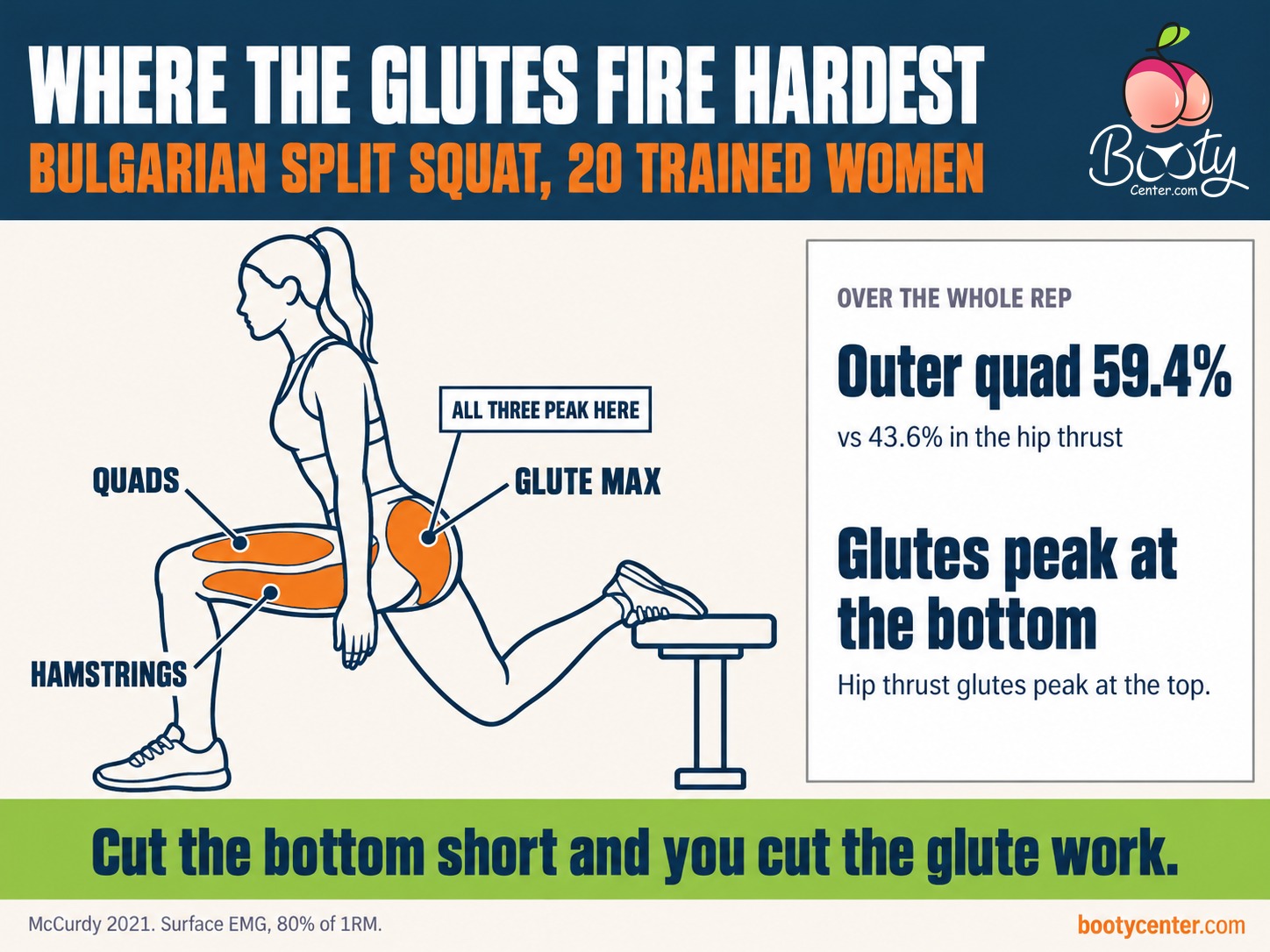
Yes. In 20 women with lifting experience, the rear-foot-elevated split squat at 80% of their max worked the gluteus maximus, hamstrings and quads, and all three fired hardest at the bottom of the rep (McCurdy 2021). Over the whole rep, it worked the outer quad harder than a hip thrust did, 59.4% against 43.6% of maximum. So the quad feeling is real, and so is the glute work.
A 2021 study of 20 trained men looked at joint loads rather than muscle activity. The hip carried far more load than the knee in the Bulgarian split squat, which makes it a hip-dominant lift, like the back squat (Mackey 2021). And in 11 moderately trained adults, peak glute max activity was the same in the Bulgarian split squat, the plain split squat and the single-leg squat. The side glute, gluteus medius, was lower in the Bulgarian version, 54.9% of maximum against 81.9% in the single-leg squat (Mausehund 2019).
So the Bulgarian split squat for glutes is a good choice for the main glute muscle. It is not the best choice for the side glute. For that, see our guide to the four movements that matter. If your butt looks narrower at the bottom than at the top, read our V-shaped glutes guide.
Why do you feel it in your quads?
Because the quads really are working, and they are easy to feel. The outer quad was the most active muscle over the full rep in the women in McCurdy 2021. The glutes fire hardest only at the bottom, where the hip is bent most. If you cut the bottom short or bounce through it, you skip the part of the rep that your glutes own.
Two more reasons: an upright torso keeps the load on the knee, and a short stance keeps the shin leaning forward, which also loads the knee. The next section fixes both. If you cannot feel your glutes in any lift, read our guide on why you can't feel your glutes first.
How do you set it up for your glutes?
Three changes have lab support. None of them came from a Bulgarian split squat study, so treat them as the best available evidence, not proof.
- Lean forward. In 10 adults doing forward lunges, leaning the trunk forward raised gluteus maximus activity and the load on the hip extensors compared with an upright trunk (Farrokhi 2008). Hinge 10 to 20 degrees from the hips. Keep the back flat.
- Step further out. In 20 adults doing loaded lunges, a long step raised gluteus maximus and gluteus medius activity compared with a short step. In the stationary version, the one closest to a split squat, quad activity was lower with the long step (Escamilla 2025). Start about 60 to 75 cm in front of the bench, so your front shin is close to vertical at the bottom.
- Go deep. All three muscles fired hardest at the bottom in McCurdy 2021. Lower until your front thigh is at least parallel to the floor. If your hip flexor stops you, work on that first.
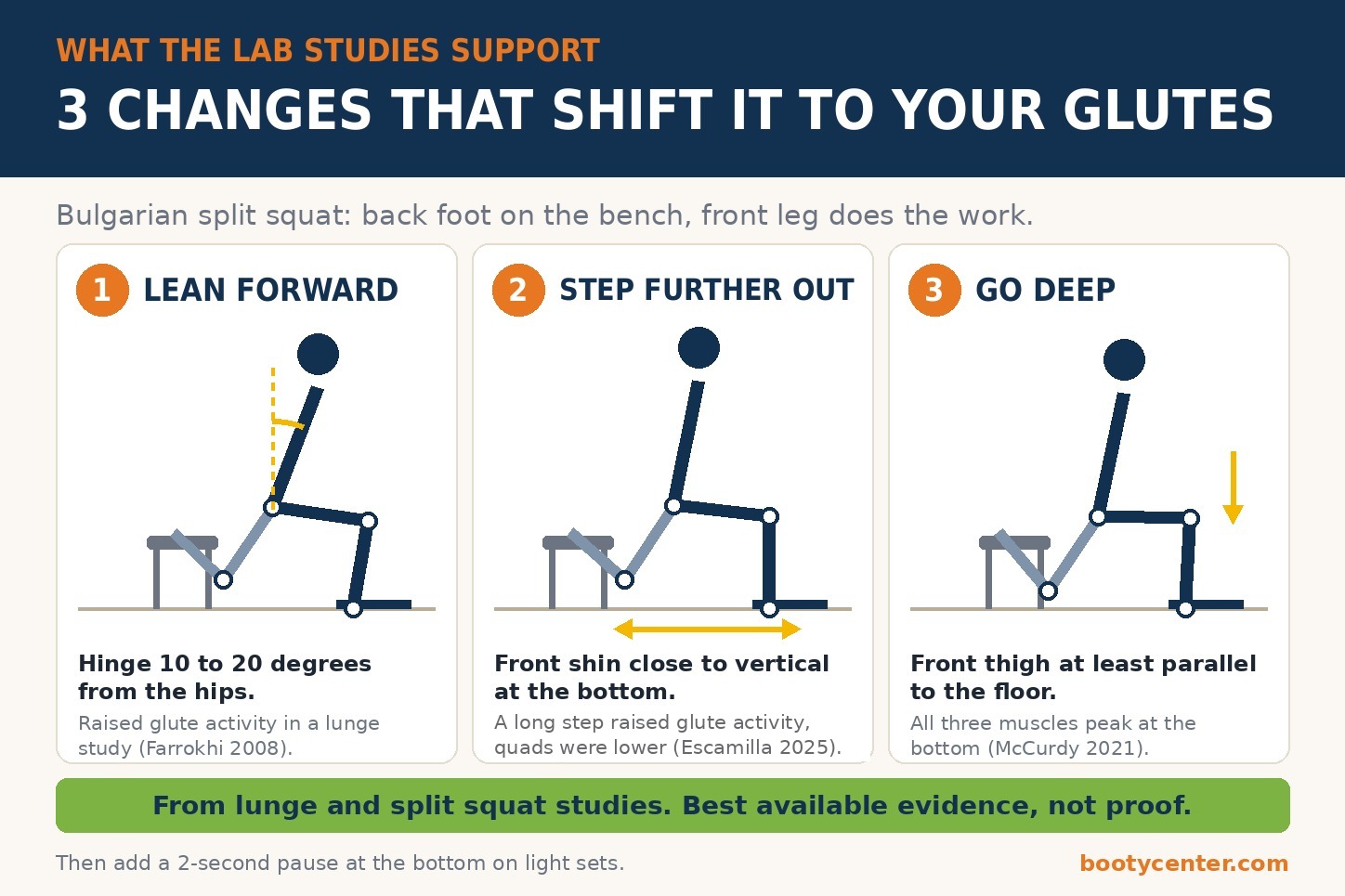 Three changes with lab support, from lunge and split squat studies. Not proof, but the best available evidence.
The rest of the set-up is coaching, not research. Rest the top of the back foot on the bench, laces down. Brace your core. Lower over 2 to 3 seconds. Push through the whole front foot, with the weight towards the heel, and squeeze the front glute at the top. Our hip thrust guide shows the same bracing cues.
Coach's tip
If you lose balance, the back foot is doing too much. Move it so only the laces touch the bench and let the front leg carry the rep. A wobble is a balance problem, not a glute problem.
Does pausing at the bottom help?
It makes sense, but no study has tested it for glute growth. The idea is simple: the glutes work hardest at the bottom (McCurdy 2021), so a 2-second pause there adds time in the position that matters and removes the bounce. It also makes the rep harder, so drop the weight by about a third when you add the pause. Use it on light sets to find the feeling, then go back to normal reps with more load.
Do Bulgarian split squats build glutes?
Probably, but nobody has measured it. We are not aware of any trial that trained people on Bulgarian split squats and scanned their glutes. The closest is a 5-week study in 18 rugby players: training only the Bulgarian split squat built leg strength as well as training only the back squat (Speirs 2016). That is strength, not size.
What we do know is that muscle growth rises as sets get closer to failure (Robinson 2024), and that the Bulgarian split squat loads the glutes hard at the bottom (McCurdy 2021) with a hip-dominant pattern (Mackey 2021). Those are the ingredients. The growth trials we have are on the hip thrust and squat, which grew glutes by similar amounts in 9 weeks (Plotkin 2023). There is no reason to expect the Bulgarian split squat to be different, and no proof either.
If you have heard that the deep stretch at the bottom is a special growth trigger, be careful. Most trials behind that idea were done on quads and calves. The one glute trial on depth used squats: in 17 untrained men, 10 weeks of full squats grew the glutes by 6.7%, against 2.2% for half squats (Kubo 2019). That supports going deep, but it does not show that the stretch itself is a special trigger. We cover what is known in our guide on growing glutes without growing legs.
Should you raise the front foot?
Only once the standard version is clean. Putting the front foot on a 3 to 5 cm plate, the deficit Bulgarian split squat, lets the hip go deeper. More depth means more time where the glutes work hardest (McCurdy 2021). There is no study on the deficit version itself. Start with bodyweight and add load slowly. If your lower back rounds at the bottom, you are too deep for your mobility.
How many sets and reps?
A coach's template built on the studies above, not a tested protocol. Do it once or twice a week, first in the session, with at least 48 hours between hard glute days.
- Working sets: 3 to 4 sets of 8 to 12 reps per leg, stopping 1 to 2 reps before failure (about 8 to 9 out of 10 effort). Rest 2 to 3 minutes between sets. Both legs count as one set.
- Warm-up: 1 set of 10 bodyweight reps per leg with a 2-second pause at the bottom. Rest 60 seconds.
- Progression: add 1 to 2 kg per hand, or 1 rep per set, every 1 to 2 weeks. When you reach 12 reps on every set, add weight and drop back to 8.
- Pair it with: a hip thrust or glute bridge in the same session, so your butt gets loaded at the top of the range as well as the bottom. McCurdy 2021 recommends both lifts for that reason.
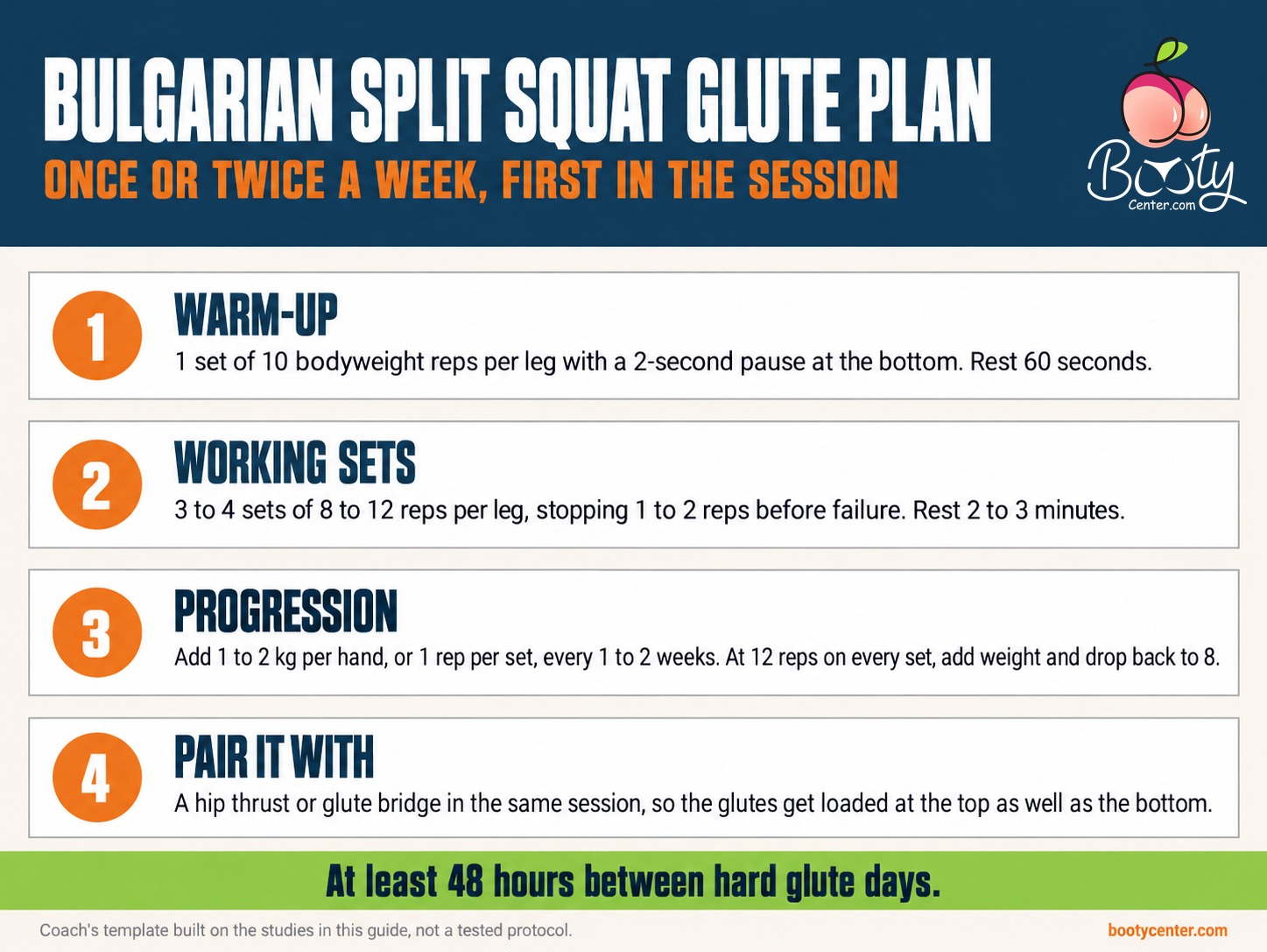 A coach's template built on the studies in this guide, not a tested protocol.
What are the common mistakes?
- Standing too close to the bench. The shin tips forward and the knee takes over. Step out until the front shin is close to vertical at the bottom.
- Staying upright. An upright trunk keeps the load on the knee. Lean 10 to 20 degrees from the hips (Farrokhi 2008).
- Cutting the bottom short. The glutes fire hardest in the lowest part of the rep (McCurdy 2021). Half reps are quad reps, not butt reps.
- Pushing with the back leg. It turns the lift into a two-leg squat. Keep only the laces on the bench.
- Going heavy before the form is stable. Add load only when 3 sets of 8 look the same on every rep.
- Dropping fast. Lower over 2 to 3 seconds. The lowering half of the rep is part of the work.
Bulgarian split squats for glutes, by the numbers
- 59.4% vs 43.6%: average outer quad activity over a full rep, Bulgarian split squat against hip thrust, in 20 trained women (McCurdy 2021).
- Bottom of the rep: where glute max, hamstrings and quads all fired hardest in the split squat (McCurdy 2021).
- 54.9% vs 81.9%: side glute activity in the Bulgarian split squat against the single-leg squat, in 11 adults (Mausehund 2019).
- Hip over knee: the hip carried far more of the load than the knee in 20 trained men (Mackey 2021).
- 10 adults: the size of the trunk-lean study (Farrokhi 2008). A hint, not proof.
- 0 trials: studies that measured glute growth from Bulgarian split squats.
Where the evidence runs thin
No trial has measured glute growth from Bulgarian split squats. The set-up advice comes from lunge studies, not split squat studies, and the trunk-lean study had 10 people. EMG shows how hard a muscle fires in one session, not how much it grows. The pause and deficit versions have no studies of their own. The sets and reps are a coach's template.
Bottom line
The Bulgarian split squat works your glutes, your hamstrings and your quads, all hardest at the bottom of the rep. Feeling your quads is normal. To favour the glutes, step further out, lean forward from the hips, go deep and pause. Pair it with a hip thrust so the glutes get loaded at the top as well. Nobody has measured growth from it yet, so track your weights and reps over weeks.
Frequently asked questions
Are Bulgarian split squats for glutes or quads?
Both. In 20 trained women they worked the glutes, hamstrings and quads hard, with the outer quad most active over the full rep (McCurdy 2021). The set-up decides the balance: a long stance, a forward lean and full depth push more of the work to the hips.
How far should my front foot be from the bench?
Far enough that your front shin is close to vertical at the bottom, usually 60 to 75 cm. In a lunge study, a long step raised glute activity, and in the stationary version, the one closest to a split squat, quad activity was lower (Escamilla 2025). If your knee travels well past your toes, step out more.
Should I lean forward in a Bulgarian split squat?
Yes, a little. In 10 adults, leaning the trunk forward in a lunge raised gluteus maximus activity and hip load (Farrokhi 2008). Hinge 10 to 20 degrees from the hips with a flat back. Do not round the spine.
Do Bulgarian split squats grow your glutes?
No trial has measured it. They load the glutes hard at the bottom (McCurdy 2021) in a hip-dominant pattern (Mackey 2021), and muscle growth rises as sets get closer to failure (Robinson 2024), so growth is likely. The only training study measured strength, not size (Speirs 2016).
Why can't I feel my glutes in Bulgarian split squats?
Most often because the stance is short, the torso is upright, or the rep stops before the bottom. Fix those three, then add a 2-second pause at the bottom with a light weight. Our guide on why you can't feel your glutes has a 3-step check.
Bulgarian split squat or hip thrust, which is better for glutes?
Do both. The hip thrust loads the glutes hardest at the top, the split squat at the bottom (McCurdy 2021). The study authors recommend using both for that reason. See our glute exercise tier list for how they rank.
References
- McCurdy K, Walker J, Kelly C, Polinski M. Hip and knee extensor activation during the hip thrust and rear-foot-elevated split squat in trained females. J Strength Cond Res. 2021;35(5):1201-7. doi:10.1519/JSC.0000000000004035
- Mackey ER, Riemann BL. Biomechanical differences between the Bulgarian split-squat and back squat. Int J Exerc Sci. 2021;14(1):533-43.
- Mausehund L, Skard AE, Krosshaug T. Muscle activation in unilateral barbell exercises: implications for strength training and rehabilitation. J Strength Cond Res. 2019;33 Suppl 1:S85-94. doi:10.1519/JSC.0000000000002617
- Farrokhi S, Pollard CD, Souza RB, Chen YJ, Reischl S, Powers CM. Trunk position influences the kinematics, kinetics, and muscle activity of the lead lower extremity during the forward lunge exercise. J Orthop Sports Phys Ther. 2008;38(7):403-9. doi:10.2519/jospt.2008.2634
- Escamilla RF, Thompson IS, Asuncion R, Bravo J, Chang T, Fournier T, et al. Effects of step length and stride variation during forward lunges on lower-extremity muscle activity. J Funct Morphol Kinesiol. 2025;10(1):42. doi:10.3390/jfmk10010042
- Speirs DE, Bennett MA, Finn CV, Turner AP. Unilateral vs. bilateral squat training for strength, sprints, and agility in academy rugby players. J Strength Cond Res. 2016;30(2):386-92. doi:10.1519/JSC.0000000000001096
- Plotkin DL, Rodas MA, Vigotsky AD, McIntosh MC, Breeze E, Ubrik R, et al. Hip thrust and back squat training elicit similar gluteus muscle hypertrophy and transfer similarly to the deadlift. Front Physiol. 2023;14:1279170. doi:10.3389/fphys.2023.1279170
- Robinson ZP, Pelland JC, Remmert JF, Refalo MC, Jukic I, Steele J, et al. Exploring the dose-response relationship between estimated resistance training proximity to failure, strength gain, and muscle hypertrophy: a series of meta-regressions. Sports Med. 2024;54(9):2209-31. doi:10.1007/s40279-024-02069-2
- Kubo K, Ikebukuro T, Yata H. Effects of squat training with different depths on lower limb muscle volumes. Eur J Appl Physiol. 2019;119(9):1933-42. doi:10.1007/s00421-019-04181-y