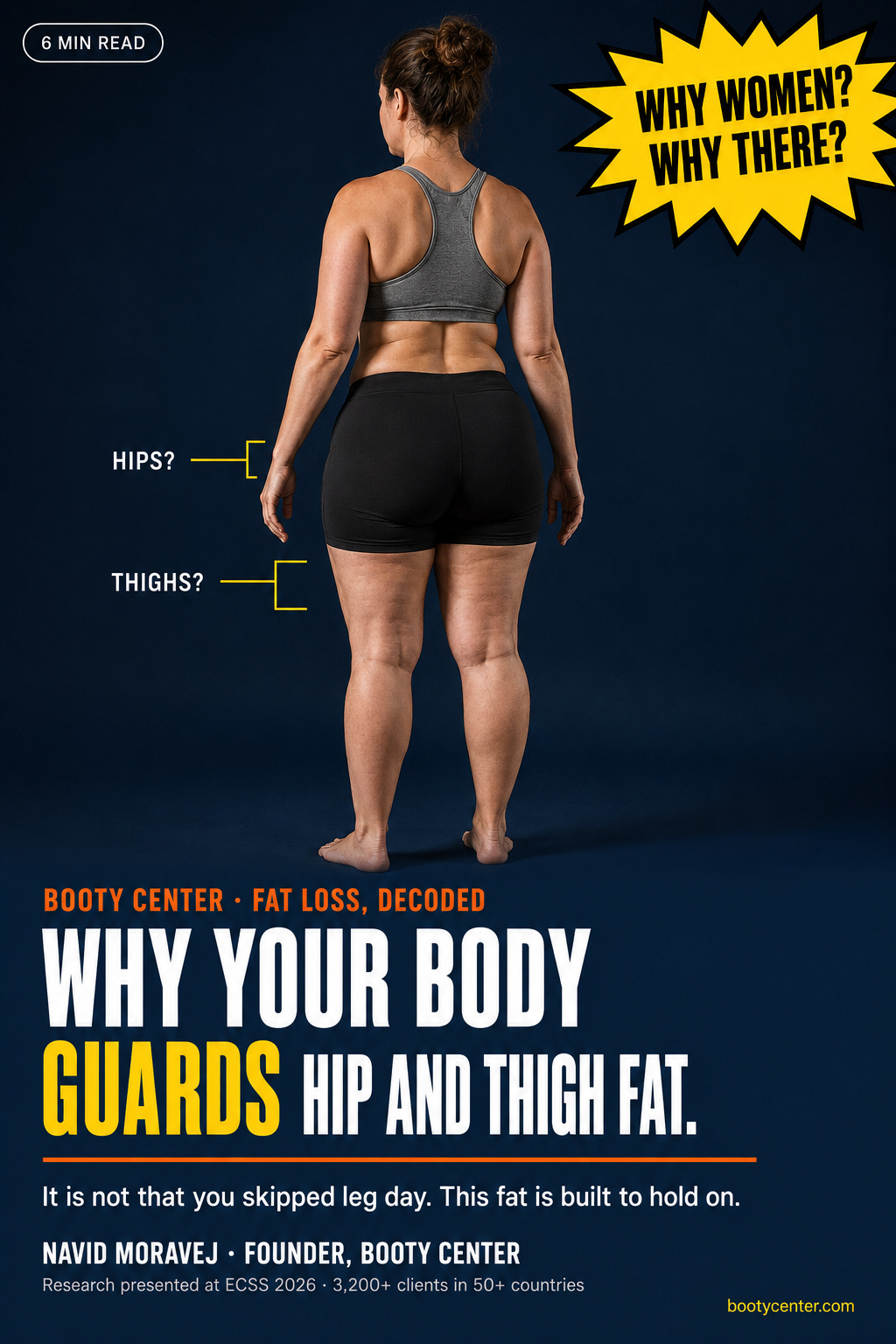
You train legs. You hold a deficit. Your waist responds, your face responds, and your hips and thighs sit there like they did not get the message. Almost every woman who has dieted knows this feeling. It is not a discipline problem. This fat is on a different setting, and there is a reasonable argument that your body is holding onto it on purpose.
"Thigh fat is stubborn because you are not doing enough leg work."
Two bodies, two different maps
Give a man and a woman the same calorie deficit and the fat does not leave in the same order.
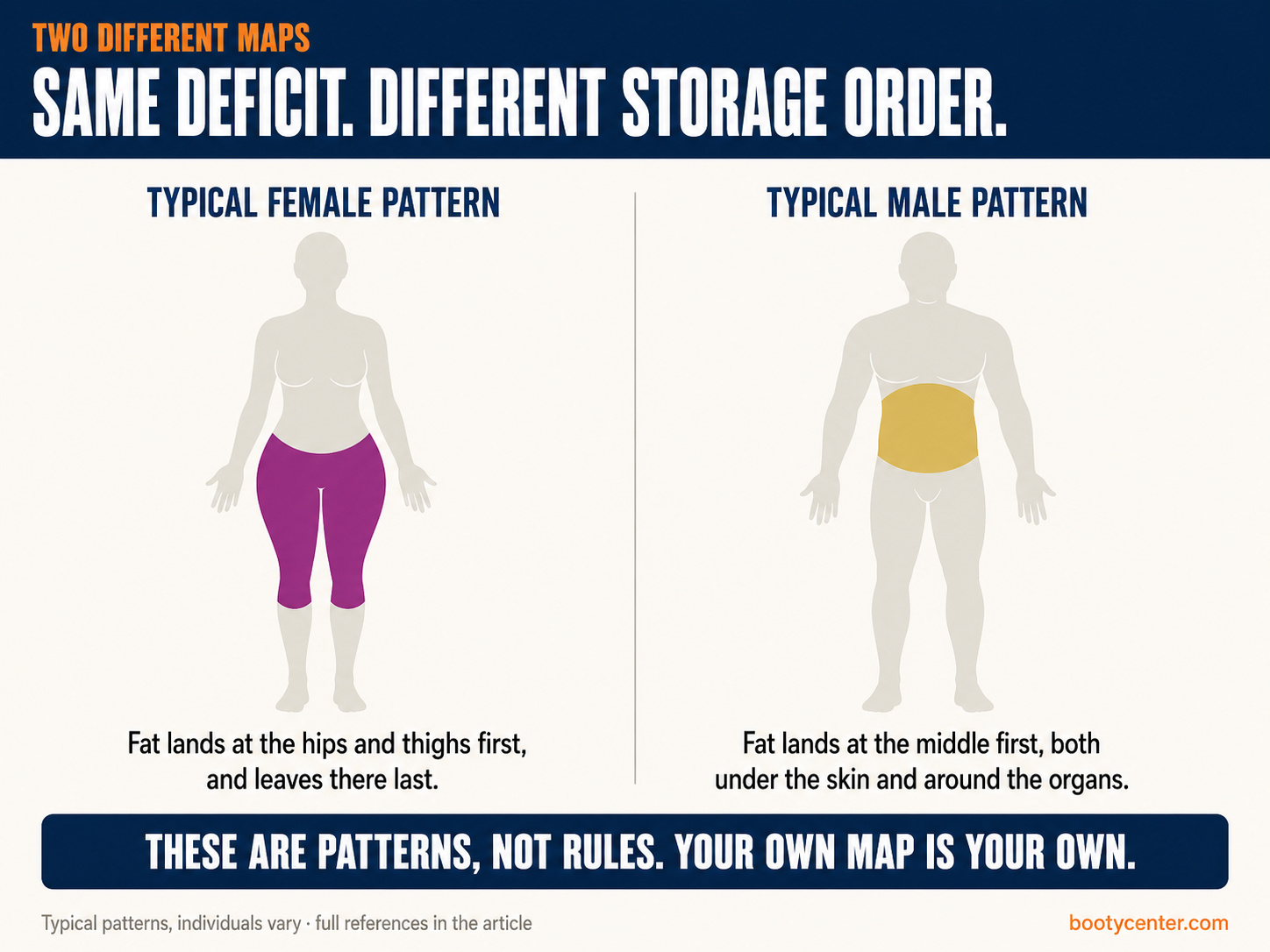 Same deficit, different storage order. These are patterns, not rules.
Most women fill at the hips and thighs first. Most men fill at the middle, both under the skin and around the organs. Fat zones are not identical tissue, and each one carries its own mix of receptors and answers hormones differently [1].
These are patterns, not laws. Plenty of women carry it at the middle and plenty of men carry it low. Your own map is your own, and it was mostly handed to you.
The map is also not fixed for life. Researchers comparing women just before and just after menopause found the later group carrying 49 percent more deep abdominal fat and 36 percent more trunk fat, with the deep abdominal difference holding even after adjusting for age and total fat [6]. That was a snapshot of two groups rather than the same women tracked through it, so treat it as a direction rather than a schedule. Many women describe exactly this, though: a lifetime of storing low, then a change of address in their fifties. If you are training through that shift, glute training for women over 40 has its own set of rules.
Why this fat holds on
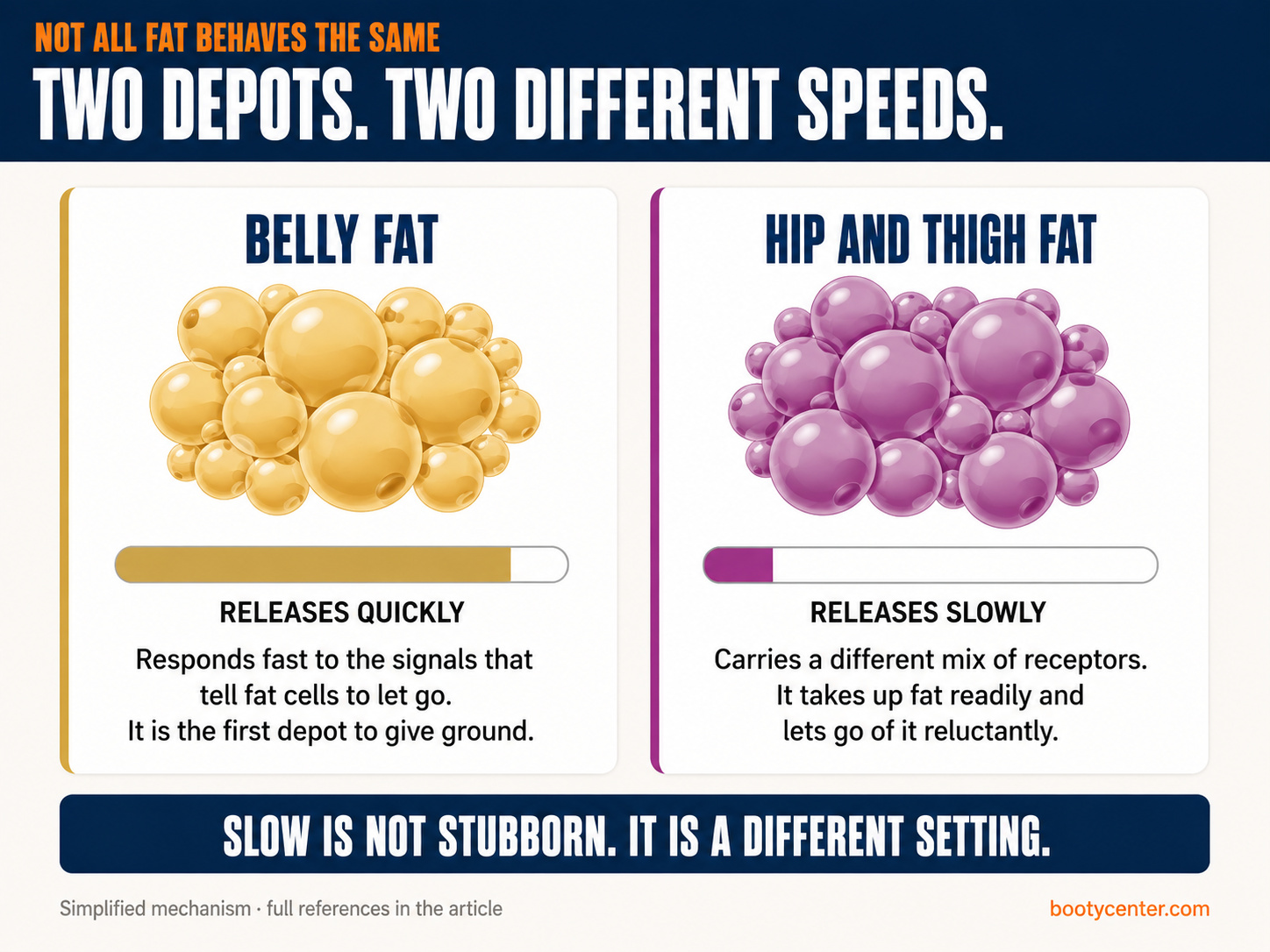 Two depots, two different release speeds.
When your body wants energy, it sends chemical messengers through the blood telling fat cells to release what they are holding. Belly fat answers that call quickly. Hip and thigh fat does not.
Researchers measured this directly. Fatty acid release from the leg in response to those messengers is lower in women than in men, while release from the upper body is much the same in both. Biopsy work agrees: the gap between upper body and lower body fat behaviour is wider in women [2].
The same depot is also good at taking fat in. It stores readily and releases reluctantly. That combination is exactly what “stubborn” feels like from the inside.
One honesty note. The author of that review says plainly that the number of studies measuring this in living people is small and the findings need confirming. We are printing a well supported direction of travel, not a settled number.
Coach's tip
Slow is not the same as stuck. A depot that releases reluctantly still releases. It just needs the deficit to run longer than your patience wants it to. This is what a 6 week transformation actually looks like when you let it run.
The finding nobody expects
Here is where this article stops being a complaint and starts being interesting.
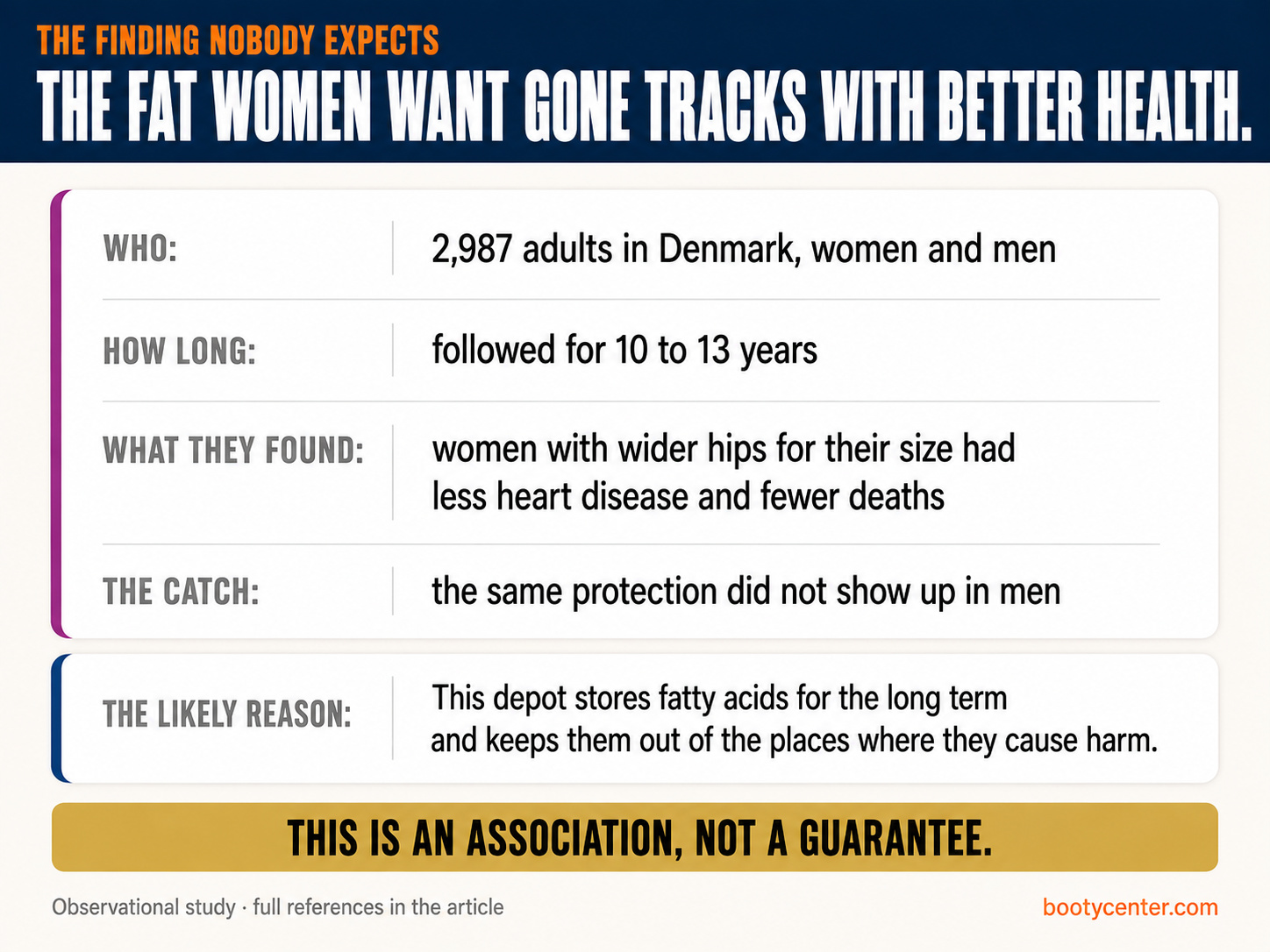 An association, not a guarantee, and it did not appear in men.
Danish researchers followed 2,987 adults for 10 to 13 years. Women with wider hips for their body size had less coronary heart disease, less cardiovascular disease and fewer deaths. The effect held after accounting for overall size and for waist. In men it did not appear at all [3].
The proposed reason is storage. A review from Oxford argues that this depot is comparatively quiet in day to day metabolism and does its work by holding fatty acids for the long term, keeping them out of the liver, the muscle and the organs where they cause trouble. That review also reports that when people lose this depot, through conditions such as lipodystrophy and Cushing’s syndrome, metabolic risk rises [4].
Read that carefully. These are observations of populations, not an experiment, and nobody has shown that adding hip fat protects anyone. What the evidence supports is narrower and still worth knowing: the fat most women want gone is the depot that tracks with better health, not worse.
The debate
We are not telling you to keep body fat you do not want. Body composition is your call. We are telling you what the data says, which is that lower body fat is not the health villain it gets treated as, and that the villain in most of this research is the fat around your organs instead.
So why does it go last?
Because your body works through its depots in an order, and the quiet ones go last.
There is good evidence for that order. When researchers pooled 89 studies covering diet, exercise, weight loss drugs and surgery, the percentage drop in deep abdominal fat was always larger than the drop in fat under the skin, whatever the method used. No approach targeted one depot on purpose. Some simply give ground faster than others [5].
So the fat that goes first is often the fat you could never see, and the fat you can see and pinch is the one still waiting its turn. The layer you can grab across your middle sits above the deep stuff and follows the same slow rules, which is why stubborn belly fat and stubborn thigh fat feel like one problem. That is why the mirror lags behind the effort while your bloodwork improves quietly behind it, and it is the whole difference between burning fat and losing fat.
The order is set by biology you did not choose. What you can change is the total. No exercise, food or supplement has been shown to reorder the queue. Here is the full evidence on why you cannot target fat loss.
What actually changes the shape
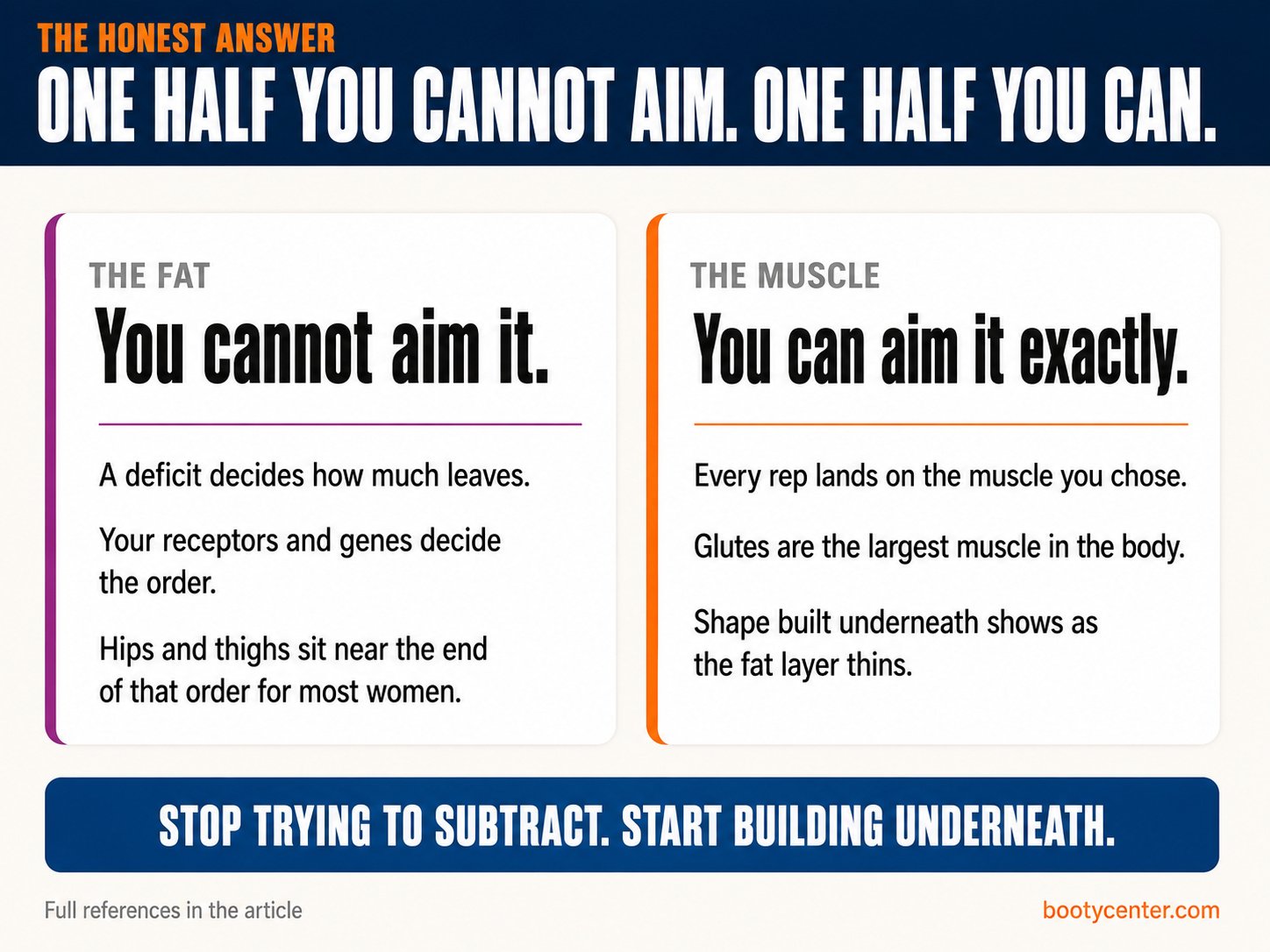 One half you cannot aim. One half you can.
Half of your shape is fat you cannot aim. A deficit decides how much leaves, your receptors and genes decide the order, and the hips and thighs sit near the end of that order for most women. It is also why weight loss can leave you with a flat butt when nothing was built underneath it.
The other half you can aim exactly. Every rep lands on the muscle you chose. This is the part almost nobody works on, because they are busy trying to subtract.
Your glutes are the largest muscle in your body, and their size responds well to training. In one trial that scanned people before and after nine weeks, both squats and hip thrusts grew the gluteus maximus across its upper, middle and lower regions [7]. Nine weeks. Measured, not guessed.
Building them changes your hip and thigh shape whatever the fat layer above decides to do, and it works on a timescale you control rather than one your receptors control. Start with the four movements that matter.
That is the whole trade. Stop negotiating with a depot that does not take instructions. Build the thing that does.
Key takeaway
You cannot subtract your way to a shape. You can build one.
Hip and thigh fat FAQs
Why do women store fat in their thighs?
Fat zones are not identical tissue. Each carries its own mix of receptors and responds differently to hormones, and in most women the hip and thigh depot takes fat up readily and releases it slowly. The pattern is largely inherited, and it shifts across life stages.
Is thigh fat harder to lose than belly fat?
It releases more slowly. Measured directly, fatty acid release from the leg in response to the body’s own signals is lower in women than in men, while upper body release is similar. So it is not resistant to a deficit, it is simply later in the order.
Can I lose fat from just my thighs?
No. Training a body part does not shrink the fat sitting on it, which has been tested repeatedly for decades. A deficit decides how much fat leaves. Your biology decides where it leaves from, and hips and thighs are near the end of that queue for most women.
Is hip and thigh fat actually healthy?
The honest answer is that it tracks with better outcomes. In one study of 2,987 adults followed for over a decade, women with wider hips for their size had less heart disease and fewer deaths, independent of waist. That is an association, not a guarantee, and it did not appear in men.
Will squats make my thighs bigger?
They build muscle in your legs and glutes, which changes your shape. Whether that reads as bigger or firmer depends on how much fat sits above it and how you train. Muscle is far denser than fat, so a stronger leg is usually a smaller looking one.
How long does hip and thigh fat take to shift?
Longer than the rest, and there is no useful number because it depends on your deficit and your starting point. Judge it in months rather than weeks, measure rather than weigh, and keep training through it so there is something built underneath when it does move.
References
- Karastergiou K, Smith SR, Greenberg AS, Fried SK. Sex differences in human adipose tissues – the biology of pear shape. Biol Sex Differ. 2012;3(1):13.
- Blaak E. Gender differences in fat metabolism. Curr Opin Clin Nutr Metab Care. 2001;4(6):499-502.
- Heitmann BL, Frederiksen P, Lissner L. Hip circumference and cardiovascular morbidity and mortality in men and women. Obes Res. 2004;12(3):482-487.
- Manolopoulos KN, Karpe F, Frayn KN. Gluteofemoral body fat as a determinant of metabolic health. Int J Obes (Lond). 2010;34(6):949-959.
- Merlotti C, Ceriani V, Morabito A, Pontiroli AE. Subcutaneous fat loss is greater than visceral fat loss with diet and exercise, weight-loss promoting drugs and bariatric surgery: a critical review and meta-analysis. Int J Obes (Lond). 2017;41(5):672-682.
- Toth MJ, Tchernof A, Sites CK, Poehlman ET. Menopause-related changes in body fat distribution. Ann N Y Acad Sci. 2000;904:502-506.
- Plotkin DL, Rodas MA, Vigotsky AD, McIntosh MC, Breeze E, Ubrik R, et al. Hip thrust and back squat training elicit similar gluteus muscle hypertrophy and transfer similarly to the deadlift. Front Physiol. 2023;14:1279170.