
"Ozempic butt" is not a medical term. It is the name people give to a flatter, softer butt after a big weight loss on a GLP-1 drug such as Ozempic, Wegovy, Mounjaro or Zepbound. The cause is the weight loss, not something the drug does to your glutes. In body scans, about a quarter of the weight people lost on tirzepatide was lean tissue, not fat, and people who lost weight on a placebo lost the same share (Look 2025). The good news is new. In a 2026 trial, adults on tirzepatide who lifted weights 3 times a week lost the same amount of fat, lost about a quarter less lean tissue, and got stronger instead of weaker (Green 2026). So you cannot choose where the fat leaves, but you can give your body a reason to keep its muscle.
Before you read on
This is general education, not medical advice. We are coaches, not doctors. Whether to start, change or stop a medicine is a decision for you and your prescriber. Nothing here is a reason to do either.
Define: GLP-1 drugs
Medicines that copy a gut hormone called GLP-1. They lower appetite, so you eat less and lose weight. Semaglutide is sold as Ozempic and Wegovy. Tirzepatide, sold as Mounjaro and Zepbound, copies GLP-1 and a second hormone called GIP.
Define: Lean mass
Everything in your body that is not fat or bone mineral, as a body scan (DXA) counts it. Muscle is a big part of it, but so are water and organs. So "lean mass lost" is not the same as "muscle lost". It is the best clue most studies have.
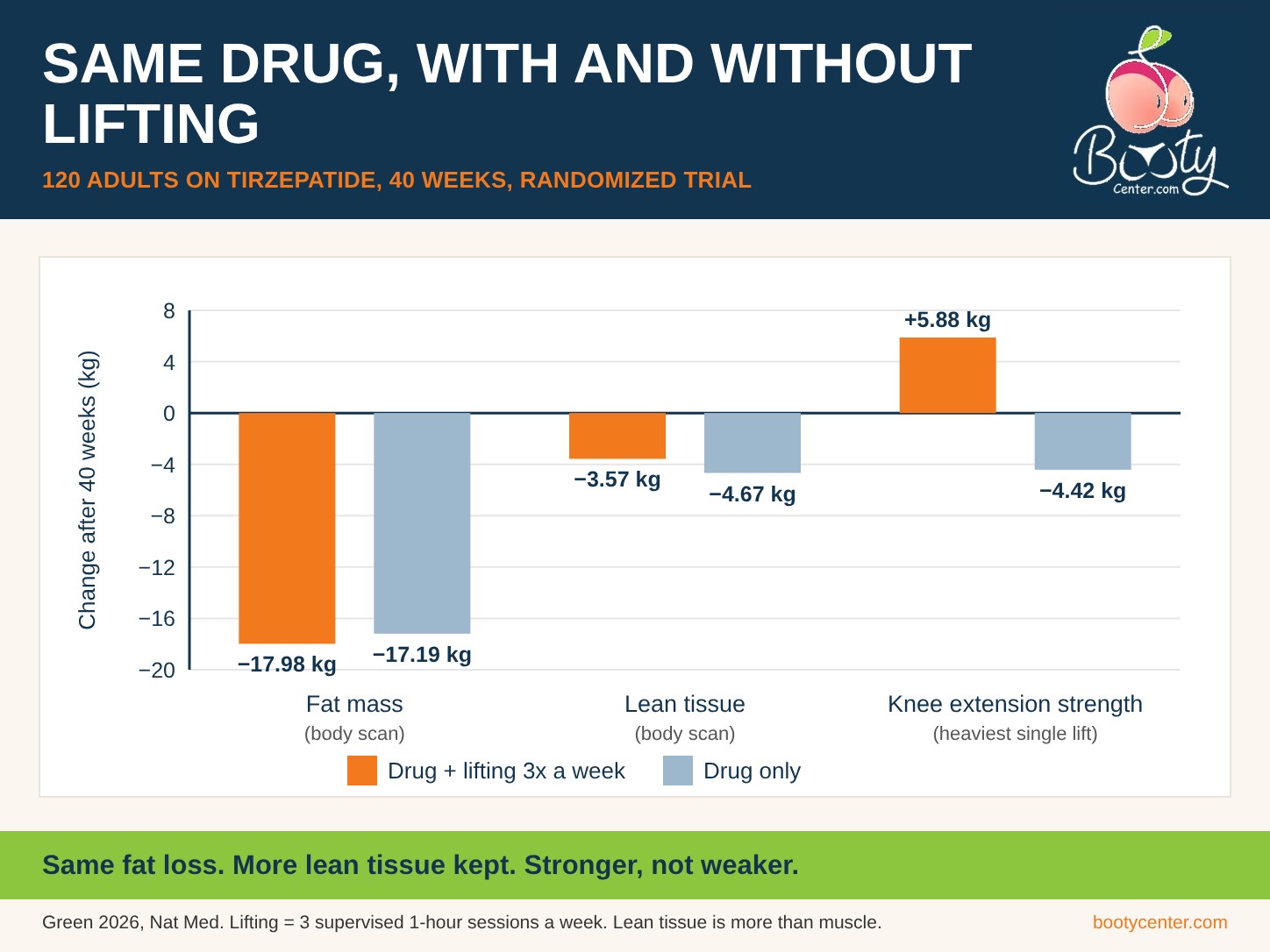 Same drug, same fat loss. The group that lifted kept more lean tissue and got stronger. 120 adults aged 50 to 70, 40 weeks (Green 2026).
What is Ozempic butt?
It is a change in shape, not a diagnosis. Three things can happen at once when you lose a lot of weight:
- Fat leaves your hips and butt. For many women this is where a lot of fat is stored, so it is where a big loss shows. You do not get to pick the place. We cover the studies in can you choose where fat leaves?
- Some lean tissue leaves too. This is the part you can influence, and the rest of this article is about it.
- Skin can look looser. Training does not tighten skin. If this is your main worry, a dermatologist is the right person to ask.
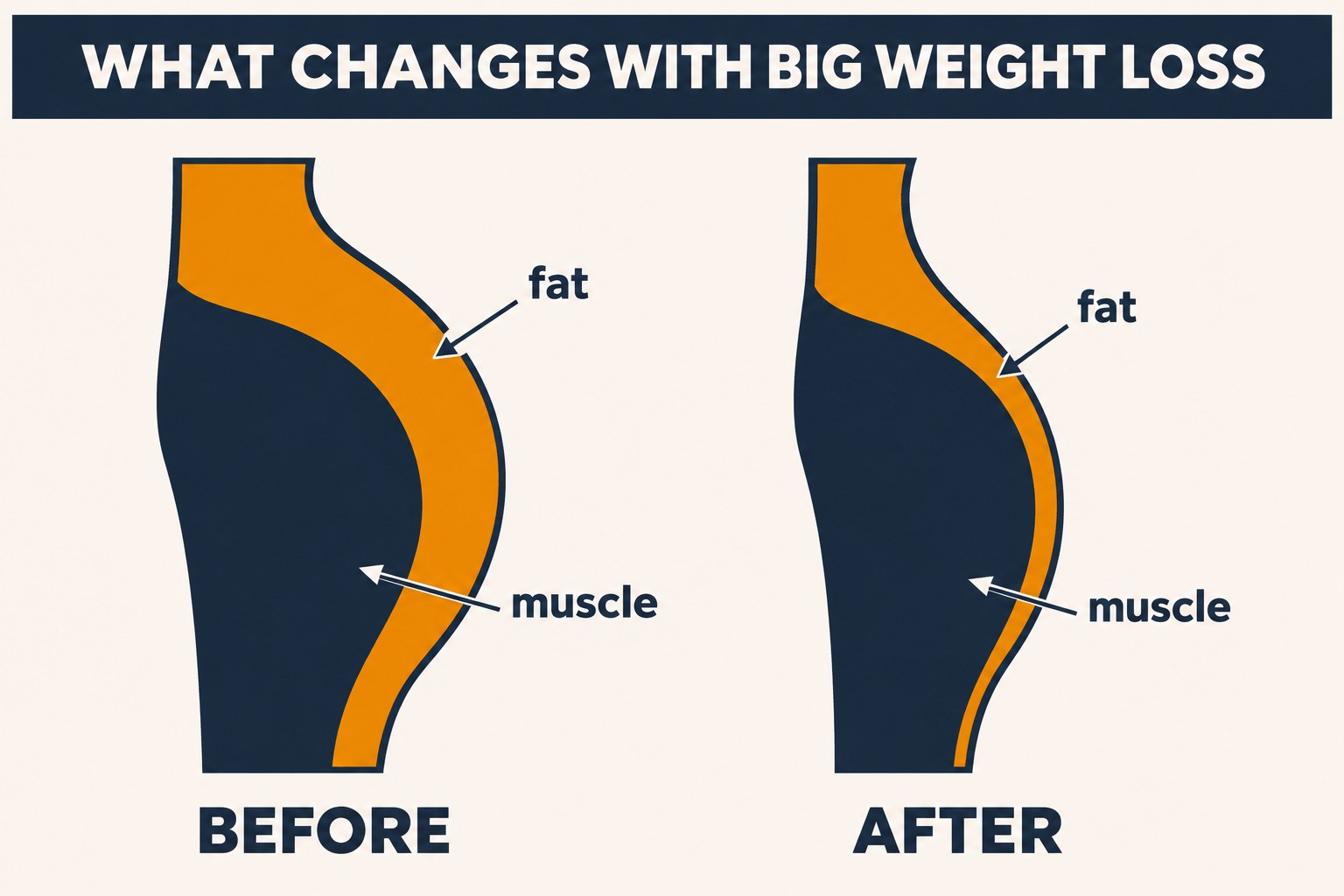 A simple picture, not to scale. Most of what leaves is fat. Some lean tissue goes with it.
None of this is special to one brand. It is what a large, fast weight loss looks like. We wrote about the same thing without the drugs in flat butt after weight loss.
How much muscle do you lose on GLP-1 drugs?
Studies measure lean mass, not muscle alone, so read these as estimates.
- Tirzepatide, 72 weeks. 160 adults had body scans, and 73% of them were women. On tirzepatide, body weight fell 21.3%, fat mass fell 33.9% and lean mass fell 10.9%. That is about 5.6 kg of lean mass. Of the weight lost, 74% was fat and 26% was lean. On placebo the split was 75% and 25% (Look 2025). The drug group lost far more weight, but the mix was the same.
- Semaglutide. The same paper sums up the body scan group of a large semaglutide trial: 10.4 kg of fat and 6.9 kg of lean mass lost, a split of about 60% fat and 40% lean (Look 2025).
- Semaglutide, MRI of the thigh. In 55 adults scanned over 72 weeks, thigh muscle volume fell about 1.1 litres more with semaglutide than with placebo. That difference was not statistically clear. The fat inside the muscle went down, and people did 13 sit-to-stand reps in 30 seconds at the start and 15 at the end (Hjelmesæth 2026). Only 6 people were in the placebo group, so treat this as an early look.
Two honest points. First, some lean loss is normal when a body gets lighter, because it has less weight to carry. The authors of the lifting trial say the same (Green 2026). Second, we are not aware of any study that measured the size of the glutes in people on these drugs. The numbers above are for the whole body or the thigh.
Does lifting weights protect your muscle on GLP-1 drugs?
Yes, in the first trial to test it. Researchers gave tirzepatide to 120 adults aged 50 to 70, 60 men and 60 women, who did not exercise regularly. Half were randomly picked to lift 3 times a week for 40 weeks. The sessions lasted 1 hour, were supervised, used exercises such as squats, deadlifts and leg presses, and got harder over time. People turned up to 91% of sessions (Green 2026).
- Weight and fat: the same. Both groups lost about 22 kg. Fat loss was 17.19 kg without lifting and 17.98 kg with it.
- Lean tissue: 4.67 kg lost without lifting, 3.57 kg lost with it. That is about 1.1 kg kept, or roughly a quarter less lost.
- Strength: without lifting, people got weaker. Knee extension fell 4.42 kg. With lifting it rose 5.88 kg.
- Timing: most of the lean loss came in the first 24 weeks, then it levelled off.
How far can you trust it? It is a randomized trial in a top journal, which is strong. But it is one trial. The people were 50 to 70 years old and did not exercise before, the scans count lean tissue and not muscle alone, and nobody measured the glutes. Lifting slowed the loss. It did not stop it. So we do not know yet what happens in a 30 year old who already trains. It is a very good reason to start, not a promise.
How much protein do you need on a GLP-1 drug?
We are not aware of a trial that tested protein amounts in people on these drugs. In the lifting trial, people were only encouraged to eat enough protein, and food diaries showed no difference between the groups (Green 2026). So the best leads come from other research:
- In people who lift, muscle gain stopped rising above about 1.6 g of protein per kg of body weight a day, in a review of 49 trials (Morton 2018). Those people were not dieting hard.
- In 40 young men on a very low calorie diet who trained hard 6 days a week for 4 weeks, 2.4 g per kg a day added 1.2 kg of lean mass. 1.2 g per kg added 0.1 kg (Longland 2016). That was a short study in young men, so it is a lead, not a rule.
The practical problem is appetite. These drugs make you less hungry, so protein is easy to miss. A common coaching start is a protein food at every meal, eaten first. If you have kidney disease or any other medical condition, ask your doctor or a dietitian for your number. Our guide to weight loss vs fat loss explains why the mix of what you lose matters more than the scale.
How to train your glutes on a GLP-1 drug
The trial used whole-body lifting, 3 times a week, and made it harder over time. You can copy that idea. There is more than one way to do it, so treat this as a starting point and track what your body does.
Coaching default: 3 sessions a week
Train 3 days a week with a rest day between, about 45 to 60 minutes each time. Warm up with 5 minutes of easy cycling or walking. Then do these four lower body lifts: hip thrust, leg press or squat, Romanian deadlift, and split squat or step-up. Do 3 sets of 8 to 12 reps of each, at 7 to 8 out of 10 effort, with 2 minutes of rest between sets. Add 2 upper body lifts, a row and a press, for 2 sets of 8 to 12 reps at the same effort, with 90 seconds of rest. When you can do 12 reps on all sets, add a little weight. On days you feel sick or have eaten very little, do the session lighter, at 5 to 6 out of 10 effort, and do not skip it. Stop if you feel dizzy or faint. This is coaching practice, not a study result.
If you are new to lifting, our guide to the 4 movements that matter shows what each lift is for, and the glute exercise tier list gives you swaps. If you are over 40, read glute training for women over 40 as well, because the people in the trial were your age.
Can you get your butt back after weight loss?
You can build the muscle. The fat that left is a different matter. Muscle responds to training at any size. But a rebuilt glute sits under less fat than before, so the shape will be firmer and usually smaller than it was at your highest weight. That is a different butt, not a failed one. Take photos in the same light every 4 weeks and track your lifts. Those tell you more than the mirror on a bad day.
Ozempic butt, by the numbers
- About 26%: share of the weight lost on tirzepatide that was lean mass, in 160 adults with body scans. On placebo it was 25% (Look 2025).
- 10.9%: fall in lean mass after 72 weeks on tirzepatide, against 33.9% for fat mass (Look 2025).
- 4.67 kg vs 3.57 kg: lean tissue lost without lifting and with lifting, in 120 adults on tirzepatide for 40 weeks (Green 2026).
- Minus 4.42 kg vs plus 5.88 kg: change in knee extension strength without lifting and with lifting (Green 2026).
- 91%: share of lifting sessions people attended (Green 2026).
- 0 known studies: glute muscle size measured in people on GLP-1 drugs.
Where the evidence runs thin
Only one trial has tested lifting together with one of these drugs, and it was in adults aged 50 to 70 who did not exercise regularly. Body scans count lean tissue, which is more than muscle. No study we know of measured the glutes. The protein numbers come from people who were not on these drugs, and we read one of them (Longland 2016) from its published summary because the full paper was not open to us. The program above is coaching practice. As more trials arrive, we will update this page.
Bottom line
A flatter butt on a GLP-1 drug comes from losing a lot of weight, part of it lean tissue. You cannot pick where fat leaves. You can lift. In the one trial so far, lifting 3 times a week cut lean tissue loss by about a quarter and turned a strength loss into a strength gain, with the same fat loss. Train your glutes and legs hard, eat protein first, and track your own results.
Frequently asked questions
What is Ozempic butt?
It is an informal name for a flatter, softer butt after a large weight loss on a GLP-1 drug. It is not a medical term. It comes from losing fat in the hips and butt together with some lean tissue, and it can happen with any large weight loss.
Does Ozempic cause muscle loss in your glutes?
Weight loss does, with or without the drug. In body scans, about 26% of the weight lost on tirzepatide was lean mass, and on placebo it was 25% (Look 2025). We are not aware of any study that measured glute muscle size in people on these drugs.
Can you prevent Ozempic butt?
You can reduce the muscle part of it. In a 2026 trial of 120 adults on tirzepatide, lifting 3 times a week cut lean tissue loss from 4.67 kg to 3.57 kg and raised strength, with the same fat loss (Green 2026). You cannot stop fat from leaving your hips.
What exercises help with Ozempic butt?
Lifts that load the glutes and legs: hip thrusts, squats or leg presses, Romanian deadlifts and split squats. The 2026 trial used whole-body lifting with squats, deadlifts and leg presses, 3 times a week, getting harder over time (Green 2026).
How much protein should I eat on a GLP-1 drug?
No trial has tested this in people on these drugs. In people who lift, muscle gain stopped rising above about 1.6 g per kg of body weight a day (Morton 2018). Ask your doctor or a dietitian for your own number, above all if you have a medical condition.
Will my butt come back if I stop the drug?
We are not aware of a study that measured this. Stopping or changing a medicine is a decision for you and your prescriber. What we can say is that muscle is built by training, on the drug or off it.
Is it too late to start lifting if I have already lost the weight?
No. Muscle responds to training at any point. In the trial, most lean loss came in the first 24 weeks (Green 2026), so earlier is better, but starting late still beats not starting.
Does lifting slow down weight loss on these drugs?
Not in the one trial so far. Both groups lost about 22 kg, and fat loss was 17.19 kg without lifting and 17.98 kg with it (Green 2026).
References
- Green DJ, Haynes A, Underwood DR, Winterton ER, Green AA, Daly RM, et al. Resistance exercise to attenuate lean mass loss during tirzepatide therapy for obesity: a randomized controlled trial. Nat Med. 2026. doi:10.1038/s41591-026-04752-5
- Look M, Dunn JP, Kushner RF, Cao D, Harris C, Gibble TH, et al. Body composition changes during weight reduction with tirzepatide in the SURMOUNT-1 study of adults with obesity or overweight. Diabetes Obes Metab. 2025;27(5):2720-9. doi:10.1111/dom.16275
- Hjelmesæth J, Bhat S, Garvey WT, Kolnes KJ, Linge J, Lingvay I, et al. Effect of semaglutide on thigh skeletal muscle volume, fat infiltration and physical function in people with obesity: secondary analysis of STEP UP. Diabetes Obes Metab. 2026;28(12):11653-63. doi:10.1111/dom.71323
- Morton RW, Murphy KT, McKellar SR, Schoenfeld BJ, Henselmans M, Helms E, et al. A systematic review, meta-analysis and meta-regression of the effect of protein supplementation on resistance training-induced gains in muscle mass and strength in healthy adults. Br J Sports Med. 2018;52(6):376-84. doi:10.1136/bjsports-2017-097608
- Longland TM, Oikawa SY, Mitchell CJ, Devries MC, Phillips SM. Higher compared with lower dietary protein during an energy deficit combined with intense exercise promotes greater lean mass gain and fat mass loss: a randomized trial. Am J Clin Nutr. 2016;103(3):738-46. doi:10.3945/ajcn.115.119339