
Yes, the Romanian deadlift works your glutes. But it is not a glute-only lift. In the studies, your hamstrings worked at least as hard, and a regular deadlift used the glutes a little more. We are not aware of any trial that trained people on RDLs alone and measured glute size. So the honest answer is this: the RDL is a strong lift for your glutes and hamstrings together, best used next to a hip thrust or squat, not instead of them. Here is what each study found and how to get more out of the lift.
Define: Muscle activity (EMG)
Small sensors on the skin measure how much electrical activity a muscle shows during a lift. High activity means the muscle is working hard in that moment. It does not prove the muscle will grow more over weeks of training. Most RDL studies measure activity, not growth.
Define: Romanian deadlift (RDL)
You hold a bar in front of your thighs, keep a slight bend in your knees, and push your hips back until you feel a stretch in the back of your legs. Then you stand back up. Your knees stay almost still. A regular deadlift starts from the floor with much more knee bend.
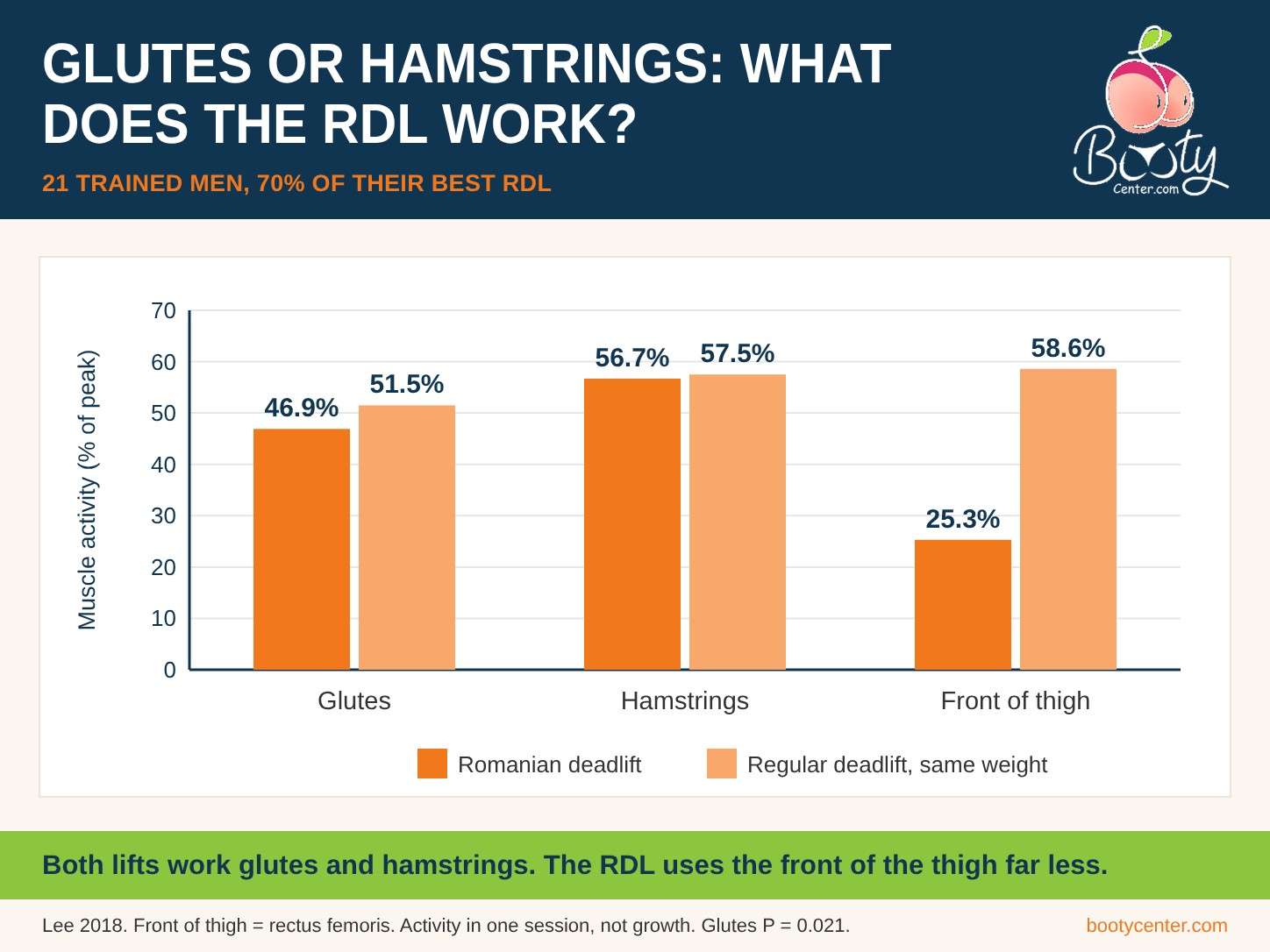 Glutes and hamstrings both work in the RDL. The front of the thigh mostly sits it out. 21 trained men (Lee 2018).
Do Romanian deadlifts work your glutes?
Yes. In 21 trained men lifting 70% of their best RDL, the glutes reached 46.9% of the peak they hit in a reference test (Lee 2018). In 15 trained women lifting their 6-rep max, the RDL used the glutes 94% more than a seated back extension machine (Andersen 2021).
So the RDL is a real glute lift. The better question is how much of the work goes to your glutes and how much goes elsewhere.
Glutes or hamstrings: which does the RDL work more?
Both, with the hamstrings at least level. In the same trial of 21 men, the hamstrings reached 56.7% of their peak in the RDL and the glutes 46.9% (Lee 2018). Comparing two different muscles this way is rough, but both were clearly working hard.
The authors pointed out something most lifters do not expect. The RDL is often called a hamstring lift, yet hamstring activity was almost the same in the regular deadlift, 57.5% against 56.7% (Lee 2018). The RDL did not single out the hamstrings. What it did was use the front of the thigh much less.
The wider research adds a caution. A 2020 review of 19 activity studies across deadlift styles found that in 9 of them, the lower back and front thigh muscles were more active than the glutes and hamstrings (Martín-Fuentes 2020). The reviewers also warned that the studies measured activity in different ways, so exact numbers do not compare well between studies.
RDL vs hip thrust: which is better for glutes?
For activity at a heavy load, they came out close. In 8 trained men lifting their 1-rep max, glute activity in the hip thrust was not clearly different from the RDL (Delgado 2019). The hip thrust did beat the back squat in that study.
For growth, the hip thrust has more proof. In 33 untrained women training 3 times a week for 10 weeks, a program of leg press and stiff-leg deadlift (a close cousin of the RDL) grew glute thickness by 6.0%. Adding barbell hip thrusts to the same program grew it by 9.3% (Kassiano 2024). The stiff-leg deadlift was part of a program that grew the glutes, but the authors said they could not tell how much each exercise added on its own.
Our take: if bigger glutes are the goal, make the hip thrust or a deep squat your main lift and add the RDL as your hinge. You get the hamstring work and the long stretch that the hip thrust does not give you. Our guides to hip thrust vs squat and glute bridge vs hip thrust cover the main lift choice.
RDL vs stiff-leg deadlift vs regular deadlift
RDL vs stiff-leg deadlift. In 10 male competitive bodybuilders lifting 80% of their max, the stiff-leg deadlift (knees straight the whole time) showed more glute activity than the RDL when standing up. The RDL showed more activity in one of the inner hamstrings (Coratella 2022). The difference was moderate. Both are good hinges.
RDL vs regular deadlift. With the same weight on the bar, the regular deadlift used the glutes a little more, 51.5% against 46.9% of peak, and the front of the thigh much more, 58.6% against 25.3% (Lee 2018). Both lifts used the same weight, set at 70% of each man's best RDL, not of his best regular deadlift. For a closer look at deadlift styles, see sumo vs conventional deadlift.
How to feel RDLs more in your glutes
1. Use more range, if your back stays neutral. Standing on a 15 cm step so the bar could go lower raised glute activity more than any other version in the bodybuilder study, both on the way down and on the way up (Coratella 2022). It also raised lower back activity. Only go deeper if your back stays in the same position the whole rep.
2. Own the bottom, not the top. The RDL is hardest near the bottom and gets easier as you stand up. The load on your hips drops to almost nothing at the top (Andersen 2021). A hard squeeze at lockout adds little. The work happens in the stretch, which is where the glutes are long. Our article on training where the muscle stretches explains why that position matters.
3. Push your hips back, not down. Keep a slight knee bend, keep the bar close to your legs, and let your hips travel back like you are closing a car door with your butt. This is a coaching cue, not a study result.
4. Stop the rep when your hips stop moving back. If you keep going after that, the extra range usually comes from your lower back rounding, not from your hips. This is also coaching practice.
If you still feel it only in your hamstrings, read why you can't feel your glutes. Keep in mind that feeling a muscle is not proof it is growing more.
Other hinges that work the glutes
- 45-degree back extension: no clear difference in glute activity from the RDL over the whole rep, and 74% more in the upper part of the rep, where the RDL goes easy (Andersen 2021, 15 trained women).
- Reverse hyper: 49% against 30% of maximum glute activity compared with the RDL, both at half of each lift's estimated max (Dicus 2023, 12 young men).
- Cable pull-through: about the same glute activity as the RDL, with less lower back and hamstring activity (Dicus 2023).
All three are activity studies, so none of them proves more growth. They are useful swaps if the RDL bothers your back or your grip gives out first. Our glute exercise tier list ranks the main options.
Does the RDL build glutes on its own?
Probably, but it has not been tested. A 2025 review of 12 training studies found that lifting grows the gluteus maximus by a moderate amount, with hip thrusts, deep squats, leg press and kneeling hip extensions all shown to work (Krause Neto 2025). None of those trials tested the RDL alone. The review authors listed the Romanian deadlift as one of the exercises future studies should test.
We are not aware of any trial that trained people on RDLs alone and measured glute size with a scan. Until one exists, treat the RDL as a strong supporting lift for your glutes, not your main one.
How to program RDLs for glutes
These numbers are our coaching default, not a study result:
- Where: after your main glute lift (hip thrust or squat), once or twice a week.
- Sets and reps: 3 sets of 6 to 10 reps.
- Effort: 7 to 8 out of 10, so you finish each set with 2 to 3 good reps left.
- Rest: 2 to 3 minutes between sets.
- Speed: lower the bar in about 2 seconds and stand up under control.
- Progress: when you get 10 reps on every set at 8 out of 10 effort or easier, add 2.5 to 5 kg next session.
For how often to train your glutes each week, see how many times a week to train glutes. For the effort scale, see what RPE means in lifting.
Coach's tip
If your grip fails before your glutes and hamstrings do, use lifting straps for your work sets. The goal of the RDL is your hips, not your hands. That is coaching practice, not a study result.
RDL for glutes, by the numbers
- 46.9% vs 56.7%: glute and hamstring activity in the RDL, as a share of each muscle's peak, in 21 trained men (Lee 2018).
- 51.5% vs 46.9%: glute activity in the regular deadlift against the RDL, same weight on the bar (Lee 2018).
- 94%: how much more the RDL used the glutes than a seated back extension machine, in 15 trained women (Andersen 2021).
- 8 men, 1-rep max: glute activity in the hip thrust not clearly different from the RDL (Delgado 2019).
- 9.3% vs 6.0%: glute growth over 10 weeks with and without hip thrusts added to leg press and stiff-leg deadlift, in 33 untrained women (Kassiano 2024).
- 0 known trials: studies that trained RDLs alone and measured glute size.
Where the evidence runs thin
Almost every RDL study measures muscle activity for a few reps, not growth over weeks. The groups were small, from 8 to 21 people, and most were men. One study used competitive bodybuilders. The only growth trial with an RDL-type lift used it inside a program with other exercises. The form cues and the program above are coaching practice.
Bottom line
The RDL works your glutes and hamstrings together, with the hamstrings at least as busy. It is not proven to grow the glutes on its own, and the hip thrust has better growth evidence. Keep the RDL as your hinge, take it as deep as your back allows, and pair it with a hip thrust or squat.
Frequently asked questions
Are Romanian deadlifts good for glutes?
Yes, as a supporting lift. The RDL clearly works the glutes, at 46.9% of their peak in trained men (Lee 2018). But no trial has tested it alone for glute growth, and the hamstrings work at least as hard. Pair it with a hip thrust or squat.
Do RDLs work glutes or hamstrings more?
The hamstrings are at least level. In 21 trained men, the hamstrings reached 56.7% of their peak and the glutes 46.9% (Lee 2018). Both are working hard, so think of the RDL as a lift for the whole back of your hips and thighs.
Is the RDL or the hip thrust better for glutes?
The hip thrust, based on growth evidence. In 8 men at max load, glute activity was not clearly different between the two (Delgado 2019). But adding hip thrusts to a program with stiff-leg deadlifts grew the glutes 9.3% against 6.0% over 10 weeks (Kassiano 2024).
Why do I only feel RDLs in my hamstrings?
Because they work hard in this lift, at 56.7% of their peak in one study (Lee 2018). Push your hips back rather than down, and use more range if your back stays neutral. Feeling a muscle is not proof it is growing more, so do not judge the lift only by where you feel it.
Should I do RDLs from a step or deficit?
If your back stays neutral, it can help. Standing on a 15 cm step raised glute activity the most of three versions in 10 bodybuilders (Coratella 2022). It also raised lower back activity, so only use the extra range you can control.
Is a stiff-leg deadlift the same as an RDL?
Close, but not the same. In a stiff-leg deadlift your knees stay straight. In an RDL they keep a slight bend. In 10 bodybuilders the stiff-leg version showed more glute activity when standing up, and the RDL more activity in one inner hamstring (Coratella 2022).
How many sets of RDLs should I do for glutes?
Our coaching default is 3 sets of 6 to 10 reps at 7 to 8 out of 10 effort, with 2 to 3 minutes of rest, once or twice a week, after your main glute lift. That is coaching practice, not a study result.
Can RDLs replace hip thrusts?
Not based on current evidence. The hip thrust has a trial showing extra glute growth (Kassiano 2024). The RDL has not been tested alone for glute growth. Keep both if you can. If you must pick one for glutes, pick the hip thrust.
References
- Lee S, Schultz J, Timgren J, Staelgraeve K, Miller M, Liu Y. An electromyographic and kinetic comparison of conventional and Romanian deadlifts. J Exerc Sci Fit. 2018;16(3):87-93. doi:10.1016/j.jesf.2018.08.001
- Andersen V, Pedersen H, Fimland MS, Shaw M, Solstad TEJ, Stien N, et al. Comparison of muscle activity in three single-joint, hip extension exercises in resistance-trained women. J Sports Sci Med. 2021;20(2):181-7. doi:10.52082/jssm.2021.181
- Martín-Fuentes I, Oliva-Lozano JM, Muyor JM. Electromyographic activity in deadlift exercise and its variants. A systematic review. PLoS One. 2020;15(2):e0229507. doi:10.1371/journal.pone.0229507
- Delgado J, Drinkwater EJ, Banyard HG, Haff GG, Nosaka K. Comparison between back squat, Romanian deadlift, and barbell hip thrust for leg and hip muscle activities during hip extension. J Strength Cond Res. 2019;33(10):2595-601. doi:10.1519/JSC.0000000000003290
- Kassiano W, Kunevaliki G, Costa B, Nunes JP, Castro-E-Souza P, Tricoli I, et al. Addition of the barbell hip thrust elicits greater increases in gluteus maximus muscle thickness in untrained young women. Int J Strength Cond. 2024;4(1). doi:10.47206/ijsc.v4i1.284
- Coratella G, Tornatore G, Longo S, Esposito F, Cè E. An electromyographic analysis of Romanian, step-Romanian, and stiff-leg deadlift: implication for resistance training. Int J Environ Res Public Health. 2022;19(3):1903. doi:10.3390/ijerph19031903
- Dicus JR, Ellestad SH, Sheaffer JE, Weber CA, Novak NC, Holmstrup ME. A comparison of muscle recruitment across three straight-legged, hinge-pattern resistance training exercises. Int J Exerc Sci. 2023;16(4):12-22. doi:10.70252/ZAOJ6139
- Krause Neto W, Krause TLV, Gama EF. The impact of resistance training on gluteus maximus hypertrophy: a systematic review and meta-analysis. Front Physiol. 2025;16:1542334. doi:10.3389/fphys.2025.1542334