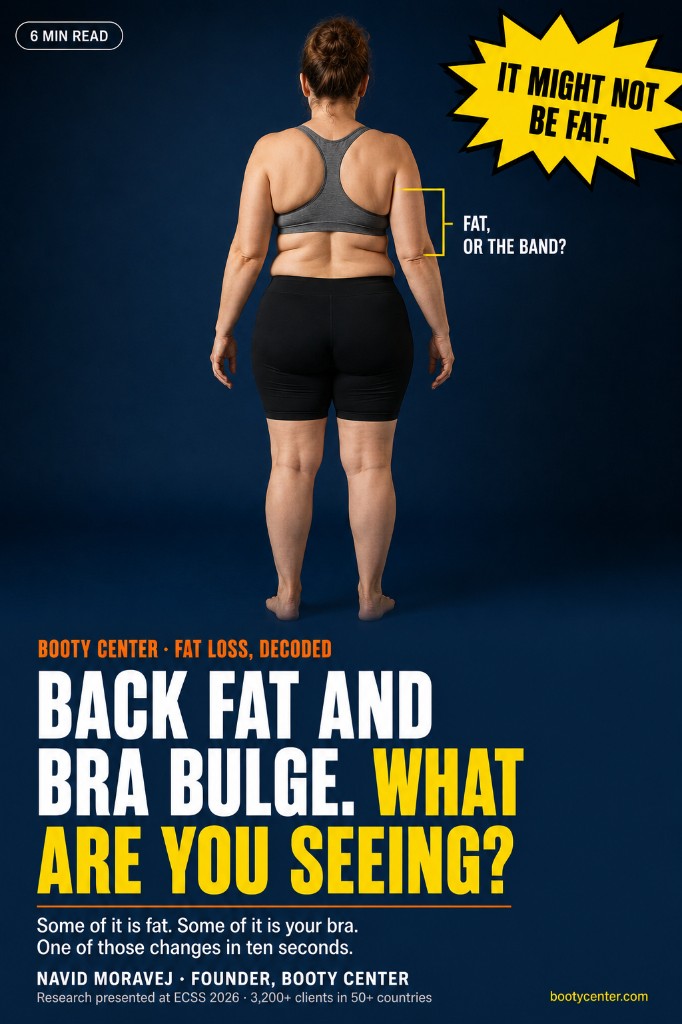
You catch yourself in a mirror at an angle you did not choose, and there is a ridge across your back that was not in the plan. Then you search for a fix, and every result assumes the same thing: that what you saw was fat. Sometimes it is. Often, a good part of it is not, and the part that is not can change before you leave the room.
"Bra bulge means you are carrying back fat."
Three things make one bump
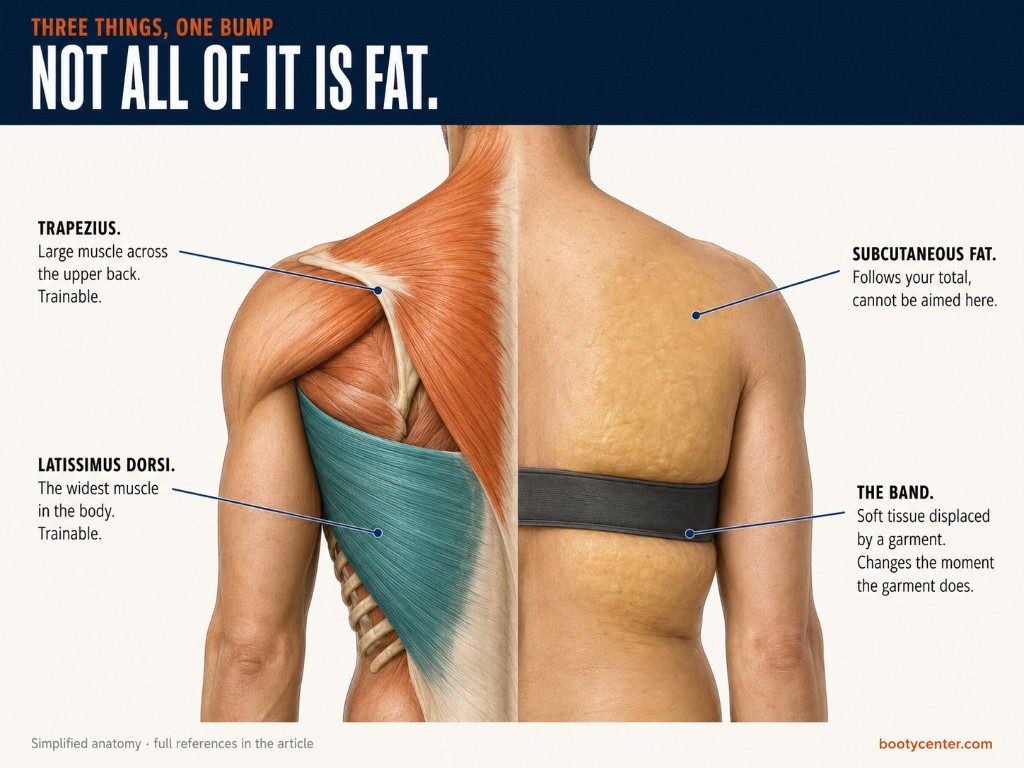 Three different things, stacked. Only one of them is fat.
Under the skin of your upper back sit two of the largest muscles you own. The trapezius spreads across the top. The latissimus dorsi, the widest muscle in the body, sweeps down and out beneath it.
On top of those is a layer of subcutaneous fat, the kind you can pinch.
And on top of that, for most women, is a band. A firm horizontal strap under tension, pressing into soft tissue that has nowhere to go except up and over it.
That third thing is not a body composition problem. It is a garment problem wearing the costume of one.
The distinction matters more here than anywhere else on the body, for a simple reason. You cannot see your own upper back. You judge it from a photograph someone else took, or a mirror at an angle you did not choose, usually while wearing the exact garment that is creating the ridge. No other part of your body is assessed under conditions that unfair.
What happened when researchers tested the fit
This has been measured, and the result is worth sitting with.
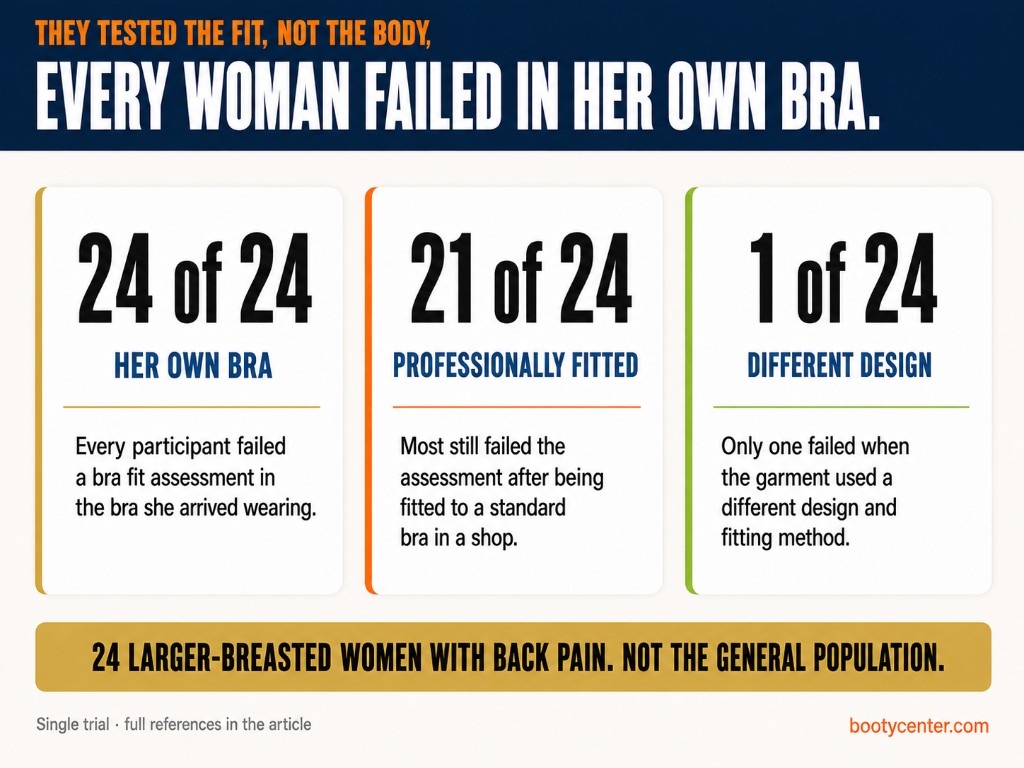 An association from one small trial in a selected group. The caveat is on the figure for a reason.
Researchers assessed 24 women against a formal bra fit assessment. Every single one failed in the bra she arrived wearing. Not most. All of them [1].
Then the participants were professionally fitted to a standard bra, the way you would be in a shop. Twenty-one of the 24 still failed. The professional fitting did not fix it.
Only when the garment used a different design, with a different measuring and fitting method, did the failures nearly disappear. One person out of 24. And after four weeks in the better-fitting garments, the women reported real symptomatic relief [1].
Now the caveat, because it matters. These were 24 larger-breasted women who already had back pain. That is a selected group, not a random sample of the population, and it is one trial. You cannot read it as "every woman is in the wrong bra." You can read it as strong evidence that fit failure is common, easy to miss, and not reliably solved by being measured in a shop.
There is a reason for that last part. The traditional method, measuring your bust and subtracting your underbust, is not a good measure of anything. When researchers compared it against 3D body scanning in 176 women, the two methods disagreed by around 11 percent, and the authors concluded that volume should replace the girth calculation entirely [2].
So the standard way of working out your size is known to be unreliable, and it is still the standard.
Read that trial once more and notice what it is actually saying. The variable that changed was never the participants. Nobody lost fat, nobody trained, nobody did anything to her body at all. The garment changed, and the outcomes changed with it. That is the cleanest demonstration you will find that some of what people call back fat is not a property of the body wearing it.
Coach's tip
None of this is a criticism of you or your body. A garment that fails a fit assessment is a design and sizing failure, not a personal one.
The ten second test
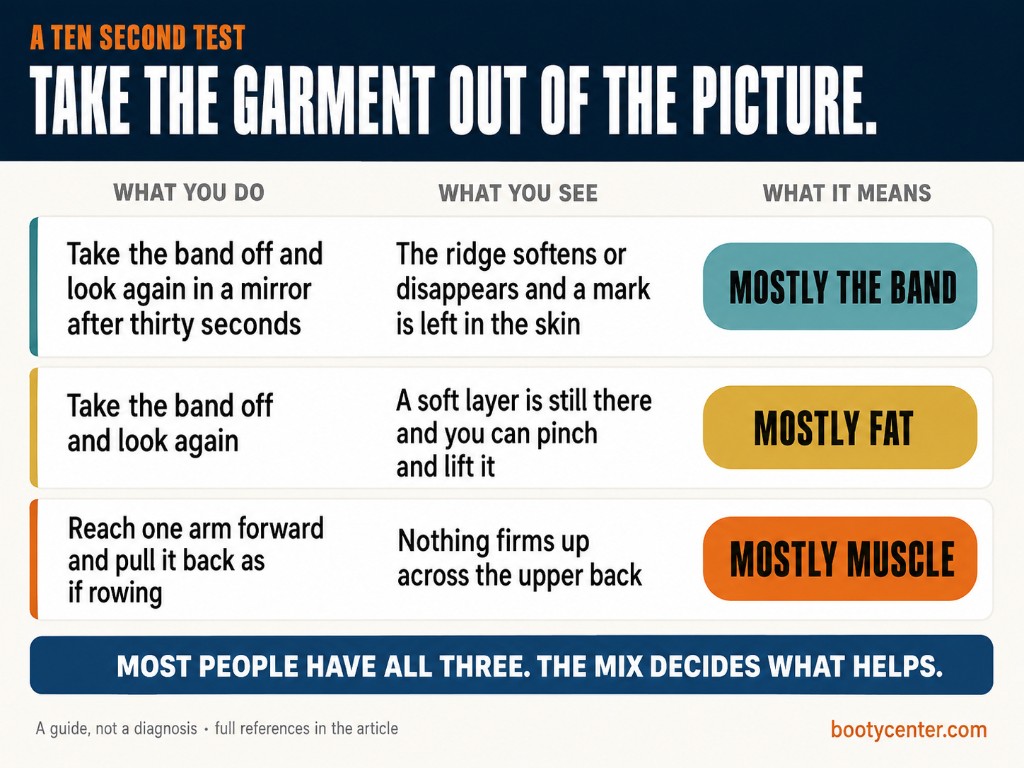 A guide, not a diagnosis. Most people find all three.
You do not need a study to work out which of the three you are dealing with. You need a mirror and half a minute.
Take the band off. Wait thirty seconds and look again. If the ridge softens or disappears and there is a red mark where the band sat, a good part of what you saw was displacement, not fat.
Look again at what remains. If there is a soft layer you can pinch and lift, that part is fat.
Now reach one arm forward and pull it back as if rowing. If nothing firms up across your upper back, the muscle underneath is undertrained.
Most people find all three. The mix is what decides what actually helps.
Do it once, properly, before you commit to a plan. If you spend six months in a deficit trying to remove something that was a strap, you will get to the end of it, see the ridge still there, and draw entirely the wrong conclusion about your body and your discipline.
What each one answers to
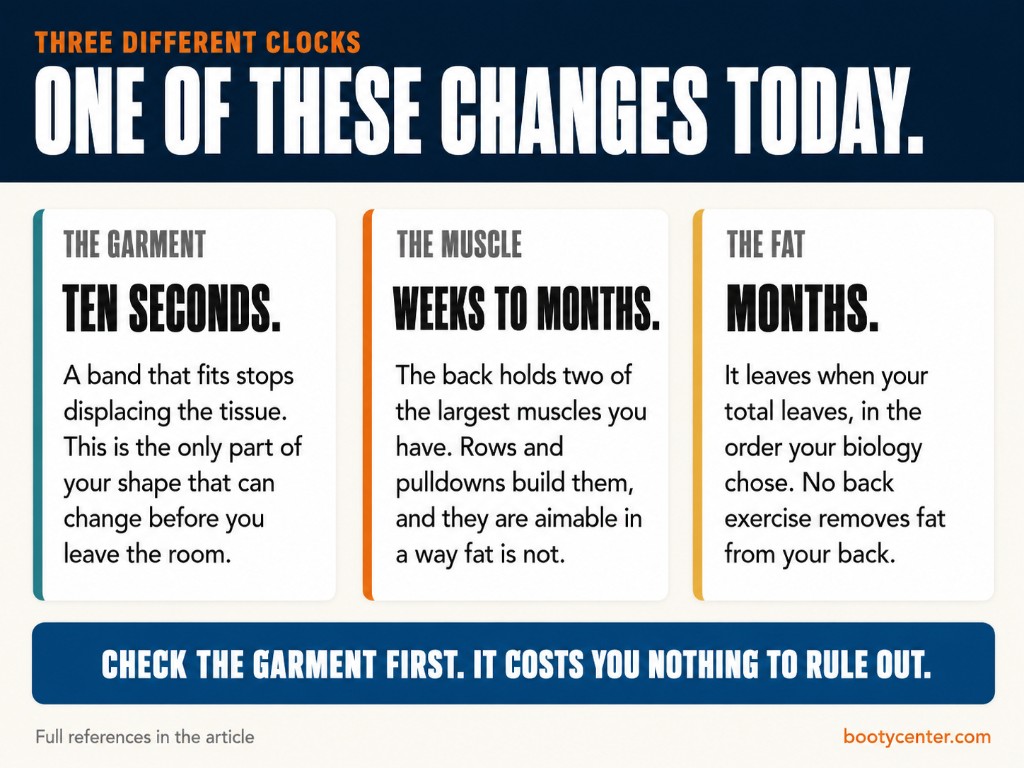 Three different clocks. Only one of them runs today.
Here is why the diagnosis matters. These three run on completely different clocks.
The garment runs on seconds. A band that fits stops displacing tissue immediately. This is the only part of your shape that can change today, and it costs nothing to rule out.
The muscle runs on weeks to months. Rows and pulldowns build the back, and unlike fat, muscle is aimable. You choose where it goes.
The fat runs on months, and it is not aimable at all.
Nothing about that ordering is a reason to skip the slow work. It is a reason to stop treating the slow work as the only work, and to stop paying the emotional cost of a months-long project for something a different band would have solved on the day.
The fat half, honestly
No back exercise removes fat from your back. That is not an opinion.
When 104 people trained one arm for twelve weeks and left the other alone, MRI found no difference in fat between the two arms [3]. Pooling 13 of these one-sided studies, across 1,158 people, the combined effect of training a limb on the fat covering it was zero [4].
Fat leaves when your total leaves, in the order your biology chose [5]. And the fat you can pinch, the subcutaneous layer, is the slower half of that process. Across 89 studies covering diet, exercise, drugs and surgery, the deep fat around the organs dropped by a larger percentage than the layer under the skin, every time [6]. Here is the full evidence on why you cannot target fat loss.
So the fat is a months-long project on somebody else's schedule. That is exactly why it is worth ruling out the ten second version first.
Key takeaway
Check the garment first. It costs you nothing and it is the only part that can change today.
Back fat FAQs
How do I get rid of back fat?
By reducing total body fat, since no back exercise removes fat from your back. Before you start, check the garment. A band under tension displaces soft tissue upward, and a good part of what looks like back fat can disappear the moment the band does.
Is bra bulge fat or is it my bra?
Usually some of both. Take the band off, wait thirty seconds and look again. If the ridge softens and leaves a mark in the skin, that part was displacement. If a soft layer remains that you can pinch and lift, that part is fat.
Do back exercises get rid of back fat?
No. They build the trapezius and latissimus dorsi underneath, which changes the shape of your back, but they do not remove the fat on top. One-arm training studies have tested this idea for decades and the effect on the fat covering the trained limb is zero.
Why does my bra dig in even though it fits?
It may not fit. In one study, all 24 women failed a formal fit assessment in their own bra, and 21 still failed after being professionally fitted to a standard one. The usual measuring method, bust minus underbust, is known to be unreliable.
Will losing weight get rid of my back fat?
It will reduce it, on your body's own timeline and in its own order. What it will not do is happen quickly or selectively. Meanwhile the garment part can change today and the muscle part responds in weeks, so neither has to wait for the fat.
What exercises build the upper back?
Rows and pulldowns, loaded properly and progressed over time. They train the two largest muscles in the region. Understand what they do: they build shape underneath the fat rather than removing the fat itself, and that is still worth having.
References
- Haworth L, May K, Janssen J, Selfe J, Chohan A. Does an alternative breast support garment provide symptomatic relief for larger breasted women with chronic non-specific back pain? Prosthet Orthot Int. 2024;48(2):213-222.
- Pandarum R, Yu W, Hunter L. 3-D breast anthropometry of plus-sized women in South Africa. Ergonomics. 2011;54(9):866-875.
- Kostek MA, Pescatello LS, Seip RL, Angelopoulos TJ, Clarkson PM, Gordon PM, et al. Subcutaneous fat alterations resulting from an upper-body resistance training program. Med Sci Sports Exerc. 2007;39(7):1177-1185.
- Ramirez-Campillo R, et al. A proposed model to test the hypothesis of exercise-induced localized fat reduction (spot reduction), including a systematic review with meta-analysis. Hum Mov. 2022;23(3):1-14.
- Karastergiou K, Smith SR, Greenberg AS, Fried SK. Sex differences in human adipose tissues - the biology of pear shape. Biol Sex Differ. 2012;3(1):13.
- Merlotti C, Ceriani V, Morabito A, Pontiroli AE. Subcutaneous fat loss is greater than visceral fat loss with diet and exercise, weight-loss promoting drugs and bariatric surgery: a critical review and meta-analysis. Int J Obes (Lond). 2017;41(5):672-682.